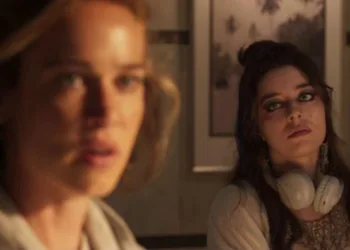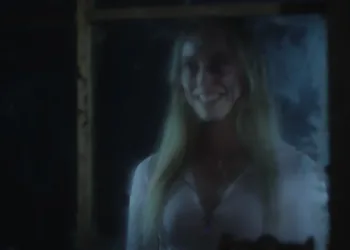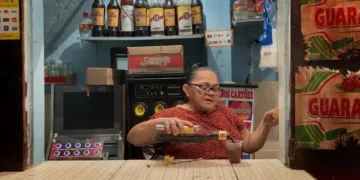


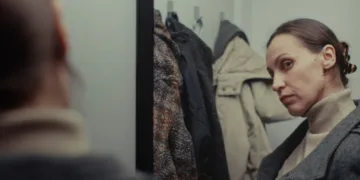
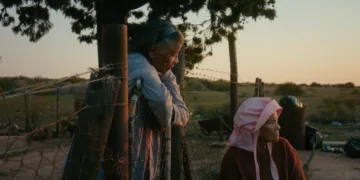




















Emma Boccanfuso’s camera treats Sueli’s home as shelter, theater, wound, and warning. Saudades Eternas stays in Chapéu Mangueira, a Rio favela close enough to Copacabana for geography to sound almost obscene, since the film keeps that postcard Brazil outside its field of vision. The beach exists nearby, but Boccanfuso is concerned with the brick rooms where a family waits, argues, laughs, repairs walls, opens a bar, listens for gunfire, and learns the terrible discipline of staying indoors.
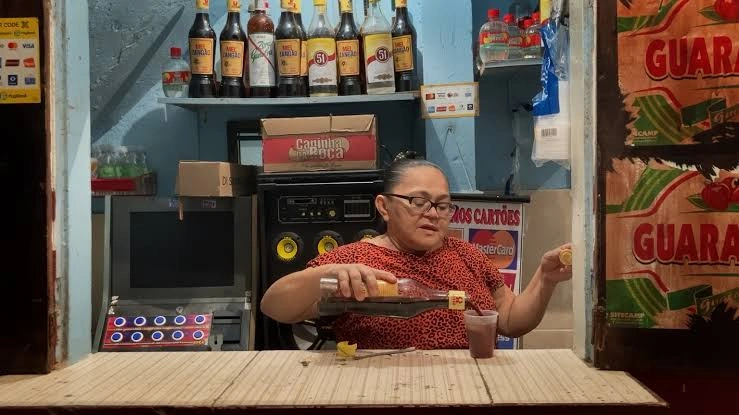
This is not a documentary that explains a favela from above. It does not arrive with maps, experts, policy language, or a clean moral diagram. It enters a household ruled, or at least held together, by Sueli, a fifty-year-old matriarch whose voice can fill every corner of the building. She shouts, curses, complains that her heart may explode, and then returns to the ordinary labor of keeping people alive. In that repetition, the film finds its pulse.
Sueli’s Kingdom
Sueli could easily have been flattened into an emblem of resilience, that polite word often used when society has failed and would prefer a compliment. Boccanfuso resists that cruelty. Sueli is funny, theatrical, severe, loving, tired, and sometimes impossible. Her line that the house will become a disaster after she leaves sounds comic for a second, then turns grave. She is not boasting. She is naming the architecture of dependence.
Around her gathers a shifting family of relatives, children, grandchildren, neighbors, and chosen kin: Rogério, Jaqueline, Wendel, Marina, Rafael, Juan, Thays, and others who drift through the rooms with the familiarity of people for whom privacy is a luxury item.
Men are missing, dead, absent, or unwilling to carry the weight of fatherhood. The title’s funerary sense, the phrase printed on memorial shirts kept by grieving families, hangs over these rooms like dust that never quite settles.
The house itself seems to share Sueli’s exhaustion. Rooms have been added, walls come down, repairs continue, upper floors stack over lower ones with the anxious logic of survival. Sueli jokes that they keep tearing down and building until one day the place will collapse. The remark lands because the film has already made the building feel alive: crowded, improvised, protective, and frail.
Rooms, Frames, Voices
Boccanfuso’s formal discipline is severe in the best sense. She often holds a static composition long past the point where a less patient film would cut away. People speak from medium distance. Doorframes divide bodies. Windows promise an outside world the film refuses to beautify. A ladder and trapdoor between floors become one of the documentary’s central images of pressure, with the camera looking down through the opening as if family life were suspended between levels of danger.
The visual field is frequently blocked by clutter, walls, household objects, and partial views. This is not decorative realism. It is the shape of confinement. Chapéu Mangueira’s vertical geography presses into the film through staircases, balconies, stacked rooms, and narrow passages, while the street remains a sound before it becomes a sight. Gunfire arrives through the ear. Police raids arrive through fear in the body. The outside is present because everyone inside is listening to it.
One of the strongest passages lets darkness do the work. During a power outage and a stretch of fear, the image gives way to black or near-black, and voices carry the scene. The absence of visible action becomes more frightening than spectacle would have been. Bricks cannot protect anyone from sound. Sound gets through.
Boccanfuso’s presence is also part of the texture. Family members speak to her while doing chores or moving through the house, and the film never pretends she is invisible. Yet her involvement does not become vanity. Trust is visible in the casual exchanges, in the way children address her, in the way Sueli allows irritation and vulnerability to exist without performance management.
Children Near the Gunfire
The children give Saudades Eternas its deepest ache. They understand the rituals of danger before they can understand danger itself. They cover their ears when shots are expected. They know when adults tell them not to play outside. They hear about deaths and restrictions, then return to the scale of childhood, where being kept from the yard can feel like punishment rather than protection.
Boccanfuso is devastating because she does not force innocence into a sentimental pose. The children are still children: bored, curious, playful, half afraid and half irritated by adult rules. Their world contains gunfire, blackouts, ghost stories, Google searches about a black butterfly that may signal a dead child’s spirit, and the strange comedy of a fan turning off by itself. Death is both metaphysical and practical here. It is a superstition, a memorial shirt, a street rumor, a sound outside, a reason to stay away from the window.
The film’s refusal to show violence directly is not evasive. It is ethical. Saudades Eternas keeps its attention on the people who must keep living after the dramatic event has passed. A party can continue near the power of gangs. A bar can open when conditions allow. Sueli can shout like a comic monarch and still carry grief like a second spine. The film understands that life under siege is not made of constant terror. It is made of interruptions: a joke cut by a shot, a chore paused by fear, a child’s game shortened by someone else’s war.
Boccanfuso’s narrowness is also the film’s limit. Some members of the household remain lightly sketched, and the decision to stay so firmly indoors leaves parts of the social machinery outside the frame. Yet the restriction has moral force. Saudades Eternas is built like Sueli’s house, cramped and unstable, full of warmth, noise, and invisible cracks. It cannot keep death out. It keeps people together while they listen for it.
The intimate French-Swiss feature documentary Saudades Eternas celebrated its world premiere in the international competition at the Visions du Réel film festival on April 17, 2026. Produced by Close Up Films and Macalube Films, this observational, non-fiction project can currently be watched on the global independent documentary film festival circuit. The observational narrative paints an immersive, empathetic portrait of Sueli, an iron-willed matriarch fighting to keep her sprawling family safe and unified inside the Chapéu Mangueira favela of Rio de Janeiro amid constant structural precarity and escalations of violence.
Full Credits
Title: Saudades Eternas
Distributor: Close Up Films, Macalube Films
Release date: April 17, 2026 (Visions du Réel World Premiere)
Running time: 94 minutes
Director: Emma Boccanfuso
Writers: Emma Boccanfuso
Producers and Executive Producers: Flavia Zanon, Anne-Catherine Witt
Cast: Sueli, Rogério, Jaqueline, Wendel, Marina, Rafael, Juan, Thays
Director of Photography (Cinematographer): Emma Boccanfuso
Editors: Emma Boccanfuso
Composer: Emma Boccanfuso Sound Team
The Review
Saudades Eternas
Saudades Eternas is a quiet house built against gunfire, grief, and the shameful indifference of power. Emma Boccanfuso’s restraint gives Sueli and her family room to exist without being turned into symbols for outsider pity. The film can feel formally narrow, and its refusal to leave the home limits some social texture, yet that narrowness becomes its moral shape. Life gathers in cramped rooms because the street has become a wager with death.
PROS
- Patient domestic intimacy
- Sueli’s vivid presence
- Strong use of confined space
- Painful focus on childhood
- Violence kept outside spectacle
CONS
- Social scope stays narrow
- Some figures remain lightly sketched
- Repetition may test patience
- Limited visual range