

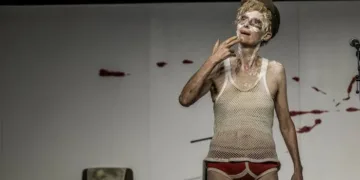


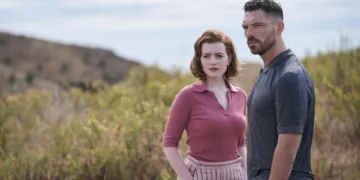


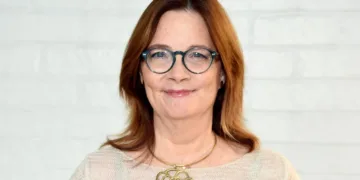
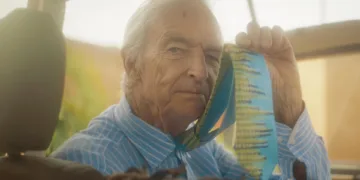
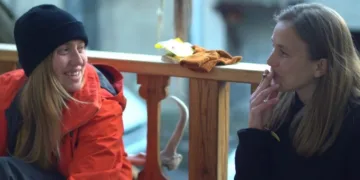







Hope often arrives in the quietest moments. For Yelena, a middle-aged woman carrying a precious, late-in-life pregnancy, that hope is a fragile thing to be protected at all costs. The film introduces her in a moment of peace, a breath before the world collapses. That collapse comes not with a bang, but with a phone call. The voice on the line is a twisted parody of enlightenment, a profane and petulant version of Buddha who introduces himself as the original “creator of content.”
This is not a call to spiritual awakening; it is a threat delivered with the cold fury of a deity fed up with his own creation. He presents Yelena with a harrowing ultimatum: she will become his hitwoman and eliminate a list of his enemies, or he will extinguish the life of her unborn child from within the womb. Her body, the vessel of her greatest hope, is now a hostage.
The Unholy Partnership
What prevents Karmadonna from becoming a simple tale of victimization is its treatment of Yelena’s agency. Jelena Djokić’s performance is grounded in a terrifying pragmatism. There is no time for a moral breakdown; she is a problem-solver dropped into an impossible scenario. We watch her gradual hardening not as a descent into madness, but as a chillingly logical adaptation.
The fear never leaves her eyes, but it is joined by a sharp, calculating resolve that allows her to evolve from a terrified mother-to-be into a surprisingly adept dispenser of punishment. Her pregnancy serves as a brilliant narrative constraint, turning every sequence into a high-stakes puzzle.
Unlike action heroes who can absorb endless damage, Yelena is effectively playing with a single health point while escorting the world’s most vulnerable VIP. This limitation forces a desperate creativity, making each confrontation a tactical scramble rather than a choreographed fight.
Her divine handler, voiced with sardonic glee by Sergej Trifunović, is a cosmic CEO disgusted with his product. His rants are a mix of petty grievances and sharp, cynical observations, all delivered with the entitlement of a being who never faces consequences.
He claims his targets are protected by a “metaphysical armor” afforded by modern corruption, a flimsy excuse that highlights the film’s bleak humor. Their dynamic, born of blackmail, evolves into something far stranger. It becomes a codependent, darkly comedic partnership, a twisted “buddy chemistry” where controller and puppet are bound together in a mission of violent, nihilistic course correction.
Sensory Overload as a Style
Director Aleksandar Radivojević constructs the film as a sustained sensory assault. This is a maximalist vision, leaving no room for quiet contemplation. The technical execution is relentlessly energetic, designed to keep the viewer off-balance from the first frame. The cinematography by Aleksandar Jakonić feels alive and malevolent.
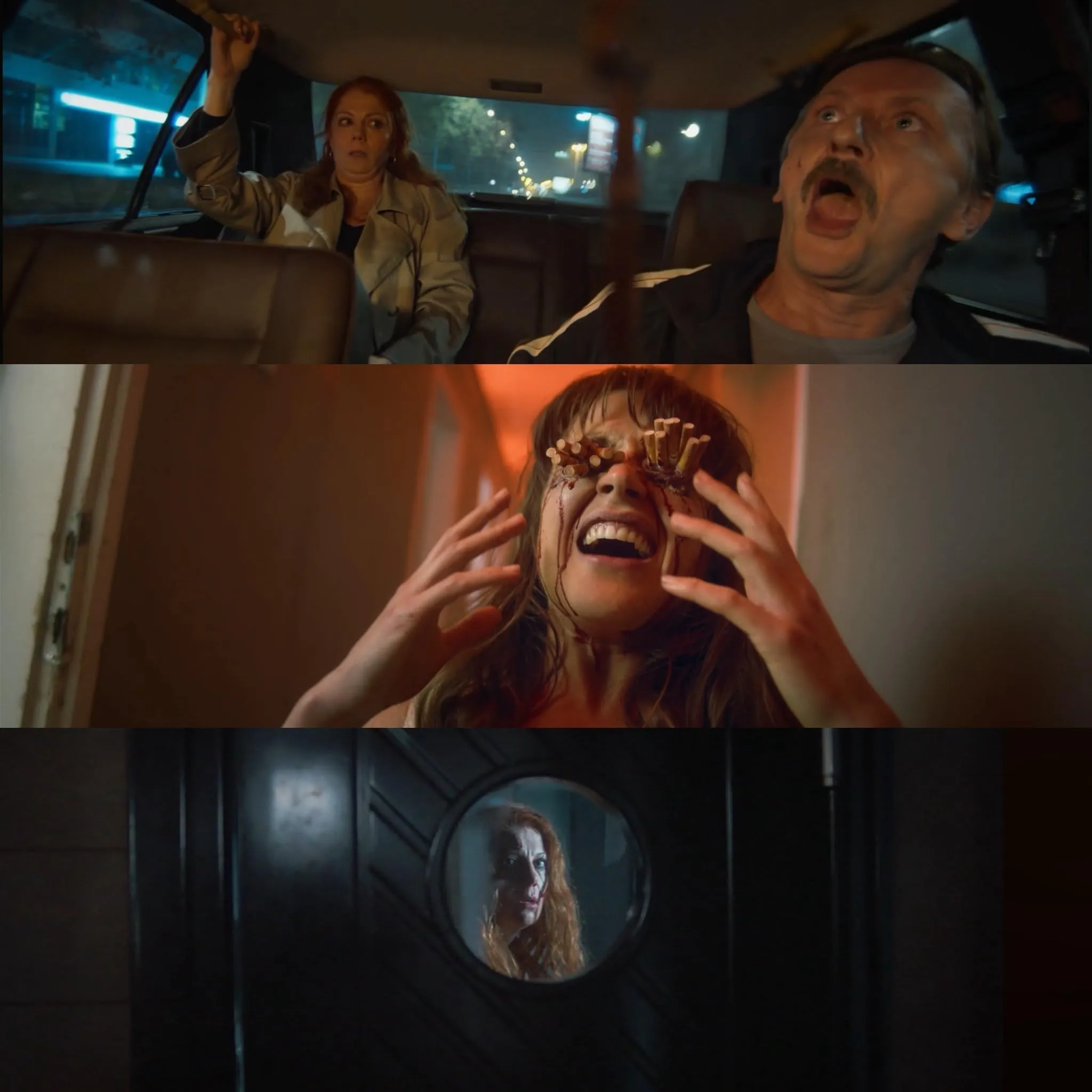
The camera prances, swoops, and swirls with a nauseating glee, frequently employing Dutch angles to infuse every scene with a deep sense of instability. The visual language feels like a direct descendant of early Sam Raimi or the more delirious works of Takashi Miike, where the camera itself is a character. This stylistic choice extends to the world design. The film’s version of Belgrade is a hyper-stylized, artificial landscape.
A key sequence unfolds in a ludicrous Titanic-themed nightclub, complete with marble statues of the film’s stars. This cartoonish quality serves a crucial function; it frames the extreme violence as a form of grotesque performance art, allowing it to be processed as dark comedy rather than grim reality.
The gore is imaginative, with mundane objects like dollar bills and crucifixes repurposed into deadly weapons. Driving this chaos is Đorđe Miljenović’s frantic score, a relentless electronic pulse that merges with the sound design to create an overwhelming, visceral experience.
All Fury, Little Focus
For all its stylistic audacity, the film’s thematic core feels underdeveloped and incoherent. Its hit list is a strange, indiscriminate collection of targets. Genuinely monstrous criminals share space with annoying social media influencers and self-help gurus. By placing a petty annoyance on the same moral plane as a human trafficker, the film’s social critique becomes a blunt instrument.
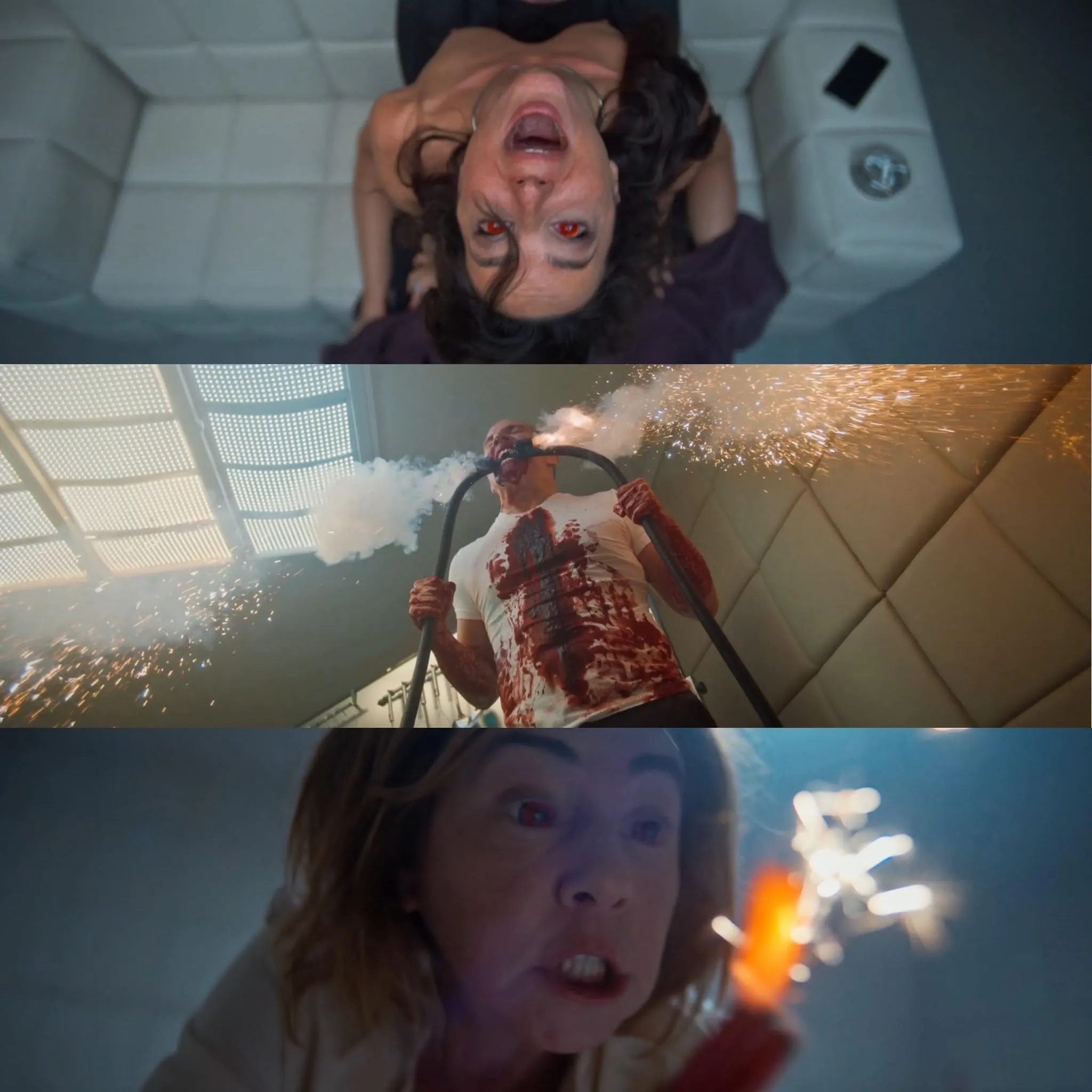
It transforms from a targeted satire into a generalized misanthropy, a cinematic shout into the void. The nihilistic anger is palpable, but the ideas behind it are a contradictory muddle. The experience is further hampered by significant structural flaws. A runtime approaching two hours is a critical miscalculation for a concept that begs for the lean efficiency of a 90-minute thriller. The episodic structure, following Yelena from one target to the next, lacks meaningful escalation.
Unlike a well-designed game or film where each encounter raises the stakes, Karmadonna offers a flat progression that quickly becomes repetitive. The shock of the violence wanes, and a sense of narrative fatigue sets in long before the credits roll. The film is a fascinating, frustrating object: a work of undeniable energy and bold vision that is ultimately betrayed by its own lack of discipline.
Karmadonna is a Serbian action, horror, and thriller film that premiered at the Toronto International Film Festival’s (TIFF) Midnight Madness section in September 2025. The film, which has a running time of approximately 118 minutes, has been shown on the film festival circuit, including TIFF and the Brooklyn Horror Fest. As of late 2025, the film is not yet widely available on a major streaming platform, with a projected general release date of October 11, 2025, and a national premiere in early 2026.
Full Credits
Director: Aleksandar Radivojević
Writers: Aleksandar Radivojević
Producers and Executive Producers: Predrag Popović, Miloš Đukelić, Gorlan Tarlać, Vladimir Đukanović
Cast: Jelena Đokić, Sergej Trifunović, Milutin Mima Karadžić, Milica Stefanović, Miloš Lolić, Miloš Timotijević, Petar Strugar, Branislav Jevtić
Director of Photography (Cinematographer): Aleksandar Jakonić
Editors: Branimir Živković
Composer: Wikluh Sky
The Review
Karmadonna
Karmadonna is an audacious and relentlessly energetic shot of adrenaline, powered by a brilliant central concept and a deliriously unhinged visual style. Its kinetic direction and darkly comedic tone make for an unforgettable, visceral experience. However, the film's undisciplined two-hour runtime and repetitive mission structure drain its momentum, turning a sharp, nasty thrill ride into an exhausting marathon. It’s a bold, bloody, and ultimately frustrating work that has plenty to say but lacks the focus to say it well.
PROS
- A wildly original and provocative central premise.
- Relentlessly energetic and stylish direction.
- A strong, pragmatic lead performance from Jelena Djokić.
- Inventive, darkly humorous approach to extreme violence.
- Kinetic cinematography that creates a constant sense of unease.
CONS
- Excessive runtime that harms the pacing.
- Repetitive, episodic structure becomes monotonous.
- Unfocused and muddled social commentary.
- Thematic ideas are underdeveloped and contradictory.
- Can be more exhausting than exhilarating by the end.