
























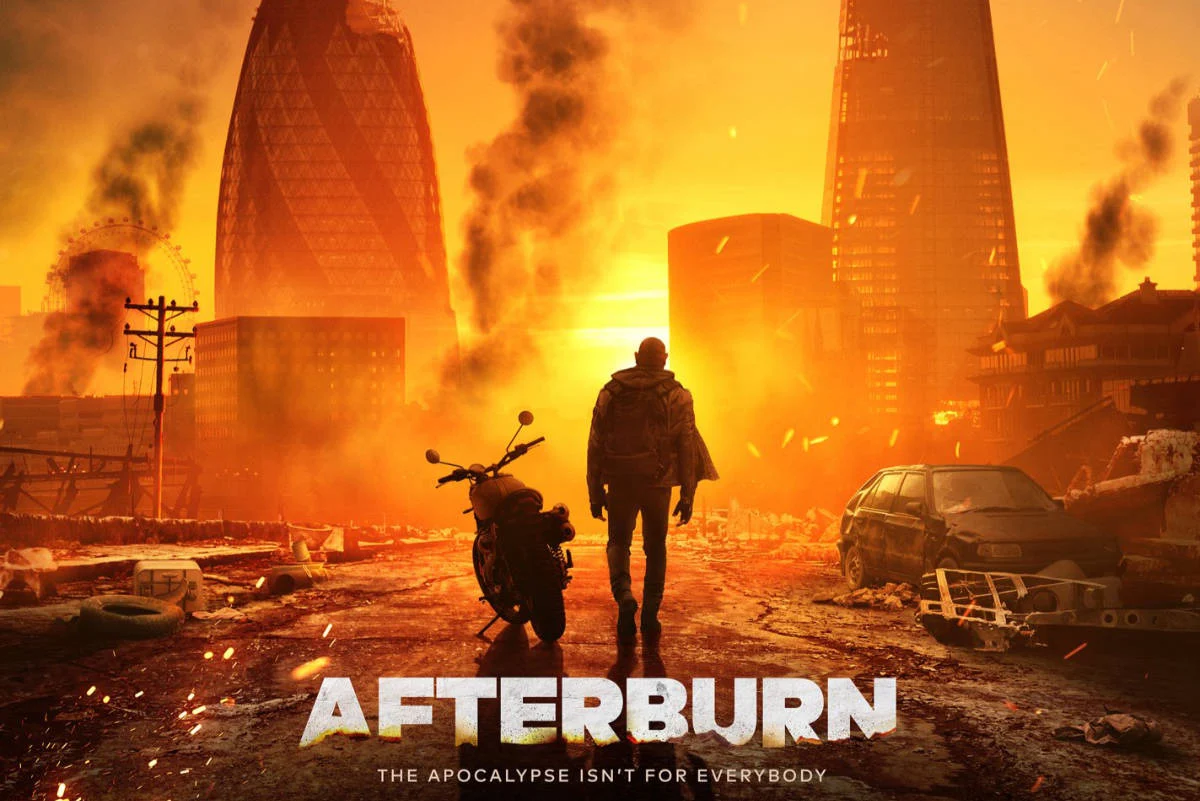

What is the worth of an image in a world that has lost the ability to see? When civilization is reduced to ash and algorithm, a painted smile becomes a relic of an extinct emotion, its value both infinite and meaningless. This is the philosophical territory J.J. Perry’s Afterburn stumbles into, though it lacks the grace or intellect to explore it.
The film posits a future where a solar flare has reset humanity to a pre-digital dark age, a landscape of salvage and survival lorded over by petty tyrants. Into this ruin, it places a man named Jake, a scavenger whose formidable physique, belonging to Dave Bautista, suggests a capacity for great violence.
Yet his stated ambition is pure absence: a boat, a dog, a quiet retreat from the wreckage of the world. He is a man trafficking in the ghosts of a dead culture, hired by a self-appointed king to retrieve the most famous ghost of all: the Mona Lisa. The film frames this as a high-stakes heist, a kinetic sprint through danger. It is, more accurately, a slow crawl through a narrative graveyard.
The Semiotics of Debris
The screenplay for Afterburn operates with the mechanical logic of a checklist. A mission is assigned, a path is charted, and the protagonist moves forward. An early sequence involving the retrieval of a Stradivarius violin feels less like character introduction and more like a tutorial level before the main campaign begins. The central quest, a journey across a fractured France to locate a secret vault, unfolds with a dispiriting lack of invention.
The inclusion of a resistance fighter, Drea, is a narrative requirement fulfilled without enthusiasm, just as the breadcrumb trail of clues is followed without any sense of discovery. The story feels exhumed, its parts scavenged from the tombs of better post-apocalyptic and heist films, then reassembled into a familiar but lifeless shape. This structural predictability drains the journey of all tension; we are not watching a man navigate a dangerous world so much as we are watching a pawn being moved across a board.
This narrative emptiness is mirrored by a visual strategy of aggressive drabness. The color palette is a persistent, muddy fusion of blacks and desaturated earth tones, a choice that signifies “dystopia” with all the subtlety of a sledgehammer. The camera observes the proceedings with a profound lack of interest.
Shots are framed for basic coverage, rarely for psychological effect. There are no expressionistic angles to heighten Jake’s isolation, no carefully composed frames to find beauty in the decay. The visual language is purely functional, capturing events without interpreting them. While the production makes effective use of Slovakia’s decaying industrial parks, lending a tangible sense of rust and ruin, this physical texture is consistently betrayed by a bafflingly incoherent approach to costume design.
Drea and Jake are clad in the requisite wasteland leather, yet King August swans about in an opulent fur coat seemingly borrowed from another film’s wardrobe. General Volkov’s uniform is a pastiche of fascist iconography, a signifier of evil that is both obvious and hollow. This sartorial chaos suggests a world where cultural symbols have been stripped of meaning, a fitting metaphor for a film that itself is a collection of empty gestures.
Phantoms in the Machine
The film’s hollow core is the figure of Jake. He is conceived as an archetype of weary masculinity, the strong, silent man who wants only to be left alone. In Dave Bautista’s portrayal, this silence becomes a vacuum. His performance is an exercise in radical stillness, his face a stoic mask that suggests not a rich inner life held in reserve, but a complete absence of one. He speaks in a monotone, delivering weak witticisms that expire the moment they leave his mouth.
This is not the quiet intensity of a classic noir protagonist, whose silence is a shield for deep wounds or a complex moral calculus. This is simply blankness. Jake is a man defined by his physical capabilities, a body that performs actions dictated by the plot. He seeks not a better world, but an absence of one, a retreat from the burden of choice. His quest for a boat is a quest for nonexistence, a desire to float in a space without moral or social consequence.
The figures orbiting this void are no more substantial. Olga Kurylenko’s Drea is a collection of abilities rather than a character. She is a crack shot, a survivor, a convenient ally. The script pays lip service to a romantic connection with Jake, but their interactions are devoid of warmth or tension. They are two automatons executing a mission protocol.
The film’s primary antagonist, Kristofer Hivju’s General Volkov, is a caricature of a despot. He is defined by a penchant for chess, a lazy shorthand for “strategist,” and a perpetually snarling demeanor. He lacks the compelling, twisted worldview of a great villain; he is a simple obstacle, a monster without a psychology.
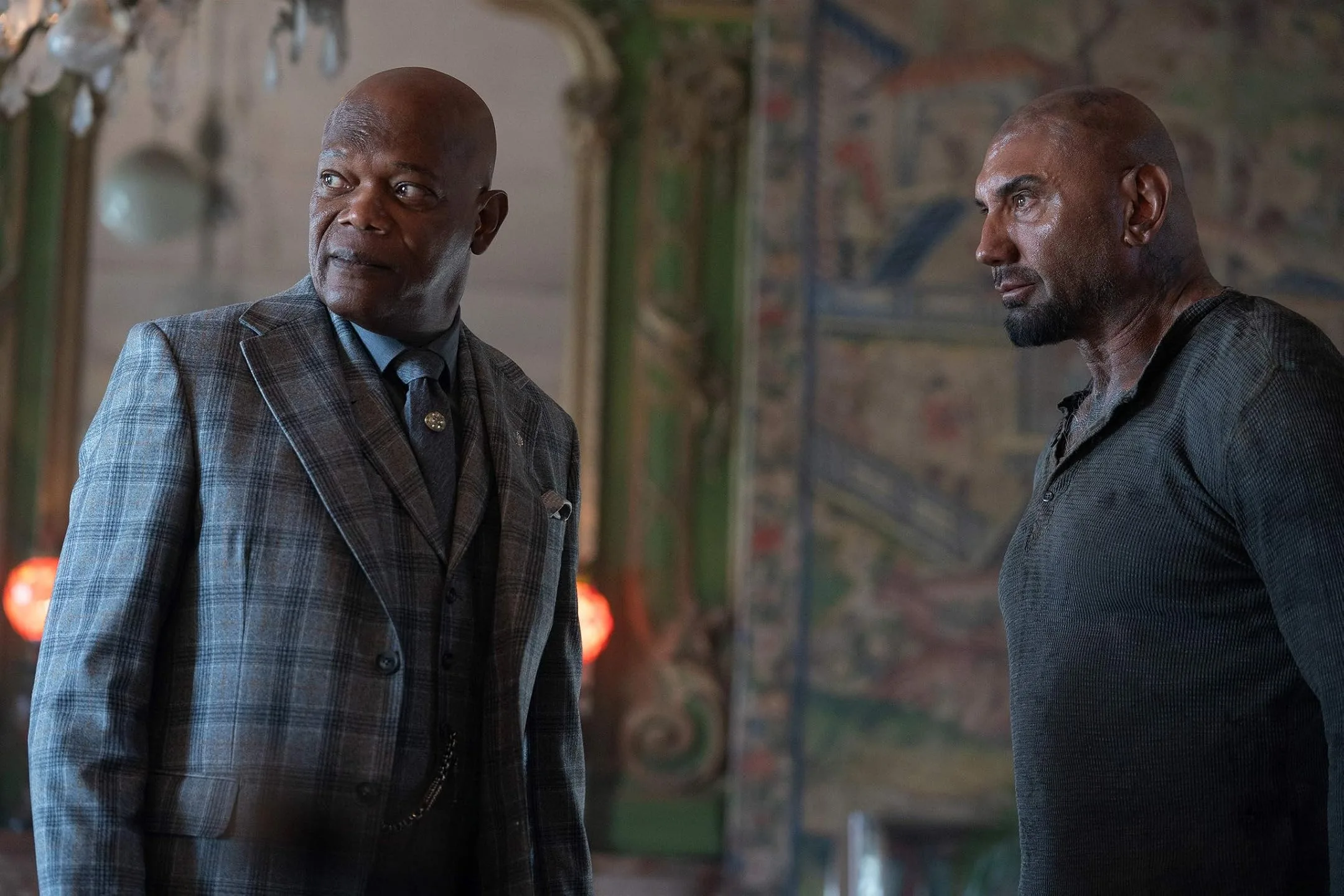
Only Samuel L. Jackson, as the artifact-hoarding King August, manages to inject a fleeting pulse of life into the proceedings. His character is a commentary on the impotent desire to own the past, a king of a trash heap who believes possessing relics grants him legitimacy. Jackson seems to be in on the joke, his brief performance a knowing wink at the absurdity surrounding him, a man enjoying his paycheck in the midst of a cinematic collapse.
The Inertia of Spectacle
One might expect a film from a veteran stunt coordinator to prioritize dynamic physical storytelling. Indeed, the few action sequences in Afterburn are staged with a clear, brutalist competence. Fights are choreographed to emphasize impact, and a chase involving a customized truck and a tank offers a jolt of visceral, uncomplicated momentum. J.J. Perry understands the mechanics of bodies and vehicles in motion.
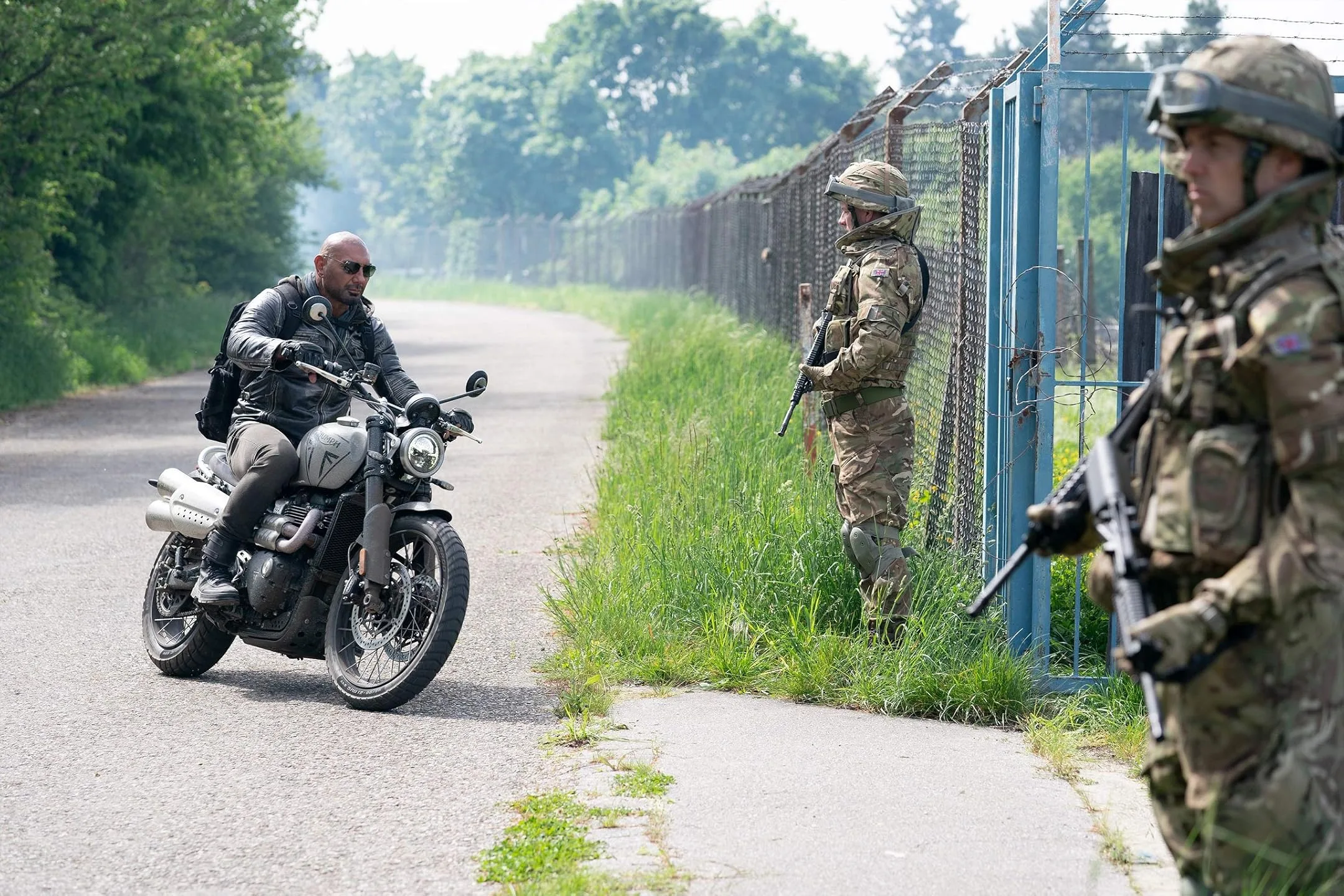
Yet this violence is purely decorative. It arrives on a predictable schedule, offering a brief, noisy interruption before the film sinks back into its default state of lethargy. The gory, computer-generated flourishes that punctuate the kills are a desperate jab at the audience’s nervous system, an attempt to provoke a physiological reaction where an emotional one is impossible. The film mistakes viscera for vitality.
The larger issue is the film’s utter failure to manipulate rhythm and pace. A thriller derives its power from the management of tension, the stretching of moments of suspense and the explosive release of action. Afterburn has only one tempo: a steady, monotonous plod. The narrative generates no forward momentum. The lengthy middle portion is a trial of duration, a sequence of scenes that add little information and build no suspense. The audience is not held in a state of anticipation; they are simply held hostage.
This structural failure culminates in a third-act twist concerning the Mona Lisa that is not merely weak but is an act of narrative sabotage. It retroactively invalidates the entire premise, a desperate gambit that reveals the screenwriters’ own lack of faith in their story. The film does not reach a conclusion; it simply ceases, having exhausted its meager store of ideas. The dominant feeling it leaves is one of wasted time, an unwelcome parallel to the wasted lives of its characters.
Afterburn is a 2025 post-apocalyptic action, science fiction, and comedy film directed by J. J. Perry, based on the Red 5 Comics graphic novel. The story is set a decade after a solar flare devastated the world’s technology, following an ex-soldier and a freedom fighter on a mission to recover the Mona Lisa before a warlord can claim it. Starring Dave Bautista and Samuel L. Jackson, the film’s North American theatrical release date was September 19, 2025, with the international release beginning earlier on August 22, 2025. As of late September, the movie has been released and is currently available to watch in movie theaters.
Full Credits
Director: J. J. Perry
Writers: Matt Johnson, Nimród Antal, Scott Chitwood, Paul Ens
Producers and Executive Producers: Neal H. Moritz, Toby Jaffe, Steve Richards, Christopher Milburn, Kevin Weisberg, Ryan D. Adams, Clay Pecorin, Dave Bautista, Jonathan Meisner, John Friedberg, Laura Austin-Little, Mike Shanks, Peter Strauss, Thane Watkins, Walter Josten, Patrick Josten
Cast: Dave Bautista, Samuel L. Jackson, Olga Kurylenko, Kristofer Hivju, Daniel Bernhardt, Eden Epstein, George Somner, Kevin Eldon
Director of Photography (Cinematographer): José David Montero
Editors: Luke Dunkley
Composer: Roque Baños
The Review
Afterburn
A hollow exercise in motion without meaning, Afterburn is a cinematic relic from a bygone era of disposable action films. Its competent stunt work is stranded within a narrative wasteland, undone by a lifeless lead performance, glacial pacing, and a script assembled from the scavenged parts of better movies. The film mistakes grim aesthetics for depth and explosive gore for excitement, resulting in an experience that is not thrilling or thought-provoking, but simply tedious. It is a portrait of inertia, a story about a ruined world that feels just as empty and broken.
PROS
- A few competently choreographed and clearly shot action sequences.
- Effective use of decaying industrial locations to create an authentic atmosphere.
- A brief, charismatic appearance by Samuel L. Jackson.
CONS
- A derivative, illogical, and profoundly dull screenplay.
- Dave Bautista’s lead performance is flat and devoid of charisma.
- Excruciatingly slow pacing with long stretches of narrative inertia.
- One-dimensional supporting characters and a cartoonish, unthreatening villain.
- A nonsensical third-act twist that invalidates the plot.