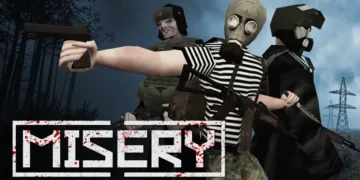





























Platypus Entertainment builds a digital wasteland that sidesteps the polished, high-fidelity look that dominates modern survival horror. MISERY drops you into the smothered remains of a fictional nation ruined by a scientific catastrophe and the nuclear fallout that followed. Heroic resistance barely exists here. The setting is radioactive rot, and you play a security contractor hired to sift through the remnants of a dead civilization. Your home is the Zone, a wide stretch of contaminated ruins and shifting anomalies where survival depends on staying ahead of forces that want you gone.
The game runs on a high-pressure loop of scavenging and bunker work. Each day starts with a scramble for supplies and ends with a hard sprint back underground before lethal emissions sweep across the surface. You can move through the fog solo or with a crew, hunting for food, tools, and valuable artifacts while keeping clear of the mutants that stalk the debris. Visually, MISERY leans into the early 3D era, using low-poly geometry to tighten the spaces and amplify decay. Missions play like calculated bets: time and resources sit on one side of the scale, the Zone’s constant threats sit on the other.
The Desperate Scramble: Core Gameplay and Loops
MISERY’s structure rests on a rhythmic, punishing cycle that keeps human fragility in the foreground. Every match begins with a sixty-second countdown that introduces the game’s obsession with urgency. You get one minute to snatch whatever you can reach, medkits, rusted tools, cans of food, before a secondary nuclear bombardment makes the surface temporarily unsurvivable. The mechanic produces instant pressure and forces quick sorting: grab what matters, leave what slows you down, keep moving. The point lands immediately: time functions like a consumable resource, and wasting it carries a cost.
After you survive that opening dash, the expedition cycle takes control. You move from bunker safety through heavy blast doors into a randomly generated landscape. Procedural layouts sit at the center of the challenge because routes never settle into routine. Each trip through the Zone presents new shapes of crumbling buildings and warped forests, which means decisions stay active instead of turning into muscle memory.
Loot temptation fights with the need to reach extraction before the sirens start. Those sirens mark the arrival of a lethal emission, a radiation wall that kills anything left exposed. That countdown hangs over every step. You keep checking the clock, scanning for landmarks, and planning a return path before the warning turns into a sentence.
Resource management adds constant stress during these runs. Inventory space matters, yet the real pressure comes from the body systems MISERY asks you to monitor. Hunger and thirst keep you on a clock, and radiation exposure and sanity apply slower, meaner pressure. Radiation builds quietly and calls for specialized medicine to clear it. Sanity drops as the Zone’s distortions pile up. Gear weight feeds into these problems by affecting speed and stamina. A pack full of valuable scrap turns you into a slower target, and that delay can decide a run when the bunker is still a stretch away.
The Sirez Hub offers the closest thing to relief, socially and economically. It’s an apartment complex repurposed into a cramped market where vendors focus on specific categories of loot. One room deals in medical supplies, another contains a weapon smith, and the narrow hallways become part of the routine as you shuttle goods around to sell and restock. Even here, the tone stays heavy. The hub reads as shelter that could vanish at any moment, not a place that invites comfort. The economy reflects scarcity, so prices push you to treat purchases like long-term bets tied to your next trip and your continued survival.
Engineering a Haven: Bunker Development and Progression
MISERY skips experience points and skill trees and puts progression into the physical space you inhabit. Your bunker becomes the clearest marker of growth. At the start, it amounts to a damp concrete box with leaking walls and flickering lights. It functions as a command center: stash your finds, patch up battered gear, prepare for the next run. The sense of advancement feels grounded because progress shows up in the environment. You climb out of the dirt by building your way through it.

Base expansion carries the long-term loop, and it delivers the most satisfying rewards. You spend currency and scavenged materials on modules that raise your survival odds. A crafting bench supports weapon upkeep and basic tool creation. A generator brings power for advanced life-support systems. Hydroponic farms eventually provide renewable food and reduce reliance on the rare cans pulled from the ruins. These upgrades function as systems, not decorations. Each station changes what you can attempt on the surface and how long you can stay there. Adding a new module lands like a hard-earned win against a world that keeps trying to strip you down.
Better technology follows base improvements. A more developed bunker opens access to improved radiation suits, specialized filters, and steadier weaponry. That gear becomes necessary when you push into deeper, more contaminated sectors of the Zone where valuable artifacts wait. The power curve stays quiet and earned. Strength arrives through equipment that performs consistently: a suit that stops leaking, a rifle that stops jamming every three rounds. Progress feels tangible, and that tangibility turns the grind for resources into something with a clear purpose.
Mastery in MISERY plays out in your head more than in a menu. The game rewards attention and memory. You learn the visual shimmer that signals a gravity anomaly. You pick up the audio cues of a mutant moving nearby. Pathfinding becomes a practiced skill as you learn which terrain types tend to hide pockets of high radiation. This progression sits with the player. A veteran can survive with basic gear because they understand how the wasteland behaves, and the design leaves room for that knowledge to matter.
A World Terminally Ill: Atmosphere and Visual Design
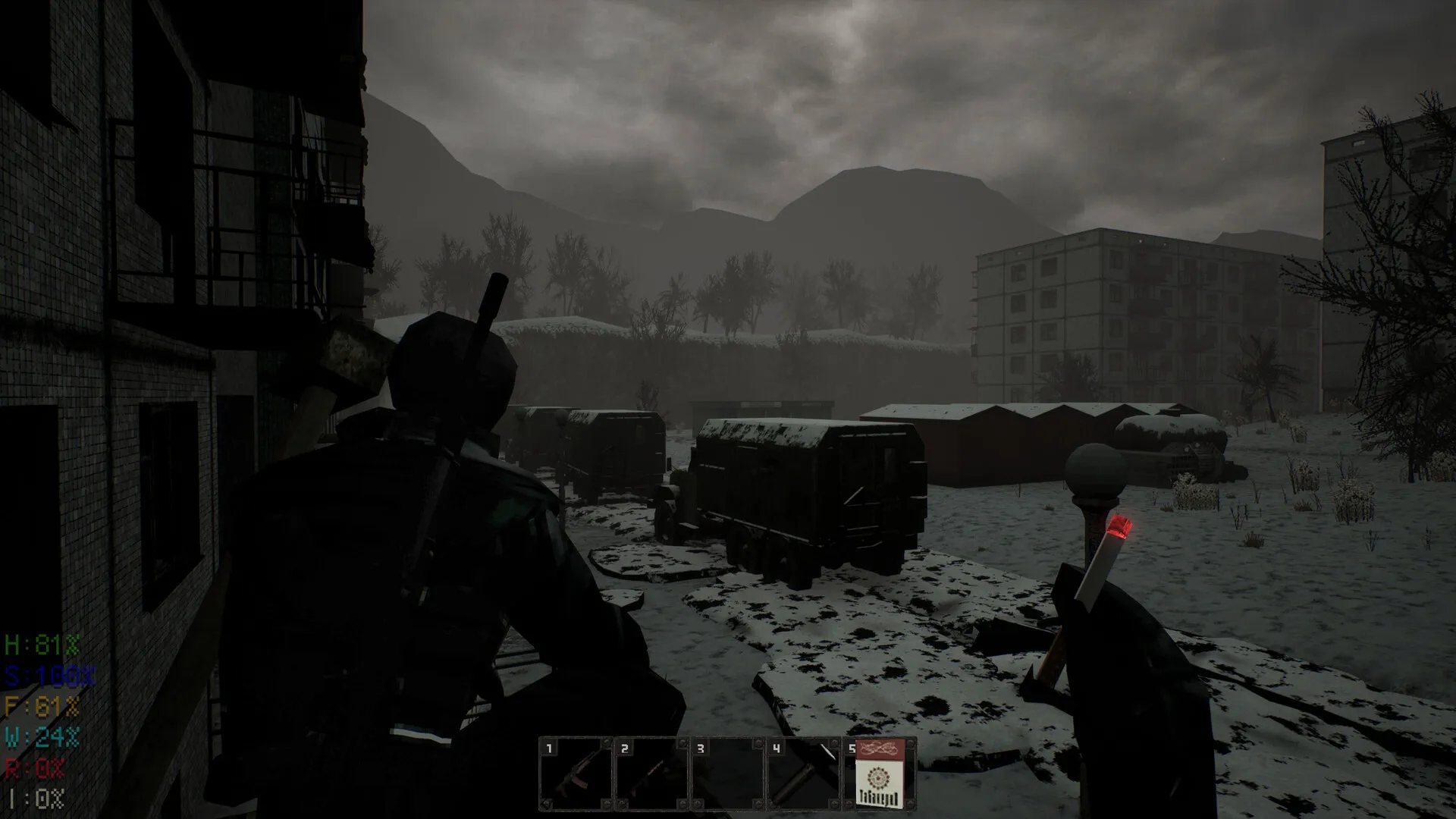
MISERY’s visual identity uses technical limitation as a horror tool. The graphics go intentionally lo-fi, echoing the PS1 era and early PC shooters like GoldenEye 007. The grainy, dirty look makes the world feel terminally ill. Low-poly models and jagged edges give environments a sharp, uncomfortable texture. Shadows turn thick and pixelated, hiding danger in a way that can feel harsher than a crisp, high-definition darkness. The style favors mood over realism, and the hostility reads immediately once you step outside.

Environmental storytelling carries the narrative weight. The game avoids long dialogue scenes and cinematic explanations and lets the ruins communicate what happened. You move through abandoned Khrushchyovka apartments with wallpaper peeling in radioactive strips. You come across a child’s toy in a bunker that never reached completion. Rusted military vehicles and bleak monuments hint at a defense effort that failed. These details build a cohesive portrait of a society that disappeared fast. The silence inside these spaces can feel colder than a jump scare because it leaves you alone with the scale of the loss.
The Zone’s supernatural elements aim for beauty paired with danger. Anomalies appear as distortions of time and space: glowing orbs, leaves rising against gravity, ghostly echoes of soldiers trapped in a loop of combat long after the war ended. These effects cut through the wasteland’s desaturated palette and act like deadly beacons. Their unease comes from what they represent: physics breaking down, the world behaving wrong, the landscape gaining a pulse that feels hostile.
Weather and lighting reinforce the oppression. Thick grey fog rolls across maps and shrinks visibility to a few meters, turning silhouettes into constant threats. Light often comes from harsh, artificial sources like flickering emergency lamps or the sick glow of radioactive pools. During a nuclear emission, the sky shifts to a violent red and the air seems to vibrate with energy. The surface reads as a place that rejects human presence, and the game keeps that message consistent through every visual choice.
Violent Desperation: Combat and Environmental Hazards
Combat in MISERY carries heavy, clunky desperation. The game turns away from the fluid feel of modern shooters and leans into friction where every movement seems difficult. Weapons carry weight and often behave unreliably, matching the idea of salvaged equipment dragged through a brutal environment. Firearms stay rare and expensive to maintain, so they work best as last-resort tools. When fights happen, they feel frantic and close. Melee is rough and unpolished, which fits the role you inhabit: a scavenger trying to survive, not a trained soldier sweeping rooms.

Hazards split between living threats and the environment itself. Mutants prowl through fog with jerky, unpredictable movement. Human bandits hold positions in the ruins, waiting to rob careless contractors. The anomalies rule the Zone, though.
These environmental traps function like deadly puzzles that demand observation before you commit to a path. Some yank you into the air and crush you. Others release lethal electricity. They frequently sit near the best loot, turning every prize into a risk-reward calculation. Survival depends on learning how each anomaly behaves and treating the world like an obstacle course built to kill you.
Death carries its own kind of weight even when the mechanical punishment stays modest. After dying, you respawn at the bunker with most permanent progress intact, yet losing your current inventory can sting hard when rare supplies were in your pack. That low penalty cuts two ways. It supports experimentation and encourages players to test dangerous routes and unknown anomalies. It also has moments where the stakes loosen and the horror thins a little. For many players, the emotional hit of a failed mission still keeps tension intact.
Combat and hazards combine to prevent comfort. Even with strong gear, one wrong step into an anomaly or a badly timed reload during a mutant attack can end a run. The game values endurance and avoidance, rewarding players who treat conflict as a problem to bypass. MISERY holds onto danger from the first minute through the last, so survival stays a relief you earn again and again.
Shared Hardship: The Cooperative Experience
MISERY works as a tense solo experience, and it hits its stride in co-op. With other players, the game turns into a tactical exercise in shared survival. Teams coordinate movement and split roles to improve efficiency in the Zone. One person scouts with binoculars to spot anomalies from a distance. Another takes on the heavy loot bags. The game doesn’t force these roles through classes. The environment creates them through practical need, and communication becomes essential, especially when fog erases sightlines and teammates fade into the murk.

The emotional tone changes in a group. Panic becomes communal when a nuclear emission catches everyone out in the open and the nearest bunker door feels too far away. Sacrificing a last medkit for a teammate or staying back to pull a mutant’s attention away from the group can create sharp moments of emergent storytelling. Those moments land differently than solo tension. The misery becomes shared, and that shared pressure can make the experience easier to carry while also making losses feel sharper.
Co-op comes with technical friction that players have to accept. Online matches can suffer network glitches, lag, and disconnections, and those problems hurt most during high-stakes runs. This kind of instability shows up often for indie titles, and it can crack immersion during scenes where the atmosphere normally holds tight. The developers have been proactive with updates, and the community tends to respond with patience. A lively Discord channel helps players find teammates and swap strategies, which strengthens the social pull of the multiplayer side.
The cooperative loop also keeps the game alive longer. Zone runs change when team composition changes, and human unpredictability adds its own chaos alongside procedural maps. Arguments over who gets to sell a rare artifact and celebrations after slipping past a bandit ambush give the multiplayer mode a social energy that fits the design. MISERY treats fear as something amplified by connection, then uses that connection to keep players coming back.
Soundscape of Solitude: Audio Design and Immersion
MISERY’s audio design stands as one of its strongest tools for dread. The soundscape prioritizes environmental noise over constant music. Distant thunder, the crackle of a Geiger counter, shifting metal, wind pushing through concrete shells: each layer makes isolation feel real. The world sounds empty, yet small noises keep suggesting company somewhere nearby. That restraint forces players to listen closely, and sudden sounds hit with more force because silence sets the stage.
The emission sirens serve as the game’s most iconic audio signal. When an emission approaches, a harsh metallic scream cuts through everything. It communicates immediate danger with no room for misreading, and it pushes stress upward fast. The siren functions as a psychological trigger tied to survival. Even inside the Sirez Hub, the memory of it hangs in the air and keeps your attention tuned to the next run.
Music appears rarely and with intent, usually in bunker safety or the underground bar. These tracks lean melancholic and low-key, and that change in texture offers a small emotional release after a successful return. Voice work is limited, yet it adds grit through radio chatter and hushed NPC talk in the hub. Those voices make the world feel populated by people clinging to survival, even when the surface stays empty and hostile.
Directional audio matters for moment-to-moment play in the Zone. Anomalies often announce themselves through sound before they come into view, like electrical humming or the whistle of distorted air. Mutants have distinct calls that help you track movement through fog. MISERY turns listening into a survival skill, and it shows how tension can come from restraint: a single footstep in an empty corridor can carry more fear than any orchestral swell.
The Review
MISERY
MISERY is a masterclass in atmospheric tension, using its retro aesthetic and punishing loops to create a genuinely unsettling survival experience. While the combat feels intentionally heavy and the narrative is thin, the sense of growth through bunker fortification and environmental mastery is deeply rewarding. It prioritizes mood over polish, delivering a shared hardship that is both exhausting and addictive. For those who value immersion and tactical patience over high-octane action, this is a standout indie gem.
PROS
- Exceptional atmospheric dread and sound design.
- Rewarding, tangible base-building progression.
- Tense, high-stakes cooperative gameplay.
- Unique lo-fi visual style that enhances the horror.
CONS
- Combat can feel frustratingly clunky.
- Occasional technical glitches and network lag.
- Minimal plot for players who prefer narrative-driven games.