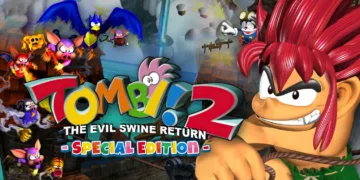






















Pink hair and raw, primitive instincts set the tone for Tomba, a feral lead from a late nineties relic that prefers momentum over exposition. The setup keeps things simple and points you straight at the chase. The malicious Evil Pigs kidnap his childhood friend, Tabby, and Tomba bolts after them, charging into a world that plays like a fever dream pulled from late-century game design.
This Special Edition brings the 1999 experience onto current hardware, keeping the aesthetic decisions that shaped the original PlayStation library. The atmosphere carries a strange pulse from the opening stretch: you begin in a coal mining town, then push onward into encounters with a cast that swings from Santa Claus to mythological creatures.
Tomba reads as a silent force of nature, powered by athletic grit and a single-minded need to deal with the porcine threat. In practice, the game works like a colorful time capsule, catching the moment when two-dimensional design started sharing space with early polygon-based exploration. The visuals stay loud and expressive, leaning into whimsy in a way that frames the kidnapping plot with Saturday morning cartoon energy. This edition keeps the chunky models and saturated colors intact, presenting them in the same form that anchored the original. That commitment keeps the era’s charm front and center, for better and for worse.
Exploring the 2.5D Mission Architecture
The level design relies on a 2.5D perspective that fits the transition between console generations. Much of the action plays out along a side-scrolling plane, yet the world keeps folding outward. Branching routes and environmental crossroads let Tomba drift into the background or surge into the foreground, creating depth that makes the island feel like a tangible place instead of a chain of isolated corridors. That shifting viewpoint supports some clever layouts, where a path you spot far off later becomes the main surface you run across during exploration.
Progress hinges on a mission-heavy structure that separates the game from traditional platformers. The rhythm comes from talking to strange NPCs, taking on tasks, and following the threads those tasks create. Missions cover straightforward item collection and environmental puzzles that demand specific tools, and the game pushes you into frequent backtracking as those requirements stack up. The structure echoes early Metroidvania patterns: certain spaces stay locked until you secure the right key or a special ability. Animal costumes serve as the upgrade system, granting skills that open hidden ledges, unlock routes, or trigger particular world events.
The island functions as a cohesive puzzle box, and much of the playtime comes from learning its geography and testing how each new find reshapes your options. A tool discovered in the mining town can end up being the missing link for a secret tucked away in a distant forest. The steady flow of dialogue with the game’s quirky inhabitants keeps the pace moving, turning the search for Tabby into a chain of interconnected favors and discoveries.
The Physics of Primitive Combat
Mechanically, the game revolves around a clear loop: stun an enemy, then toss it. Tomba carries multiple weapons, including flails and ranged tools, and they exist to daze the pigs that roam the stages. After you land the stun, you need to jump directly onto the enemy to trigger the throw. It is a clean, readable idea that demands accuracy, and it can punish small mistakes. A sloppy landing or brushing a pig at the wrong moment leads to immediate damage. Early on, the health pool is small, so a few missed jumps can end a run fast. Health upgrades and healing items show up later, yet the opening hours ask for caution and discipline in every encounter.

The movement physics carry the fingerprints of the game’s era. Tomba has weight, and mid-air direction changes can feel slow or stubborn. Landing precisely on a small platform or a moving enemy can turn into a repeated struggle against the controls, especially when the game asks for tight execution. That rigidity stands out during the infamous trolley cart sequence, a timed challenge built around near-flawless inputs.
The camera can also raise the difficulty by blocking your view of hazards ahead or by setting up jumps where you commit before you truly know what waits off-screen. Costumes help by handing out elemental powers or mobility boosts, yet the underlying stiffness remains part of the baseline feel. As the game goes on, success depends on internalizing the arc of Tomba’s jump and reading the hitboxes tied to each weapon. Combat stays simple on paper, yet fixed camera angles paired with twitchy air control turn bosses and platforming stretches into repeated tests of patience and timing.
Technical Preservation and Modern Utility
This release works as a direct route to a classic title, without needing vintage hardware. The presentation keeps the original 32-bit models and low-resolution textures in a raw state that reflects the game’s 1999 identity. Optional CRT filters can soften the image, and you can adjust the aspect ratio, yet the look remains firmly rooted in its time. A Museum mode adds a development-history component, including high-quality scans of the original Japanese and Western manuals plus pieces of box art. That archival material adds meaningful value for anyone interested in the franchise’s history, even with the main game staying largely untouched.

Quality-of-life tools do the heavy lifting for modern play. Save states and rewind are the standout additions, giving you ways to erase a fatal error or skip the annoyance of unskippable cutscenes after a death. Since the original design used sparse save points, the ability to lock in progress at any moment makes the harder platforming stretches far easier to manage. The audio sticks closely to the past as well.
The English voice acting carries the amateurish deliveries associated with early disc-based games, and the soundtrack includes a memorable song that repeats during every NPC conversation. That conversation theme, marked by a farty trumpet sound, becomes a constant refrain across the adventure. The level music often lands well, yet the mission-heavy structure makes that conversation loop unavoidable. For players with affection for the PlayStation library, these preserved quirks can hit like genuine nostalgia, capturing textures that modern remakes often fail to replicate.
The Review
Tomba! 2: The Evil Swine Return Special Edition
This release serves as a faithful preservation of a quirky, experimental era in gaming. While the mission-driven structure and imaginative world remain engaging, the stiff controls and dated camera show their age. The modern additions are essential for managing the inherent frustrations of the original design. It is a worthwhile trip for those seeking a specific type of nostalgia, provided they can overlook the technical rigidities of 1999.
PROS
- Inventive 2.5D world design and layered exploration.
- Engaging mission-based progression.
- Essential rewind and save state features.
- Includes a comprehensive museum mode for fans.
CONS
- Stiff movement and frustrating air control.
- Repetitive conversation music.
- Outdated camera angles lead to blind jumps.
- Amateurish voice acting and unskippable cutscenes.