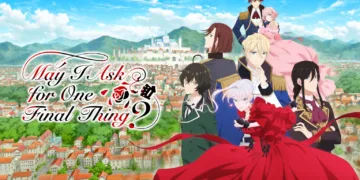






























Silver hair pulled back for utility and clothed in bold reds, Scarlet enters the Royal Academy wearing the look of a perfect noblewoman and carrying the habits of intense martial discipline under her skin. She posts top scores across the curriculum, keeps her expression steady, and treats composure as a practiced performance. That polish functions like a locked door. Behind it sits the instinct that earned her the childhood name “Mad Dog Princess,” an identity she learned to keep out of sight in exchange for survival in a court that rewards obedience.
That bargain shapes her engagement to Prince Kyle. The agreement reads as strategy, a sacrifice made for her family’s standing, sealed by the daily work of suppressing a combative nature. Years pass in that posture: tolerating the whims of a mediocre prince, trading agency for the stability of the Vandimion name, accepting that public decorum demands private erasure. The contract’s public dissolution breaks the spell. With the engagement gone, the silk gloves come off and her body becomes the argument, fists delivering a kind of honesty the court has spent years refusing to speak.
Scarlet’s response rejects the familiar route assigned to the scorned woman. No careful psychological games, no quiet suffering performed for an audience waiting to call it dignity. Her appearance supports the rejection. Scarlet’s reds and tied-back silver hair read as readiness, a visual language built for motion and impact. Terenezza Hopkins occupies the room through a soft pink aesthetic and a cultivated vulnerability designed to generate influence. Scarlet treats that performance as artifice.
She reaches for power through blunt clarity, using force to tear through the lies of a corrupt court and expose what polite speech keeps hidden. In her moral logic, a punch becomes the final step after conversation collapses, a direct answer to people committed to bad faith. The violence carries intention: a reclamation of self that measures worth through capability, not marital prospects.
Structural Rot and the Path of Retribution
The story moves quickly from the sting of a broken engagement to the rot that makes such humiliation possible. Prince Kyle levels public accusations of bullying without evidence, and the surrounding nobility accepts his story with immediate ease. The speed of that agreement signals the kingdom’s sickness. Truth holds little value beside closeness to the throne, and reputation becomes a weapon wielded by whoever has the right bloodline. Scarlet’s retaliation against the entire ballroom plays like a purge of that false order, a physical rejection of a social system that treats lies as currency.
The scope widens through her discovery of illegal beastkin trafficking rings operating beneath the polished surface of high society. The entry point is Nanaka, a young boy used as a pawn in an external political plot, his presence turning a private scandal into an investigation with stakes measured in bodies and stolen rights. The kingdom’s machinery reveals itself as exploitation with good manners, sustained by people who believe status grants immunity.
Figures such as Lord Zatharin embody that belief, profiting from suffering while expecting consequence to land on someone else. Scarlet’s pursuit brings her to Godwin Bene Carmine, a portrait of high-noble greed, and the plot introduces pressure from the Vankish Empire, known for dragon riders and superior military force.
The world expands into geopolitics: Pallistan faces threats from foreign aggression and the corruption eating away at its own institutions. Advanced weaponry, including firearms, raises the lethality of conflict and disrupts the old reliance on swords and magic. Within this tightening vise, Scarlet becomes a reformist instrument, her skills applied to dismantling predatory systems that the court has protected for convenience.
Intellectual Parity and the Insecurity of the Crown
The court’s psychological strain emerges through the power dynamics between its key figures. Prince Julius von Pallistan stands as Scarlet’s intellectual peer and primary rival, someone able to read through her practiced poker face and notice the genuine expressions she keeps buried. Their encounters during a marketplace investigation build a relationship grounded in mutual respect and competitive drive. Julius engages with the person behind the performance, testing her reactions under pressure and treating authenticity as the rare commodity the court cannot counterfeit.

Kyle operates as Julius’s opposite, driven by profound insecurity and a hunger to protect a fragile self-image. His resentment of Scarlet grows from comparison: her natural brilliance in academics and magecraft throws his lack of talent into sharp relief, and he responds by weaponizing accusation and public spectacle. The crown’s weakness becomes personal, then political, as private envy gains the authority to shape public narrative.
Leonardo El Vandimion introduces another angle on this hierarchy. As Scarlet’s older brother, he mediates between her volatile instincts and the family’s need to survive within aristocratic rules. He recognizes the danger in her fury, a force capable of ruining their standing, yet he supports her pursuit of justice once the stakes become impossible to ignore.
Scarlet’s bond with Nanaka draws out a protective current in her character. She uses physical dominance to shield those stripped of rights, turning strength into a tool for the defenseless. That instinct separates her from the nobles she hunts. Power holds value for her as corrective force, applied to the imbalances created by people who abuse their positions.
The Aesthetics of Impact and Satirical Tone
The series frames its world through a collision of surfaces: the elegance of high society pressed against the brutality of the street. Combat animation emphasizes the physics of impact, giving weight to Scarlet’s strikes and letting the body language of each hit carry narrative force. Faces twist into exaggerated, grotesque shapes on contact, and the violence lands with dark humor that refuses to treat aristocratic dignity as sacred.
The score leans into refinement, using themes like ballet compositions to accompany chaos. The choice suggests Scarlet experiences these fights as disciplined motion, closer to rhythmic exercise or crafted expression than emotional outburst. Episode pacing keeps political dialogue in motion beside physical action, preventing the story from drowning in exposition and ensuring each exchange has momentum.
Comedy flows from Scarlet’s consistent lack of visible emotional reaction. Her internal monologues track practical details while everyone around her spirals through drama and romance. Julius’s charm meets annoyance, his advances filed away as another obstacle standing between her and the work at hand.
Godwin’s revelations introduce isekai elements, bringing a supernatural dimension to her origins and hinting that her overwhelming physical prowess connects to a reality beyond the kingdom’s limits. The tone holds action fantasy and satire in the same grip, ridiculing aristocratic self-importance while delivering the blunt pleasure of watching that class meet consequence in the most physical way possible.
May I Ask for One Final Thing? premiered on October 4, 2025, and recently concluded its first season on December 20, 2025. Produced by LIDENFILMS Kyoto Studio, the series follows the high-impact journey of Scarlet El Vandimion, a noblewoman who shatters fantasy tropes by dealing with her enemies through physical force. Viewers can currently stream the entire season on Crunchyroll, where it has become a prominent action-fantasy title of the late 2025 television landscape.
Full Credits
Title: May I Ask for One Final Thing?
Distributor: Crunchyroll, Tokyo MX, BS11, GTV, GYT, MBS, Chukyo TV, AT-X
Release date: October 4, 2025
Rating: TV-14
Running time: 24 minutes
Director: Kazuya Sakamoto
Writers: Deko Akao, Nana Otori
Producers and Executive Producers: Nobuhiro Nakayama, Tomoyuki Oowada, Zach Bolton
Cast: Asami Seto, Wataru Kato, Shoya Ishige, Miyu Tomita, Kazuki Ura, Taito Ban, Ai Kakuma, Sally Amaki
Director of Photography (Cinematographer): Tetsuya Kawada
Editors: Satomi Yamada
Composer: Hinako Tsubakiyama
The Review
May I Ask for One Final Thing?
Scarlet El Vandimion delivers a refreshing subversion of the fantasy genre by replacing stagnant courtly drama with visceral accountability. The series thrives on the contrast between its refined setting and the blunt honesty of a well-placed punch. While the animation occasionally lacks fluidity in minor scenes, the central character’s rejection of passive victimhood remains deeply satisfying. It provides a rare look at a protagonist who values direct action over social performance. This production is a sharp, satirical, and cathartic experience for those weary of traditional romance tropes.
PROS
- Subversion of the villainess archetype through physical agency.
- Satirical take on high-society romance tropes.
- Sharp intellectual rivalry between Scarlet and Julius.
- Thematic focus on dismantling institutional corruption.
CONS
- Inconsistent animation quality in non-combat sequences.
- Supporting characters require extra development.
- Romance subplots move at a slower pace.