





























Silence often represents a lack of presence in modern storytelling, the missing beat that tells you a character has slipped out of the room. This series flips that expectation and makes quiet the foundation of extreme capability. The Kingdom of Ridill faces frequent dragon attacks, and the Seven Sages stand as the peak of magical talent.
Monica Everett remains the most enigmatic among them, carrying the title of the Silent Witch. She can manifest complex spells without verbal incantations. This ability makes her an asset on the battlefield. It also lets her avoid the human interaction she fears so much. She spends her days in a cabin filled with books to keep the world at a distance.
That isolation ends when Louis Miller, a fellow Sage, arrives at her door and pushes a secret mission on her. Monica must enter Serendia Academy and protect the second prince, Felix. She goes undercover as a servant to Isabelle Norton. Isabelle is a noble student who secretly worships the witch, and her devotion becomes part of the cover. The narrative pivots from high fantasy battles to the structured social environment of an elite school, and that change forces Monica to face her social terrors in public.
Mathematical Logic and the Weight of Genius
Monica approaches life through calculations. Magic becomes variables and formulas, a system she can solve even when emotions feel unruly. That analytical frame gives her a sense of safety. Her chantless magic began as a way to avoid speaking to people. It grows into a kind of power that other mages find terrifying. Monica is a genius who functions best while hidden, and the series treats that hiding as both habit and survival.
Her familiar, a black cat named Nero, adds a needed counterweight to her timid presence. He can take human form and often mocks her for constant panic. Nero keeps the scenes from sinking into pure dread by giving Monica a voice outside her own head. Their timing reminded me of a jazz set where the rhythm section stays steady and the solo line wobbles, then finds its footing again. The writing also grounds Monica’s strength in mundane uses. She organizes her library with magic. She turns that same precision toward life-saving interventions.
Her anxiety shows up as physical symptoms and relentless internal monologues. She faints when people get too close. She avoids cafeteria crowds by eating nuts in private. Numbers become obsession and tool at the same time. Monica spots patterns other people miss. She can look at someone and know exact measurements instantly, and the story frames that talent as a side effect of a traumatic childhood.
She remembers her father as a researcher devoted to formulas, and she remembers the pain that followed his death. Monica does not try to fix her personality. She builds workarounds that let her move through the day on her own terms, and that approach makes her feel relatable for anyone who has felt overwhelmed by the world.
Social Hierarchies and the Serendia Student Council
Serendia Academy treats social standing as law. The hierarchy decides who gets heard, who gets ignored, and who gets punished. Prince Felix leads the Student Council with charisma that hides his secrets. Cyril Ashley serves beside him, disciplined and rigid, using ice magic like a badge of control. A secretary named Elliot completes the council’s inner workings.

Monica begins her school life as an outcast. She looks messy and lacks the confidence that noble students wear like uniform. She finds a friend in Lana Colette, a wealthy student who helps with her hair and social integration. The plot keeps circling back to the prince’s safety, and the school’s calm surface starts to crack. A mysterious student named Aaron O’Brien causes a disturbance that leads to his expulsion.
Monica earns a seat on the council through competence that reads as pure mastery. She audits five years of financial records in one afternoon and catches errors the previous treasurer missed. That feat earns the respect of the other members. Her relationship with Isabelle Norton plays for comedy. Isabelle performs the role of a cruel mistress to keep Monica’s secret safe. She takes the act seriously because she admires the witch, and the performance becomes its own running gag inside the mission.
The academy remains dangerous in quiet, petty ways. Flower pots fall. Corrupted amulets circulate. These items cause mages to lose control of their powers. Monica has to watch for threats while maintaining the servant disguise, and every social interaction carries tension because her real job has to stay invisible. She balances student routines with bodyguard duty, and the script keeps that pressure present even in small conversations.
Technical Prowess and the Echoes of Memory
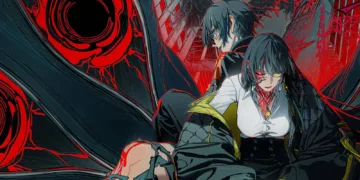
Studio Gokumi handles the animation with a focus on visual clarity. The scenes involving magic are bright and detailed, and Monica’s biggest feats communicate her standing as a Sage with clean staging. She summons dozens of glowing circles at once to stop a dragon, and the image lands like a statement of authority.
The visual approach shifts along with the setting. Dragon fights move fast and hit hard. School scenes soften and use a lighter color palette, giving the social comedy room to breathe. Voice acting is another strength. Saya Aizawa captures the protagonist’s quiet nature and the struggle of someone who cannot speak easily. Junichi Suwabe plays Louis Miller with sharp arrogance, and his delivery gives Monica a thorny presence to contend with.
The series uses the magic school setting to look at deeper themes. It implies Monica’s withdrawal from society traces back to a public execution she witnessed as a child, and that memory feeds her fear of the public eye. Comedy and drama stay in balance, and the show keeps returning to personal limits and the weight of being powerful. Monica wants to be left alone, and the story keeps insisting that saving the world sits on her shoulders.
Secrets of the Silent Witch is an animated fantasy series adapted from the light novel series written by Matsuura. The show premiered in July 2025 and quickly gained popularity for its unique take on the “overpowered protagonist” trope, focusing on the socially anxious Monica Everett, a legendary witch who can cast spells without speaking. You can currently stream the series on Crunchyroll, where it is available with subtitles and dubbing in multiple languages.
Full Credits
Title: Secrets of the Silent Witch (Silent Witch: Chinmoku no Majo no Ura Jijou)
Distributor: Kadokawa, Crunchyroll, Tokyo MX, AT-X
Release date: July 2025
Rating: TV-14
Running time: 24 minutes
Director: Masako Sato
Writers: Mitsutaka Hirota, Matsuura (Original Story), Tenichi
Producers and Executive Producers: Shinichiro Jo, Takuya Ito, Masayuki Akasaka, Kadokawa, Bit Grooove Promotion
Cast: Saya Aizawa, Junichi Suwabe, Masayuki Akasaka, Kengo Kawanishi, Shogo Sakata, Yoshiki Nakajima, Ryohei Kimura
Director of Photography (Cinematographer): Hiroyuki Chiba
Editors: Masayuki Kurosawa
Composer: Agematsu Noriyasu, Elements Garden
The Review
Secrets of the Silent Witch
Secrets of the Silent Witch succeeds because it anchors high fantasy stakes in a deeply human struggle. Monica Everett provides a refreshing perspective on the overpowered protagonist trope. Her magical genius feels earned rather than accidental. The series maintains a steady balance between humorous school interactions and the looming threat of political conspiracies. The secondary characters sometimes feel like archetypes. Their chemistry with the lead keeps the narrative moving. It is a thoughtful look at how past pain shapes our present courage.
PROS
- Strong character work for the lead protagonist.
- High-quality animation during the spellcasting sequences.
- Effective mix of funny and serious storytelling moments.
- Interesting use of mathematical logic within the magic system.
CONS
- Supporting cast members need more development.
- Some episode resolutions feel too fast.