


























The film begins inside the sterile, unforgiving geometry of a maximum-security facility in upstate New York. Frank Baker enters as a man in his 40s whose last two decades have been measured by the routines and restrictions of the state. He reveals himself through restraint and careful control.
His cell is kept with near-clinical neatness, and his hours are filled by a precise hobby: carving intricate miniature motorcycles from bars of soap. That disciplined order meets a new test when Frank signs up for the Yellow Coats, a memory care program that trains younger inmates to assist older prisoners living with dementia. Frank treats the assignment as a calculated step toward his next parole board hearing.
His pairing places him beside Louis Nelson, a 60-year-old lifer whose fearsome standing as a former gang leader is gradually dissolving. Alzheimer’s is erasing the man Louis used to be, leaving a volatile senior caught in confusion and fear. The prison’s severe environment becomes a hard-edged stage for a story about connection formed through slow effort, inside a system built to keep people separate.
The Weight of Shared Silence
Kingsley Ben-Adir plays Frank with pensive, internalized gravity. His face stays controlled, his emotions held behind stoic expressions that suggest a life fractured by experience, including seventeen years spent in the sensory deprivation of solitary confinement. That stillness sets the tone for the film’s human drama, and it also sharpens the contrast in movement and energy when Louis enters the frame.
Rob Morgan portrays Louis with a painful loss of autonomy. His performance tracks the dazed stare, the sudden turns toward aggression, and the moments of profound confusion that arrive without warning. From their first encounters, the relationship carries tension. Louis greets Frank with paranoia and a defensive ferocity, resisting help at every step. The film lets that resistance play out in detail, without smoothing it into quick catharsis.
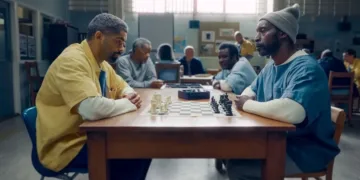
Their connection develops through small, repeatable rituals grounded in the day-to-day. Quiet meals become shared moments, including cup noodles brightened with Louisiana hot sauce. Chess games bring a different kind of pressure, where each move can feel like a test of patience and control.
As the story moves forward, Frank’s initial self-interest shifts in incremental ways. He starts reading caregiving manuals and commits real attention to Louis’ well-being, even as Louis’ condition keeps the environment high-stakes and unpredictable. The writing stays focused on the relentlessness of care in this setting. Emotional breakthroughs arrive rarely, and the film keeps clear of tidy resolutions.
European Formalism in the American Cage
Director Petra Volpe brings a distinct European formalism to an American carceral story, shaping a film that recalls the social realism associated with Indian parallel cinema. That sensibility shows in the film’s observation and restraint, and it also shapes how the institution is filmed as a place with texture and daily rhythm.
Cinematographer Judith Kaufmann uses fluid tracking shots to follow Frank through steel-blue corridors, catching small details inside a muted world. The camera’s movement feels attentive and measured, matching Frank’s controlled presence while still registering the prison as an active pressure on every interaction. Oliver Coates’ score supports that approach with low, pensive strings that hold a somber mood and steer the film away from melodrama.
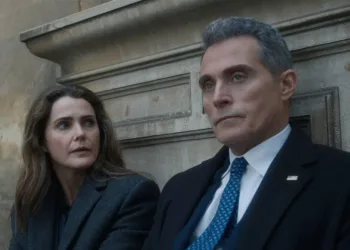
The supporting cast gives the institution social weight. Indira Varma plays Dr. Watts with pragmatic, weary kindness, a figure who carries professional responsibility without sentimentality. Rosalind Eleazar appears as Frank’s sister, Trish, providing a connective thread to the life Frank has outside these walls. René Pérez Joglar, known as Residente, stands out as Julian, a Yellow Coats veteran who acts as mentor and guide.
Julian offers a grounded view of the job’s emotional cost, and the film underlines that cost through his patient care of an aging bigot whose latent hatred persists even as memory collapses. Taken together, these performances present the prison as a lived-in community with its own frictions and routines, not a blank cinematic container.
The Architecture of Atonement and Identity
A central philosophical tension runs through the film: moral responsibility in the face of a crime that the mind can no longer hold. That tension reaches its sharpest point during Frank’s parole hearing. The impact statement from the daughter of Frank’s victim forces him to face the permanence of what he did, at the same time he watches Louis lose his own history day by day.
The film frames that pressure through the Ship of Theseus paradox, pressing a question about continuity and identity. Are Frank and Louis the same men who committed violent acts decades earlier, or has time, along with the decay of memory, remade them into something else?
Louis’ tragedy lands in intimate details. He clings to the belief that he has a lunch date coming up with his daughter, and he waits for letters that never arrive. The film lets that hope sit in the air as a recurring ache, a reminder of how dementia can preserve desire while stripping away the facts that might answer it.
One pivotal scene has Frank giving Louis a sponge bath. The act plays like a ritual of cleansing and care, and it grants Louis a rare moment of dignity inside a harsh punitive system. The film holds back from easy absolution and refuses clean answers. It suggests that the mind can fade toward nothingness, while the act of caregiving can still carry a quiet form of redemption that remains internal and deeply personal.
Frank & Louis celebrated its highly anticipated world premiere in the “Premieres” section of the Sundance Film Festival on January 25, 2026. This English-language debut from Swiss director Petra Volpe is a poignant drama set within a U.S. correctional facility, focusing on a unique memory care program for elderly inmates. Following its successful festival debut, the film is scheduled for a wider theatrical release in Switzerland and across Europe starting in late 2026. Currently, the film is primarily available through select festival screenings, with digital and streaming availability expected to be announced following its international theatrical run.
Full Credits
Title: Frank & Louis
Distributor: TrustNordisk (International Sales), Constantin Film (Germany/Austria), Filmcoopi (Switzerland), September Film (Benelux)
Release date: January 25, 2026 (Sundance Film Festival)
Running time: 95 minutes
Director: Petra Volpe
Writers: Petra Volpe, Esther Bernstorff
Producers and Executive Producers: Reto Schaerli, Lukas Hobi, Thembisa Cochrane, Georgie Paget
Cast: Kingsley Ben-Adir, Rob Morgan, Indira Varma, Rosalind Eleazar, René Pérez Joglar, Calum MacPherson
Director of Photography (Cinematographer): Judith Kaufmann
Editors: Hansjörg Weißbrich
Composer: Oliver Coates
The Review
Frank & Louis
Frank & Louis provides a grounded look at the intersection of aging and incarceration. The film avoids loud theatrics and prefers the quiet reality of care work. Kingsley Ben-Adir and Rob Morgan anchor the story with great emotional depth. While the narrative follows a familiar path, the specific focus on memory care offers a fresh perspective. It asks difficult questions about guilt without providing easy resolutions. The result is a sober piece of cinema that prioritizes human dignity.
PROS
- Strong, internalized lead performances
- Precise and observant visual direction
- Sincere handling of difficult ethical themes
CONS
- Slow, methodical pacing
- Predictable plot developments