

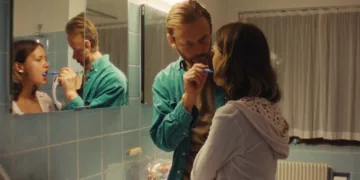


















The town of Bellefontaine, Ohio, frames this look at the opioid crisis with an unvarnished sense of place. Cody Parsons, played by Will Poulter, is a man trying to build a life after getting out of prison. His release comes with strict conditions: an eighteen-month, court-ordered recovery program built around frequent drug tests and regular check-ins with a judge.
Cody lives close to collapse, sleeping in a white car tucked away in the woods. That physical distance from town matches the way he carries himself as he takes a job at a local lumber mill, where the film keeps returning to the grind of repetitive, physical work. He is placed under the same court supervision as his brother Jack, portrayed by Noah Centineo, the sibling he was raised alongside through the care system.
Together they reflect a damaged kind of home life in a region where narcotics have settled deep into everyday routines. The air of the place feels weighed down by rules and monitoring, a community where the legal system and personal health stay tightly connected. Bellefontaine becomes an entry point that feels rooted in real struggle, with the story staying close to the pressures people carry day after day.
The Intersection of Performance and Authenticity
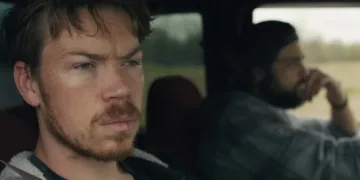
Will Poulter builds Cody around a constant internal fight. A guarded stillness, lowered eyes, and small, restrained movements communicate a man who wants to rejoin the world and fears it at the same time. That quiet physical approach helps him sit naturally beside the local non-professional actors who appear as participants in the Bellefontaine Adult Recovery Court.
Annette Deao, a real-life counselor playing herself, brings compassion that feels practiced and personal. Judge Kevin P. Braig appears as himself as well, and his authority lands with an everyday firmness that avoids the manufactured heat common in courtroom stories. Cody’s reserve comes through in how little he offers people. Jack presents himself with a scruffier edge and a more outward energy, giving off the sense of someone whose sobriety can slip at any moment.
The film leans heavily on raw testimonials from program members, and those accounts keep the narrative tethered to lived experience. They avoid big dramatic flourishes and stay with the quieter work of getting through the day. By placing recognizable actors inside a real community, the film builds sincerity through proximity, letting the performances recede into a collective portrait that feels larger than any single character.
Directorial Intent and the Beauty of Stillness
Director Adam Meeks returns to the area near Bellefontaine and expands his 2020 short film into a feature. His method stays minimal and controlled, steering clear of the sensational cues that often shape stories about substance abuse. Cinematographer Stefan Weinberger photographs the Midwest through long, uninterrupted takes and plain, patient framing.
The camera holds on lumber plants and wavy grassy fields, finding beauty in open, unfilled spaces. Celia Hollander’s score supports that visual restraint with gentle, chiming textures that never try to force emotion onto a scene. The pacing moves slowly on purpose, matching recovery’s daily rhythm where progress shows up in routine and repetition. Meeks pushes away a “Hollywoodized” dramatic shape and commits to a restrained tone built on observation and silence.
Without the usual crescendos, meaning comes through small gestures, work-worn environments, and the pauses people leave between sentences. The film keeps attention on the facts of these lives, and that steady focus makes it feel like a window into a world mainstream cinema frequently passes by.
Fractured Bonds and the Persistence of the Cycle
The film’s emotional center sits with the guilt Cody carries after introducing Jack to drugs seven years earlier. That mistake stays present in how they relate to each other, turning their shared time in the recovery program into something fragile. Cody also has to live with Kat’s anger. His sister’s resentment reflects the long-term harm his addiction brought into their family, and her refusal to forgive him deepens his isolation.
He finds a brief point of connection with Anna, a peer supporter who keeps careful distance to protect her own sobriety and her child. Their dynamic underlines the stakes that come with any relationship in recovery, where closeness can carry risk. The film reaches a pivotal turn when Cody relapses and passes out at the wheel, his white car rolling slowly into a ditch.
It’s a blunt reminder that recovery moves in stops and starts, with setbacks cutting through any sense of forward momentum. The film treats success as something measured in day-to-day sobriety and the support of the group home. It also keeps the ending quiet and cautious, avoiding a neat resolution. The final note points to a life where addiction’s hold may be easing, yet the fight remains constant, demanding commitment that does not end.
Union County had its world premiere at the Sundance Film Festival on January 25, 2026. Right now, in February 2026, the film appears at various festivals while searching for a wide release. It looks at the harsh realities of the opioid epidemic in rural Ohio. The production uses professional actors and local residents to create an authentic atmosphere.
Full Credits
Title: Union County
Distributor: Seaview Productions, Ley Line Entertainment, Arkhum Productions, Burn These Words, Kindred Spirit
Release date: January 25, 2026
Running time: 97 minutes
Director: Adam Meeks
Writers: Adam Meeks
Producers and Executive Producers: Brad Becker-Parton, Martha Gregory, Stephanie Roush, Faye Tsakas, Sean Weiner, Tim Headington, Theresa Steele Page, Ellyn Daniels, Will O’Connor, Will Poulter, Noah Centineo, Anita Gou
Cast: Will Poulter, Noah Centineo, Elise Kibler, Emily Meade, Annette Deao, Danny Wolohan, Kevin P. Braig
Director of Photography (Cinematographer): Stefan Weinberger
Editors: Adam Meeks, Sean Weiner
Composer: Celia Hollander
The Review
Union County
Union County is a quiet, necessary observation of the grueling path to sobriety. By blending Will Poulter’s internalized performance with the raw honesty of real Ohio recovery participants, Adam Meeks avoids the typical traps of addiction dramas. The film values steady, daily persistence over forced emotional peaks, resulting in a work that feels less like a movie and more like a window into a community. It demands patience but rewards it with a sincere, unvarnished look at the long road toward healing.
PROS
- Use of non-actors from real recovery courts provides unmatched realism.
- Will Poulter delivers a career-best, understated performance.
- Beautiful, unadorned cinematography captures the Midwestern setting.
CONS
- The slow, deliberate speed might feel plodding for some viewers.
- The skeletal plot lacks traditional subplots or dramatic "hooks."
- The consistently somber atmosphere can feel heavy or one-note.