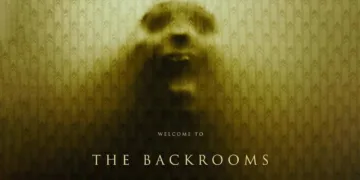















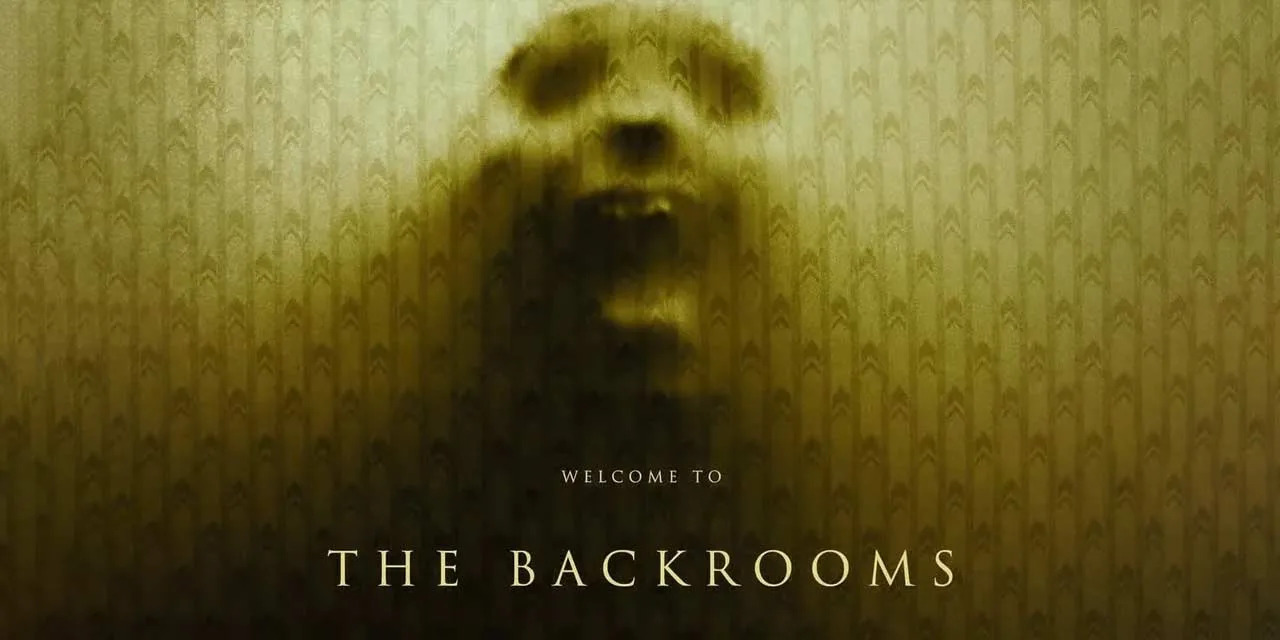

In May 2019, an anonymous photograph appeared on 4chan: a vacated furniture store in Oshkosh, Wisconsin, walls the color of old mustard, beige carpet absorbing whatever the fluorescent panels above could offer, silence you could almost hear through a screen. The image spread because it touched something specific and difficult to name, a familiar space stripped of its human purpose, recognizable and wrong at once. Internet users built on it, post by post, threading a mythology about “noclipping” beyond reality’s boundaries into a network of endless, empty rooms. Kane Parsons, who taught himself 3D modeling software at 16, turned that mythology into a 22-episode YouTube series earning tens of millions of views and codifying Backrooms lore into something approaching a shared cultural language.
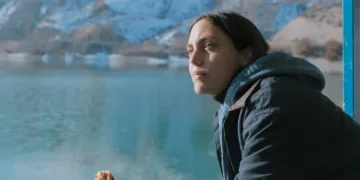
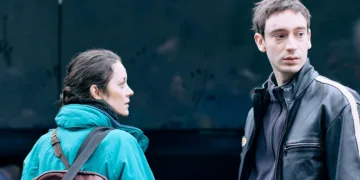
Now 20, and the youngest director commissioned by A24, Parsons has translated that work into a feature film. Scripted by Will Soodik and starring Chiwetel Ejiofor and Renate Reinsve, Backrooms is set in the early 1990s, a deliberate stripping-away of digital mediation. It arrives less as a horror film in any conventional sense than as a surrealist mood piece built from Gen Z unease: a half-nostalgic grief for an analogue era, the spatial dread of abandoned malls and empty showrooms, and the collective nightmare of spaces that feel designed for no one.
The Empire of Failure
Clark (Chiwetel Ejiofor) runs Cap’n Clark’s Ottoman Empire, a vast, eerily banal discount furniture showroom in California’s Santa Clara Valley. He films amateurish TV commercials dressed as a pirate, which is already a joke with a flaw built in: the Ottoman Empire requires a sultan, and Clark is dressed as a pirate. It is a small, quietly devastating detail — the way a man’s self-image can curdle so completely that the punchline no longer lands and he no longer notices. Clark is a divorced failed architect sleeping on a mattress for sale, his life arranged around him like a showroom tableau of what went wrong.
His therapist is Dr. Mary Kline (Renate Reinsve), author of the self-help audio series Guided Openings, a woman who preaches that people are trapped in behavioral loops and must open “windows” to escape. Her theory has literal roots: as flashbacks reveal, her childhood was spent with an unstable mother who sealed the windows and kept her indoors, and Mary now watches that same house demolished to make way for an apartment block. Their therapy sessions are lengthy, probing role-plays that strip Clark down to his component resentments — money, drinking, a career he abandoned or was abandoned by — and Ejiofor conveys the rage and insecurity beneath the bluster without softening either quality.
The portal arrives in the basement. New breakers have appeared on the circuit board; power outages have no explanation; Clark flips the switches and passes through a porous section of wall. What lies beyond is an endless network: bile-yellow walls, beige carpeting, rectangular fluorescent ceiling panels, furniture stacked and half-sunken into floors or jutting from ceilings. Stop signs are reversed. A door has three doorknobs. A power cord runs to nothing. Before long, Clark recruits assistant manager Kat (Lukita Maxwell) and her boyfriend Bobby (Finn Bennett) to document the space with a camcorder and a length of rope — and the sequence that follows is among the film’s most frightening.
Soodik’s script anchors the horror in psychological realism: the Backrooms appear to be a warped materialisation of the subconscious traumas and emotional loops of whoever enters them. Mary’s self-help vocabulary becomes the film’s literal architecture. It is a clean and effective idea, and the discipline of never naming the Backrooms onscreen preserves their sense of undefined menace. The script’s weaknesses are proportional to its ambition: the psychoanalytic scaffolding grows laboured in places, flashbacks to Mary’s adolescence over-literalise what is most frightening when left abstract, and dialogue occasionally sounds intelligent while landing opaque. Soodik is reaching for the language of the subconscious and sometimes settles for the language of the therapy room.
The Architecture of Dread
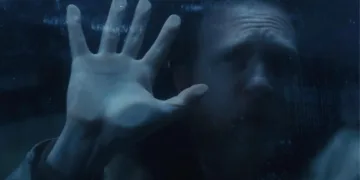
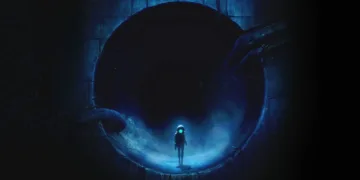
Parsons opens in June 1990 with a hazmat-suited researcher moving through the Backrooms on a handheld camera, breathing heavily, searching for lost colleagues. The sequence ends abruptly on a collision with something unseen. No context is offered, no explanation follows; Parsons establishes the tone and the found-footage lineage of the project in a single unbroken gesture and moves on. It is a confident opening for a first feature from anyone, let alone a director two decades old.
Cinematographer Jeremy Cox frames even the therapy scenes with slight wide angles and excessive headroom, keeping the viewer subtly off-balance in every environment. Parsons also places characters at unusual distances from one another in every real-world scene, so that the world outside the Backrooms already feels liminal — isolated, antiseptic, not quite right. Follow shots accentuate the Backrooms’ vast emptiness; the first-person perspective during Clark and Mary’s solo traversals proves the film’s most discomfiting mode. The question of where they are and what they are looking at generates more fear than any creature reveal.
Production designer Danny Vermette works across physical construction and digital fabrication to build rooms that could resemble one another or be completely alien, sometimes both at once. Items are half-buried in walls; furniture assembles itself into something like a mocking shrine to Clark’s accumulated failures; gravitational logic is quietly discarded. The bile-yellow palette is consistent and suffocating, the fluorescent lighting rendered as something that leaks from every surface rather than illuminates. As the film progresses, the Backrooms expand in scale — by the time Mary enters, the network has grown to the dimensions of a small city.
The sound design, co-created by Parsons and Canadian composer Edo Van Breemen, is among the film’s most significant achievements. Buzzing overhead lights, heavy footsteps, panicked breathing, and low-frequency hums seep into the subconscious in a manner closer to early David Lynch than to anything in contemporary genre filmmaking. Jump scares are few and far between; the harder road of sustained spatial anxiety is the one Parsons chooses, and it largely holds.
Creatures do appear, a towering demon version of Cap’n Clark, figures with multiple faces compressed into themselves, half-glimpsed forms that moan and recede, but they are deployed sparingly, and when they arrive, they carry weight. The final act escalates toward more conventional horror mechanics, including chase sequences and jolts, but the transition feels earned rather than panicked.
Two People in a Maze
Ejiofor carries the film’s emotional and narrative weight with the kind of economy that makes it easy to underestimate how much work he is doing. Clark is not sympathetic in any straightforward way, he is petty, alcoholic, self-pitying, and occasionally cruel, but Ejiofor makes his entrapment feel less like punishment than revelation. The character arc bends from morose melancholic to increasingly manic self-appointed cartographer of the impossible, and both ends are entirely credible. His expressive face conveys fear and gradual disconnection with precision, without overdoing a single moment.
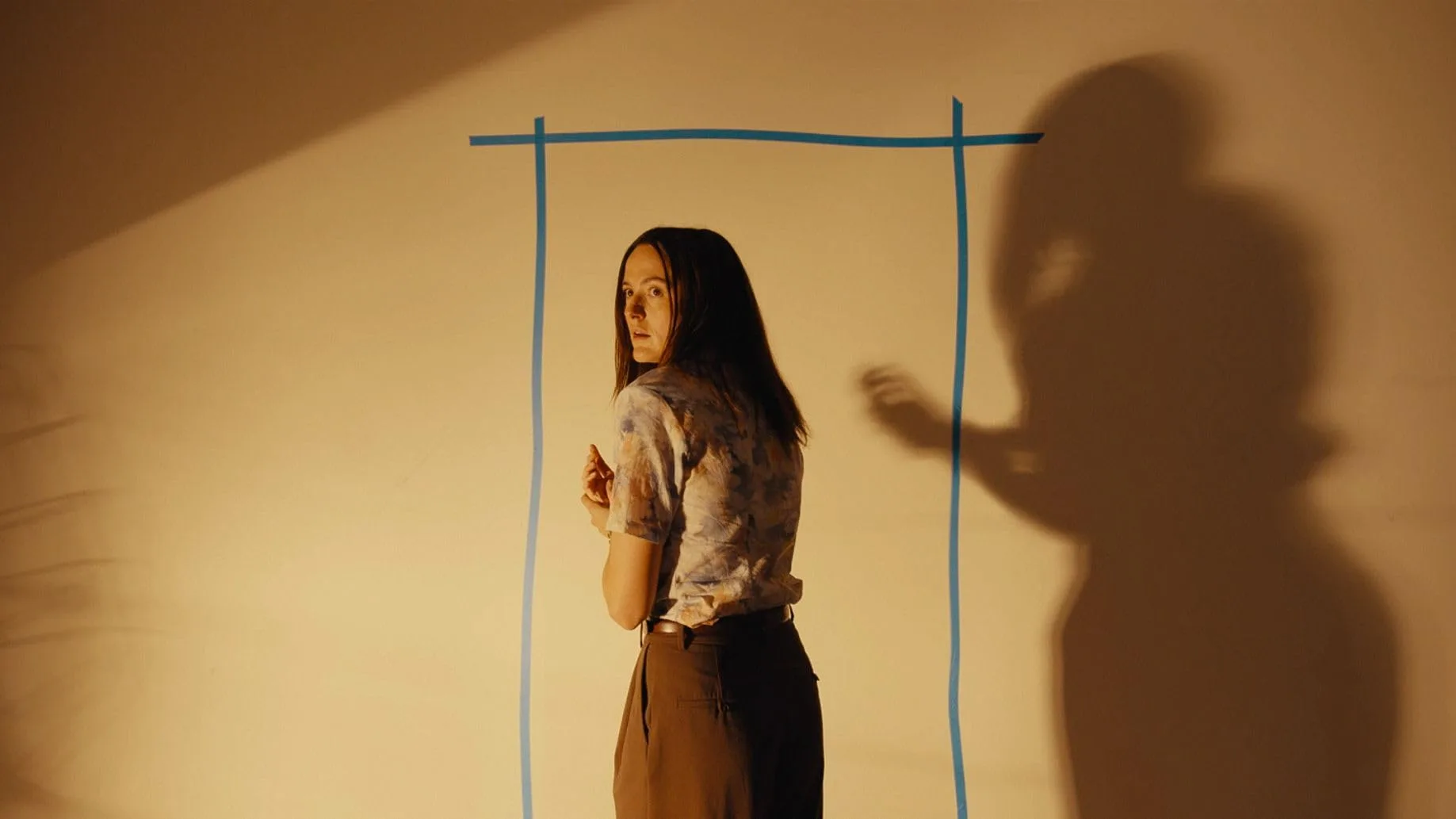
Reinsve brings the composed, tensile quality that has distinguished her work elsewhere, and her stillness against Ejiofor’s barely contained volatility creates a productive friction in their scenes together. The casting choice is shrewd: neither actor is associated with genre filmmaking, and that unfamiliarity keeps the horror from feeling performed.
Reinsve’s final-act entry into the Backrooms reframes Mary entirely — she arrives as a rescuer but is just as clearly pursuing her own psychological confrontation with what the space represents. Her climactic encounter with Clark, in which her trauma and his collide in the film’s most Lynchian sequence, is where the script’s ambitions finally align fully with its execution.
Lukita Maxwell and Finn Bennett, as Kat and Bobby, are largely confined to horror archetypes, the cautious one and the reckless one, but they perform their function in the rope sequence with conviction, and the sequence asks a great deal of them. Mark Duplass appears in scattered glimpses as a figure associated with A-Sync, a corporation conducting research on the Backrooms. His presence is never explained, adding to the film’s architecture of deliberate incompletion, the sense that the lore extends beyond what any single narrative can contain.
A Shared Nightmare, Given One Voice
The Backrooms, as the film frames them, are a materialisation of psychological imprisonment, spaces built from the memories and emotional loops of their entrants, a literal rendering of the inability to outrun one’s own past. The 1990s setting strips away digital mediation: the horror exists in analogue, in VHS grain and fluorescent buzz, in a period before the internet could name or categorise it. And the spaces the film inhabits before the portal even opens — the furniture showroom, the strip-lit therapy office, the demolished family home — are already liminal, already emptied of genuine human warmth.
Parsons has said he is no cinephile, and the Lynchian qualities of the film feel accordingly generational rather than studied, absorbed through video games like Control, Silent Hill, and Alan Wake, through Severance, through decades of internet image culture passed through countless hands before reaching his. The found-footage lineage is present but repurposed: this is not a film about the horror of being recorded, but about spaces that exist beyond the reach of documentation entirely.
The Backrooms lore grew through collective online authorship, and Parsons’ film carries that communal, accreted quality. It feels like a shared nightmare given a single authorial voice for the first time, which is, at once, its power and its limitation. Translating collective mythology into individual cinema requires decisions that mythology never has to make, and some of those decisions, particularly in the script, show the strain. What is harder to dispute is that Parsons has done something no filmmaker before him has managed: built a feature-length cinematic argument from the language of internet image culture. How far that argument can travel is the question the film leaves open.
The surreal sci-fi horror film Backrooms, directed by internet phenomenon Kane Parsons in his feature directorial debut, is scheduled for theatrical release in the United States on May 29, 2026. Distributed by A24, the highly anticipated film expands on Parsons’ viral YouTube “found footage” web series and the wider internet creepypasta lore, exploring the eerie, unsettling concept of slipping out of reality into endless liminal spaces. Audiences can experience the tension-fueled nightmare exclusively in theaters upon its wide release.
Where to Watch Backrooms (2026) Online







Full Credits
Title: Backrooms
Distributor: A24
Release date: May 29, 2026
Rating: R
Running time: 110 minutes
Director: Kane Parsons
Writers: Will Soodik
Producers and Executive Producers: James Wan, Michael Clear, Roberto Patino, Shawn Levy, Dan Cohen, Dan Levine, Osgood Perkins, Chris Ferguson, Peter Chernin, Jenno Topping, Kori Adelson, Alayna Glasthal, Jesse Savath, Judson Scott, Chris White
Cast: Chiwetel Ejiofor, Renate Reinsve, Mark Duplass, Finn Bennett, Lukita Maxwell, Avan Jogia, Robert Bobroczkyi, Krista Kosonen
Director of Photography (Cinematographer): Jeremy Cox
Editors: Greg Ng
Composer: Edo Van Breemen, Kane Parsons
The Review
Backrooms
Backrooms is a genuinely singular horror debut — a film that reads the internet's collective subconscious and projects it onto a cinema screen with atmospheric precision. Parsons is a visual and sonic talent of real consequence, and Ejiofor and Reinsve anchor the surrealism with performances of unusual psychological weight. The script strains under its own psychoanalytic ambitions, and the laboured flashbacks blunt what abstraction sharpens. Those willing to surrender to its logic will find something rare: a horror film that disturbs through architecture and sound rather than shock.
PROS
- Masterful sound design and atmosphere
- Ejiofor and Reinsve deliver grounded, psychologically rich performances
- Vermette's production design is visually inventive and suffocating
- Disciplined restraint with jump scares
- Genuinely original cinematic vision rooted in internet culture
CONS
- Script over-explains its psychological framework
- Flashback sequences undermine the film's most effective ambiguity
- Supporting characters confined to thin archetypes
- Dialogue occasionally collapses into opacity