





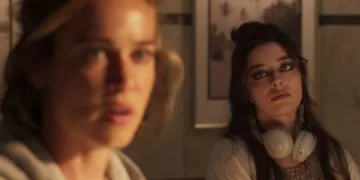








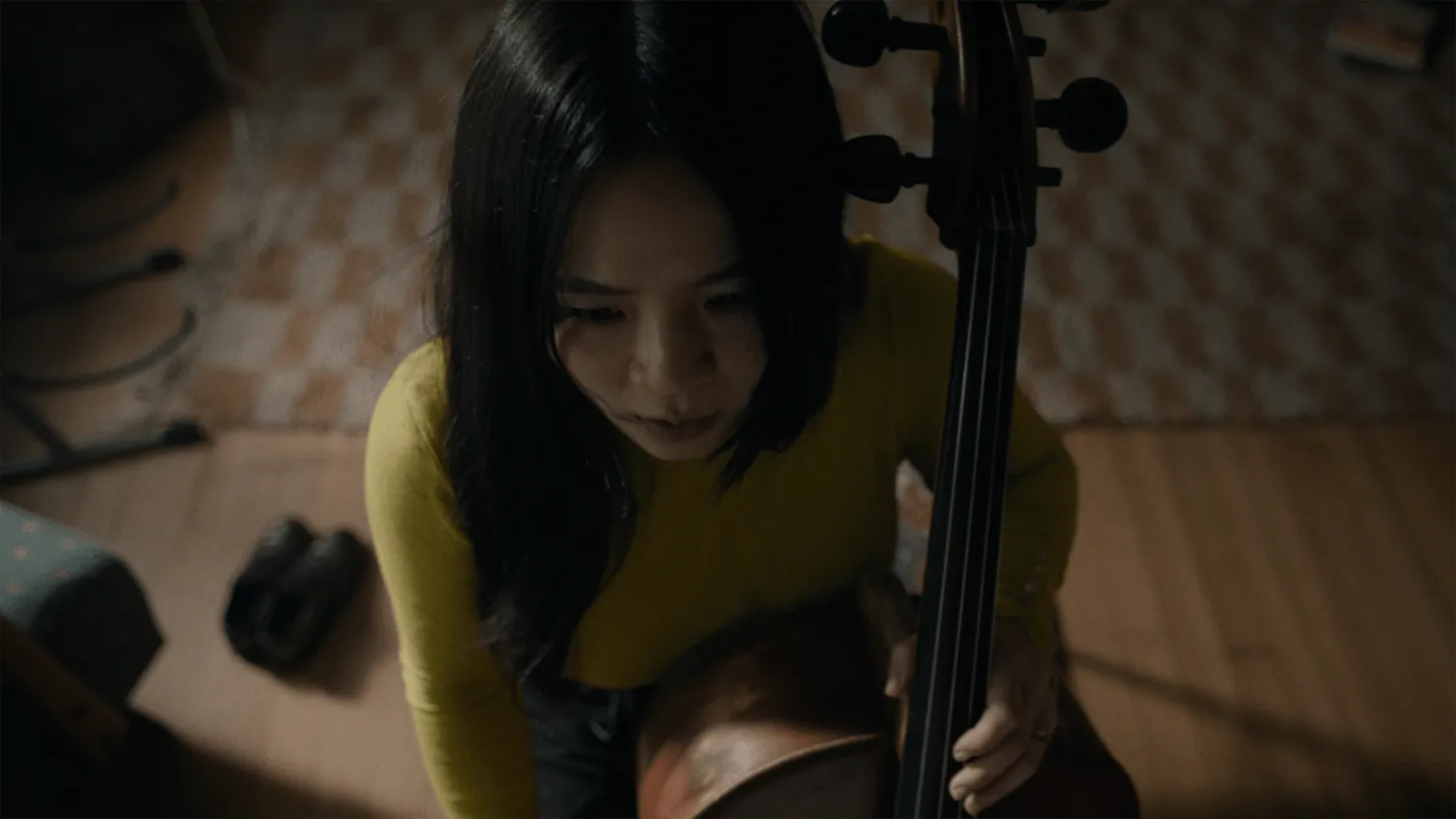

Vera Miao’s debut feature brings in a kind of quiet that hums, embodied by Emily, a widowed cellist played by Kelly Marie Tran. She goes looking for shelter from the noise of fresh loss and ends up in a remote cottage set deep in the Wyoming wilderness. The building reads like a living thing: floorboards that complain underfoot, shadows that settle heavily, a bordering forest that seems to breathe out an ancient, watchful pressure.
Emily arrives with her daughter, Gracie, whose grief has hardened into a dense silence, and her mother-in-law, Nai Nai. Their timing aligns with the Month of Hungry Ghosts, a lunar season that imagines the membrane between realms thinning while the gates of hell hang open. Nai Nai carries ancestral caution into every room, attentive to the possibility of restless souls.
Emily holds to a modern skepticism, a posture that offers her little cover once the unease begins to accumulate. The dread gains a tangible form when Gracie pulls a weathered, raven-haired doll from the dirt. The object feels like a container for something older, something hungrier than memory alone. The household becomes a study in splintered identity, each woman locked inside her own solitary register of mourning.
Fractured Mirrors and Ancestral Gaps
The film’s narrative geometry moves through deliberate shifts in perspective, echoing the way trauma breaks perception into uneven shards. We first inhabit the world through Gracie as she drifts through the woods without speech. Her wandering functions like a tuning fork held up to the unseen, registering rustles from the beyond that adults have trained themselves to miss. When the viewpoint turns to Emily, the domestic soundscape of grief starts to feel unreliable.
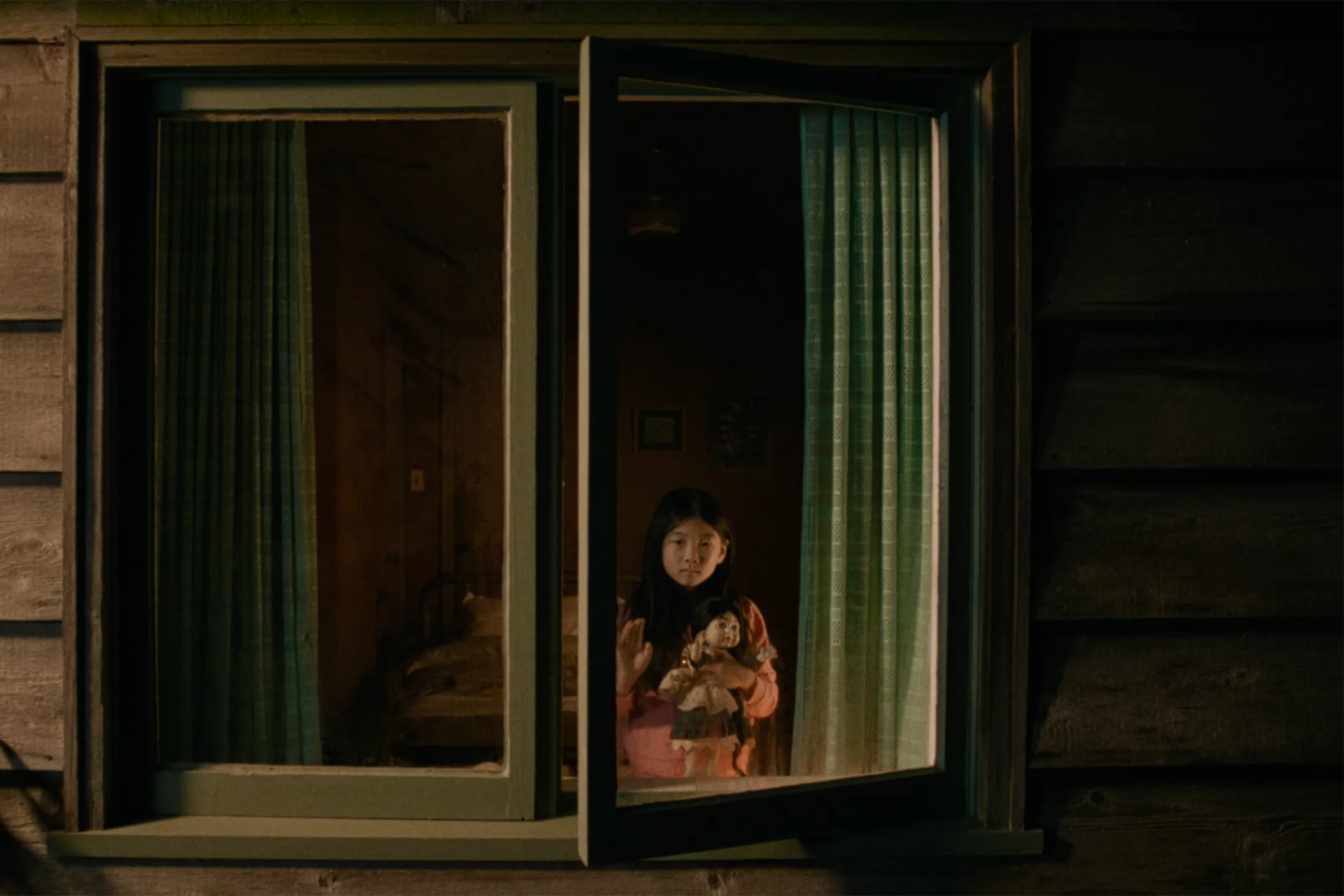
A scene of Emily sobbing behind a door returns later from another angle, and the muffled rhythm changes its meaning. Those contained gasps reveal themselves as frantic efforts to hold back screams of real terror. The repetition is more than a structural flourish. It presses on a philosophical question about empathy as interpretation: how easily we name a sound “sorrow,” how quickly we decide we understand, how often that certainty covers a deeper dread that has no easy language.
Cultural friction thickens the air inside this isolation. Emily is a Vietnamese woman adopted by a white family, and that history leaves her cut off from the Chinese traditions Nai Nai practices, both in language and in spiritual fluency. She cannot take part in rituals meant to calm the spirits because the vocabulary of the ancestors is not hers to speak. The gap becomes its own haunting, born from cultural erasure and the strain of keeping a family intact while belief pulls them in different directions.
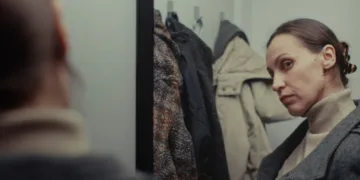
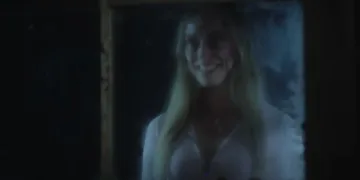
More familiar horror imagery enters through the deceased husband, a presence that lurks in the cottage’s shadows. These scares arrive framed by dizzying overhead shots that imply a predatory, celestial gaze. The camera peers down on the women with the chill remove of a scientist studying specimens in a sealed container, and that distance sharpens their vulnerability. The cinematography catches the house seeming to tighten around them, converting refuge into a mirrored maze where each reflection insists on absence, on what grief keeps replaying.
The Geography of Slaughter
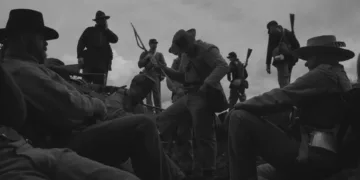
The film takes a jarring, necessary turn into 1885, shifting to a mining camp on the same ground where the cottage now stands. Ah Tseng appears, a miner played by Benedict Wong with bruised, tectonic force. This section reconstructs the Rock Springs Massacre, where at least 28 Chinese immigrant miners were slaughtered by their white counterparts.
The imagery refuses comfort: homes collapsing into ash, bodies broken into the mud, the kind of reality that can seed hauntings without any help from the supernatural. The violence lands with a heart-in-mouth immediacy that strips away genre distance. It suggests a bleak metaphysics of history, where ghosts signify the residue of unresolved injustice, not a decorative fright.
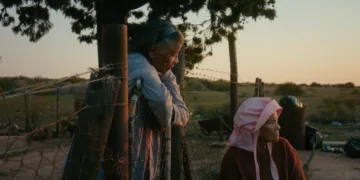
Ah Tseng tries to protect his nephews within a country that treats their labor as a commodity and their lives as an inconvenience. His exhaustion stands as evidence of diasporic survival under hostility, the slow grind of endurance in a place that keeps demanding more while offering less. Wyoming soil is filmed as if saturated with historical cruelty, the landscape becoming a record that remembers what people try to forget. These scenes feel most terrifying because they need no special effects.
The horror is daylight-clear: human beings animated by bigotry and greed, choosing violence as a form of power. When the film returns to the present, the cut carries the sense of trauma filtering through generations, showing up as microaggressions and a pervasive displacement that never fully loosens its grip. The past refuses burial; it persists as a restless presence that demands acknowledgement.
By placing the massacre at the film’s core event, Miao turns the haunted-house frame into a meditation on the costs of American progress and the lives thrown aside in its wake. There is a grim existential weight here, a question that stays unresolved: what does it mean to live on land that remembers, when the living keep trying to move forward without looking down?
A Communion of Ash and Strings
Heyjin Jun’s cinematography binds the two eras with a visual logic that insists on grief as something physical. The massacre unfolds through frantic handheld movement that generates kinetic panic, mirroring the confusion and terror of the victims. The contemporary scenes arrive in muted, overcast light that feels like a slow submersion into grey.
The eventual appearance of the “hungry ghost” unsettles familiar creature expectations. The entity presents as a fleshy, bulbous mass of collective suffering. It reads as an image for anonymity, for those lost to history without names preserved, compressed into a single body still seeking voice after a century of silence. The grotesque form carries a strange poignancy: the victims merged by shared tragedy, a communal wound given shape.
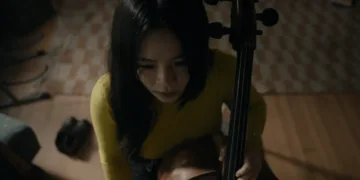
Kelly Marie Tran shines in a sequence where Emily plays her cello alone inside the house. Her bow works in a desperate, frantic rhythm while she senses spectral weight watching from the room’s corner. The moment externalizes anxiety, connecting art to survival through breath, muscle, and sound.
The film’s final movement points toward peace through witnessing and active remembrance. Healing requires Emily to face the specific contours of the past, to treat the history of the land as lived reality rather than folklore to dismiss. The climax becomes an act of cinematic remembrance that pushes her into that history to keep her daughter from being consumed by it. The film argues for an ethics of inheritance: carrying the weight of ancestors so the next generation does not fall into the void of erasure.
The closing beats refuse an easy banishment. They settle into a sober acknowledgement of spirits that remain, and the work stays fractured in a way that feels honest. It lingers after the final frame, asking what kind of life can be built on suppressed violence, and how much witnessing is enough when the ground itself seems to remember.
Rock Springs had its world premiere at the 2026 Sundance Film Festival on January 25, 2026, where it screened in the prestigious Midnight section. As of today, February 1, 2026, the film is currently concluding its digital run at the festival, with online screenings available to the public through the Sundance Film Festival Player app and website. While a wider theatrical or streaming release date through a major distributor has yet to be finalized, the film’s buzz at Sundance suggests it will likely find a home on a prominent platform later this year.
Full Credits
Title: Rock Springs
Distributor: Macro Film Studios, Juniper Productions, Mandalay Pictures, Counterculture, Gold House
Release date: January 25, 2026
Running time: 96 minutes
Director: Vera Miao
Writers: Vera Miao
Producers and Executive Producers: Stephen Feder, Kiri Hart, Charles D. King, Poppy Hanks, Greta Talia Fuentes, Jason Michael Berman, Matthew Lindner, Jordan Moldo, Vera Miao, James Lopez, Mike Downing, Christine Yi, Brian Nemes, Shawn Angelski, Caroline Connor, Kelly Marie Tran, Benedict Wong
Cast: Kelly Marie Tran, Benedict Wong, Jimmy O. Yang, Aria Kim, Fiona Fu, Ricky He, Cardi Wong, Tanja Dixon-Warren
Director of Photography (Cinematographer): Heyjin Jun
Editors: David Marks
Composer: Robert Aiki Aubrey Lowe
The Review
Rock Springs
Despite a narrative structure that occasionally feels fractured, the film possesses a rare, haunting gravity. It rejects the ease of jump scares in favor of an existential reckoning with historical erasure and the physicality of mourning. The shift to 1885 provides the piece with a visceral, necessary soul that elevates it above typical genre offerings. It is a somber, poetic debut that finds beauty in the act of remembering. While the creature design and pacing may falter, the emotional resonance of the performances ensures that the ghosts of Rock Springs remain unshakable.
PROS
- Benedict Wong's harrowing and grounded performance
- Visceral and unflinching historical recreations
- Thoughtful exploration of diasporic identity
- Striking, atmospheric cinematography
CONS
- Uneven narrative pacing in the first act
- Creature design feels slightly underdeveloped
- Heavy reliance on established horror tropes
- Disjointed transition between time periods