





























Every citizen in D-topia receives housing, meals, employment, and a schedule engineered to keep them content. The settlement’s governing AI can predict nutritional needs, regulate the weather, and assign meaningful labour long after automation has made human workers economically unnecessary. It still cannot work out what to do with an abandoned cat.
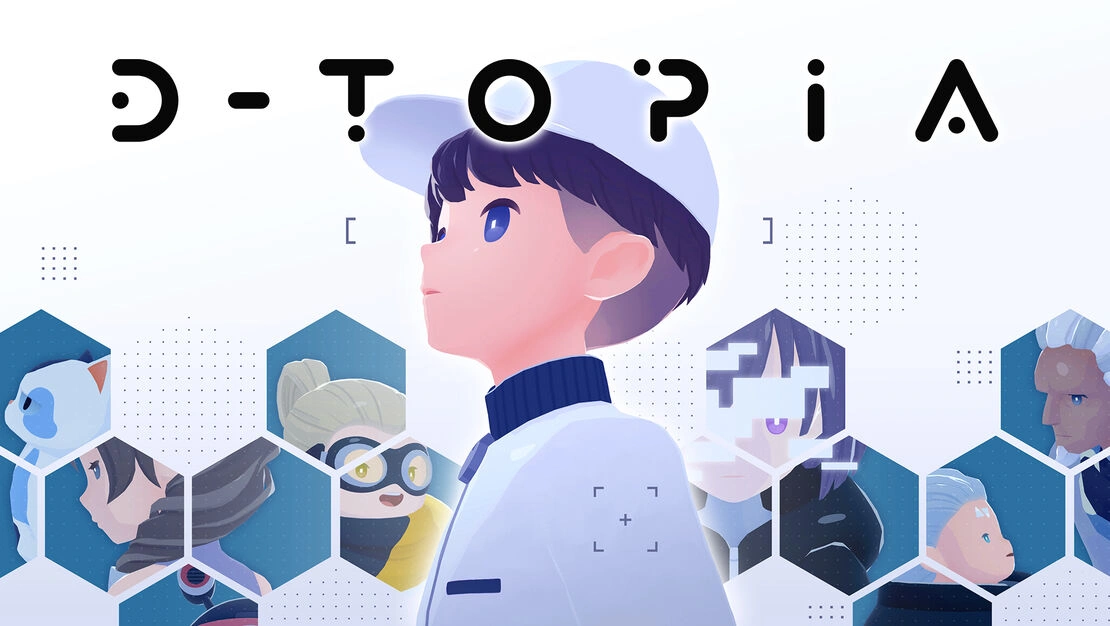
That contradiction drives Marumittu Games’ narrative puzzler. Shiro, otherwise known as Resident #046, arrives as a Facilitator tasked with repairing machinery and settling disputes between residents. His position gives the player access to both sides of the city: the spotless public simulation and the Block Side, where exposed machinery reveals what supports the illusion.
The premise initially suggests a dense examination of algorithmic government. D-topia raises questions about emotional regulators, synthetic people, genetic selection, social rankings, and the quiet removal of residents who fail to fit the model. Its systems are much better at presenting these subjects than testing them. The AI proposes an efficient answer, a resident asks for compassion, and Shiro chooses which value receives priority. Efficiency rarely makes a persuasive case.
Work as Tutorial
Each of the game’s seven days follows a rigid sequence. Shiro completes a health check, eats breakfast, reports to the Factory, solves a set of puzzles, and spends the afternoon responding to emergencies. The repetition is deliberate. D-topia believes routine creates psychological stability, so the player experiences that theory through the structure of every day.
The Factory puzzles work as mechanical training. Early tasks involve pushing numbered blocks onto matching spaces. Later variations introduce multipliers, warp tiles, path drawing, mirrored movement, and grids where each step changes a block’s value. An afternoon repair then applies the same rule to a malfunctioning display, weather system, or robotic assistant.
This creates a clean relationship between Shiro’s job and the player’s learning curve. The morning teaches a rule in isolation. The afternoon gives that rule a narrative purpose. Few puzzle games explain their mechanics this neatly.
The problem is resistance. Required puzzles usually reveal their solution within seconds, and the work timer is so generous that earning the highest wage requires little urgency. Optional overtime offers harder layouts, yet these rarely demand prolonged experimentation. Players can skip any troublesome task, which suits the relaxed tone but further reduces pressure.
Some puzzles also reject valid alternate solutions because the game expects one programmed sequence. A system built around logical deduction should reward logical deduction. When a correct path fails because it is not the intended path, the puzzle stops measuring understanding and starts checking paperwork.
Money earned at work buys snacks, gifts, and apartment decorations. These rewards add texture, though the furnishings remain cosmetic. Even the record player refuses to play records. D-topia provides a home, then treats living in it as optional.
Compassion by Flowchart
Major decisions occur through Brain Meetings, where the player guides Shiro across an IF/THEN diagram. The presentation fits the setting perfectly. Personal crises are converted into branching logic, as though empathy could be found by following enough arrows.

The abandoned cat establishes the pattern. Since no registered caretaker exists, the AI recommends euthanasia. Adoption is the obvious humane answer, and choosing it teaches the player how most conflicts operate. Rules preserve order until an individual circumstance exposes their limits.
Later disputes concern exile, clones, modified animals, and residents classified as incompatible with D-topia. These situations sound morally difficult, yet the compassionate route is usually signposted so clearly that the choice becomes procedural. Supporting a frightened person tends to produce the best result. Following the AI tends to cause harm. The interface branches, but the ethics travel in a straight line.
Some decisions alter later scenes and contribute to multiple endings. Others produce nearly identical outcomes, revealing an occasional illusion of consequence. The best ending is also easy to reach through ordinary sympathetic behaviour. That makes the game welcoming, though it weakens the promise that Shiro is shaping a fragile society.
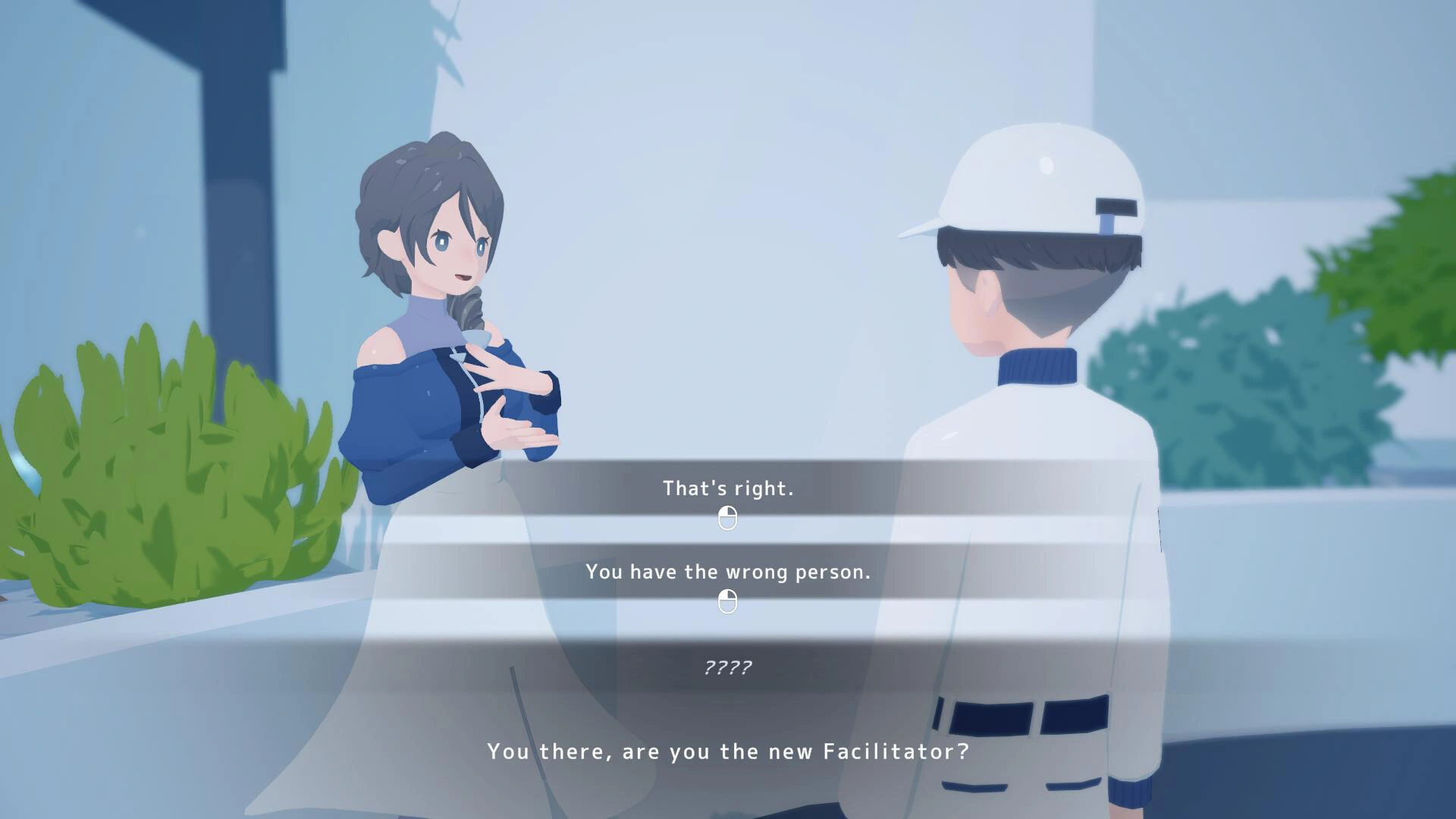
The strongest consequences appear in the smaller character stories. Ten residents can be befriended through dialogue choices and gifts, including an intellectual child, a woman who hides behind a virtual mask, and another Facilitator who relates to robots with greater ease than people. Their problems give the city the individuality its architecture suppresses.
Seven days leave little time for those relationships to breathe. Several arcs move from introduction to emotional disclosure with startling speed, as if friendship itself had been optimized.
Behind the Projection
D-topia’s visual design makes the city’s philosophy immediately legible. Apartments, gardens, shops, and workplaces share soft colours, clean surfaces, and rounded character designs. Every space looks pleasant. Few spaces look personal.
The Block Side provides the necessary disruption. Activating a terminal strips away the projected comfort, replacing bright public rooms with industrial frameworks, darker lighting, and exposed mechanisms. Music recedes, machinery takes over, and the same location suddenly feels indifferent to the people living above it. The contrast communicates the game’s argument better than many of its dialogue choices.
The restrained electronic score shifts effectively between workplace calm, emergency tension, and melancholy during late decisions. The absence of voice acting strengthens the clinical mood, though repeated environments and limited interactions make the city feel smaller with each day. Frequent trips to terminals also create unnecessary backtracking whenever a repair lies across the room from the entrance point.
D-topia builds a coherent loop from work puzzles, social visits, hidden infrastructure, and moral decisions. Its mechanics support its fiction with unusual discipline. Yet the game trusts the player with systems it rarely allows them to struggle against. Its city promises optimized happiness, and its design makes kindness nearly automatic. That may produce a comfortable week. It does not produce a difficult choice.
The Review
D-topia
D-topia turns civic maintenance into a readable loop of number puzzles, social check-ins, and branching Brain Meetings. Its strongest design choice is how Factory tasks prepare players for afternoon repairs, giving the daily routine a mechanical purpose. The choice system is less convincing: compassionate responses are telegraphed, several branches barely diverge, and the easiest ending rewards basic decency rather than difficult judgment. Its clean interface, Block Side contrast, and personable cast keep the week engaging, but the systems rarely test the ideas they introduce.
PROS
- Clear, approachable puzzle rules
- Factory mechanics support story tasks
- Strong Block Side visual contrast
- Likeable supporting characters
- Relaxed daily structure
CONS
- Moral choices feel obvious
- Limited puzzle difficulty
- Several branches change little
- Repetitive navigation and backtracking
- Character arcs develop too quickly