

























![Kingdom Hearts Collection [I-III] Review](https://gazettely.com/wp-content/uploads/2026/10/Kingdom-Hearts-Collection-I-III-1-360x180.webp "Kingdom Hearts Collection [I-III] Review: KHII Holds Steady as Newer Entries Fluctuate 37")



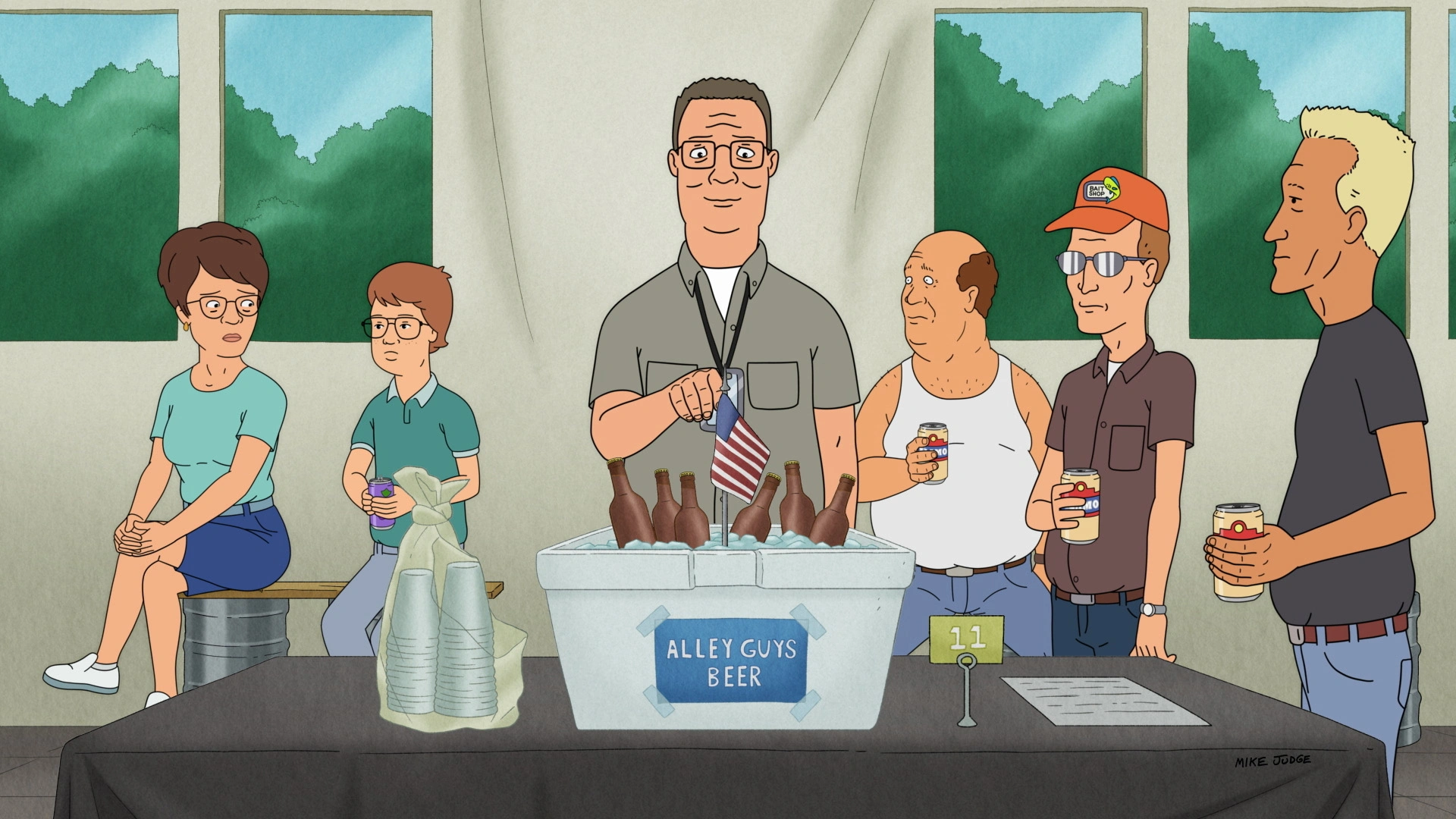

Hank Hill can recognize a safe-space joke now, yet an electric truck parked near his lawn still registers as a civic emergency. That tension gives King of the Hill Season 15 its comic engine. Hank has absorbed enough of the present to function inside it, while every new app, phrase, vehicle, and social custom still has to pass through the narrow gate of his common sense.
The Hulu revival spent its previous season explaining what had changed during the Hills’ long absence. Hank and Peggy had returned from Saudi Arabia, Bobby had become the 21-year-old owner of Robata Chane, and Arlen had accumulated the small social revisions that sixteen years can produce. Season 15 no longer has to conduct that tour. It can let the characters live inside the altered world.
That change gives the season a looser, sturdier episodic shape. Bobby and Connie are now together. Kahn and Minh have separated publicly, leaving Kahn in Bill’s home. Hank and Peggy are retired, or close enough to retirement that every crisis carries a faint question about aging. These developments remain present across the ten episodes, though the season mostly returns to the old rhythm of one neighborhood problem at a time.
The approach suits a series that has always treated political change as something people encounter through parking spaces, church groups, workplaces, marriages, and misunderstandings. Television regularly insists that relevance requires speeches. King of the Hill still prefers an irritated man staring at a truck.
Modern Problems, Arlen Solutions
The electric-truck episode captures the method cleanly. Hank, Dale, Bill, and Boomhauer become consumed by the vehicle because none of them can determine who owns it or why it has appeared near Hank’s property. The truck itself matters less than the panic it inspires. To Hank, it signals an invisible change in etiquette, masculinity, and neighborhood order. To Dale, it is evidence. Everything is evidence to Dale.
A separate episode sends the same group toward an antique cannon, a premise stripped down to four middle-aged men discovering an object they should absolutely leave alone. Dale and Bill bring the reckless curiosity of much younger Mike Judge characters, except age has supplied them with sore backs and insurance concerns. The comedy comes from the gap between how responsible these men believe they are and how quickly they can be reduced to boys near machinery.
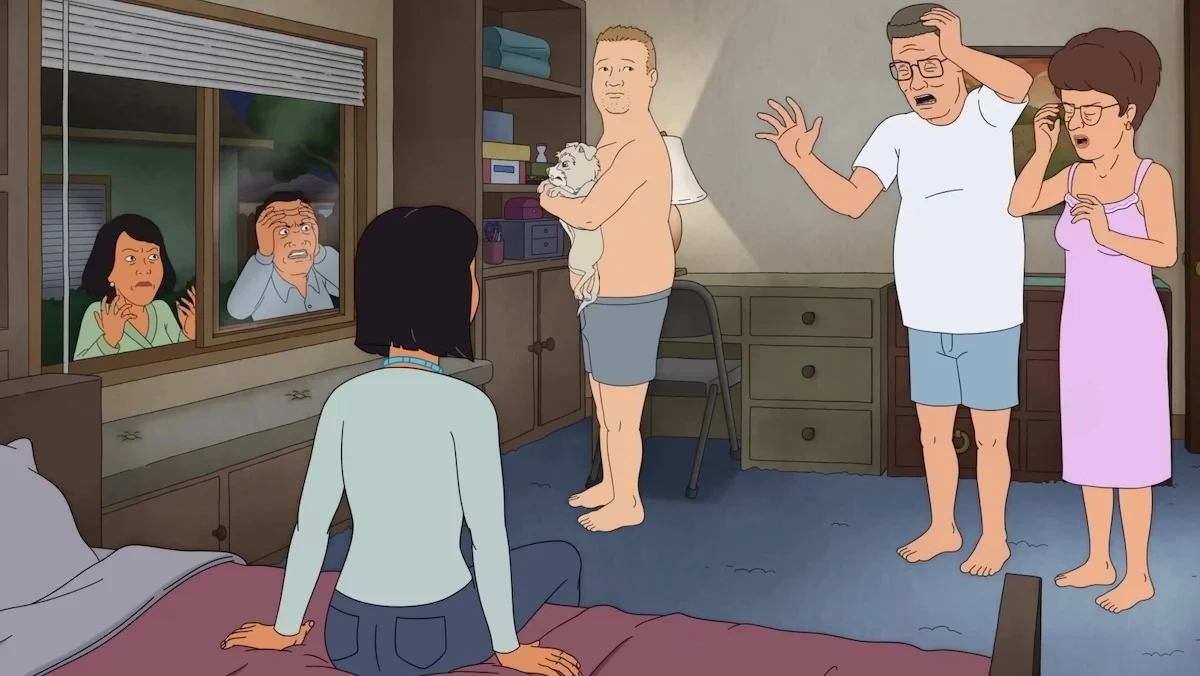
Season 15 works best when new anxieties enter through such ordinary doors. Hank and Peggy fall victim to a phone scam that uses artificial intelligence to imitate Bobby’s voice. Hank responds because the caller sounds frightened, and his instinct to protect his son overwhelms his suspicion. Dale’s paranoia then spreads through the house until every voice and phone call seems compromised.
The episode could have treated older people as easy targets for a technology joke. Instead, it locates the cruelty in a system designed to exploit intimacy. Hank is vulnerable because he loves Bobby. The scam succeeds by reproducing a relationship, which is a sharper observation than another gag about retirees failing to understand their phones.
Bobby’s attempt to join a reality cooking competition extends the season’s attention to media as an extractor of personality. His ambition begins with a practical goal: Robata Chane needs attention. The program wants a marketable version of him, complete with conflict, romance, and a restaurant identity strange enough to package. Bobby has spent his life refusing the version of masculinity that Arlen expected from him. Reality television offers a different kind of box, one decorated with better lighting.
The recurring plot gives the season a light connective thread, though Bobby’s early scenes sometimes flatten younger adulthood into topical references. His stories gain force whenever Connie, Chane, Hank, or Peggy enters the frame. The show understands Bobby as a son, partner, chef, and friend far better than it understands him as a representative of his generation.
Aging Without Humiliation
Peggy’s menopause episode contains the season’s finest writing because it refuses the easy target. Her sleeplessness, discomfort, and fear are funny in places, yet the jokes never reduce her body to punishment. Peggy has spent decades constructing her identity from certainty. Menopause confronts her with changes she cannot outtalk, outteach, or convert into a personal achievement.
Hank’s response recalls the series’ earlier stories about women’s health, especially his discomfort when caring for Connie during her first period. He panics at the subject, searches for the proper language, and tries to avoid saying anything that might make the situation worse. Then he stays.
That last part matters. Adult animation has built a profitable tradition around men whose emotional illiteracy becomes permission for cruelty. Hank’s limitations work differently. His embarrassment remains visible, yet the episode measures him by what he does after the embarrassment. He listens to Peggy, takes her distress seriously, and looks for a way to help without pretending he fully understands it.
The writing also allows Peggy to sound furious, frightened, and vain without turning those qualities into moral failures. She is losing sleep and control at once. Her line about life getting worse while she remains awake for longer lands because it compresses physical misery into the kind of theatrical complaint Peggy would consider perfectly reasonable.
“Care of the Dog” approaches aging from another angle. Peggy persuades Hank to foster Caesar Salad, a difficult dog whose needs disrupt the house. Hank resists the arrangement with the firmness of a man who already knows he is going to care too much. The episode uses damaged furniture, exhaustion, and canine chaos for familiar pet-owner comedy, then lets Hank’s attachment emerge through behavior rather than declaration.
The emotional finish works because the episode has spent its running time watching care become routine. Feeding, walking, cleaning, and waiting build a bond before Hank admits one exists. The series has always understood affection as labor. Season 15 returns to that idea each time an older character needs help and feels ashamed of needing it.
Bill’s turn toward paid cuddle therapy is a less successful use of the same theme. Hank, Dale, and Boomhauer treat the service as a threat and attempt to rescue him. There are good reactions throughout, especially Hank’s inability to process physical comfort outside a narrow set of approved relationships. Still, Bill’s loneliness has supplied the show with so many plots that this episode can feel like another variation on an old wound.
Love, Rivalry, and Coexistence
Bobby and Connie’s adult relationship gives his Dallas material the anchor it lacked last season. Their affection is established, which lets the conflict shift toward the people around them. Chane is Connie’s former boyfriend and Bobby’s business partner, placing jealousy inside the daily operation of Robata Chane. Bobby cannot defeat him, dismiss him, or leave him behind without damaging the restaurant.
Their eventual accommodation fits the season’s recurring argument that coexistence is a skill rather than a feeling. Bobby does not have to like every part of the arrangement. He has to behave well enough for work, romance, and friendship to survive the same room.
Peggy tests that survival when her interference contributes to a damaging review of Bobby’s restaurant. Her actions emerge from the familiar mixture of pride and maternal concern that has powered many of her disasters. The sharper change is Bobby’s position. He is no longer a child who can absorb his mother’s mistake at home. Her behavior threatens employees, a business partnership, and his public reputation.
Peggy’s attempt to repair the damage requires her to admit fault, at least in the Peggy Hill dialect of admission. The scene lands because the apology remains imperfect. Total self-awareness would be less honest for her and considerably less funny.
Kahn’s new life with Bill provides the stranger relationship. He initially treats Bill as someone who can be trained to replace Minh’s domestic role, issuing instructions with the confidence of a man who has mistaken dependence for management. Bill accepts the arrangement because companionship, even insulting companionship, still counts.
What develops between them is unexpectedly tender. Kahn’s contempt never disappears, and Bill’s neediness remains exhausting, yet their routines expose a genuine attachment neither man has the language to state directly. The writing finds vulnerability inside two abrasive characters without sanding either one smooth.
Peggy and Minh reach a related accommodation during a poetry class. Peggy’s work is too pleasant. Minh’s is too severe. Their combined writing succeeds because each woman corrects the other’s excess. The episode wisely declines to make them close friends. Television loves reconciliation because it produces clean emotional arithmetic. King of the Hill permits the messier arrangement of productive hostility.
Dale and Nancy’s church-couples material revisits the long shadow of Nancy’s affair with John Redcorn, while Boomhauer’s scenes with Luke Jr. reveal patience beneath a character often reduced to cadence and romantic mystique. These stories give the supporting cast lives shaped by the years viewers did not see.
The Missing Years
The season’s flashbacks treat those unseen years as narrative material rather than fan service. Small lines from Season 14 gain weight when placed beside scenes from Hank and Peggy’s earlier life, and the younger designs make time visible without turning the characters into museum pieces.
“Propane Recall” uses that structure to answer the largest lingering question: what could persuade Hank to leave Texas and Strickland Propane for Saudi Arabia? Propane has never been a simple occupation for him. It is vocation, ethics, community, and identity compressed into one clean-burning fuel. Any explanation for his departure has to threaten several parts of his life at once.
The finale supplies that pressure while clarifying what happened at Strickland and why leaving became possible. Its final stretch moves faster than the material deserves, yet the episode makes Hank’s decision emotionally credible. It also reframes the revival’s premise. His years abroad were not an interruption inserted to make the time jump interesting. They were the consequence of a choice that once would have seemed unthinkable.
The voice transition from the late Johnny Hardwick to Toby Huss as Dale occasionally reveals itself in a shifted pitch or rhythm, though most scenes preserve Dale’s clipped suspicion well enough that the performance change does not overwhelm the character. References to Luanne and John Redcorn show similar care toward a series carrying the absences of performers alongside the aging of its cast.
Streaming services have spent years excavating familiar properties, frequently confusing recognition with purpose. Season 15 avoids that trap by allowing time to alter Arlen. Hank can leave Texas. Bobby can become a chef. Peggy can fear her changing body. Kahn can need Bill. The characters remain recognizable because their growth emerges through choices, compromises, and stubborn habits, not because the revival freezes them in 1997.
The fifteenth season of this long-running animated sitcom premieres on July 20, 2026, and will be available to stream exclusively on Hulu and Disney+. This season finds Hank and Peggy Hill navigating the realities of retirement on Rainey Street, while their adult son, Bobby, balances his personal relationships with the challenges of managing his own restaurant business.
Where to Watch King of the Hill Season 15 Online




Full Credits
Title: King of the Hill
Distributor: Hulu, Disney+
Release date: July 20, 2026 (Season 15 premiere)
Rating: TV-14
Running time: Approximately 22 minutes per episode
Director: Mike Judge (Co-creator)
Writers: Mike Judge, Greg Daniels, Saladin K. Patterson
Producers and Executive Producers: Mike Judge, Greg Daniels, Saladin K. Patterson, Michael Rotenberg, Howard Klein, Dustin Davis, Norm Hiscock
Cast: Mike Judge, Kathy Najimy, Pamela Adlon, Stephen Root, Toby Huss, Lauren Tom, Ronny Chieng, Tai Leclaire, Kenneth Choi, Ki Hong Lee
Composer: John O’Connor
The Review
King of the Hill Season 15
King of the Hill Season 15 proves the revival has moved past its nostalgia test. Its electric trucks, AI scams, reality television, menopause, and male loneliness plots work because social change reaches Arlen through relationships rather than speeches. The season occasionally leans on familiar Bill misery or less convincing youth-culture shorthand, yet its attention to aging, care, and coexistence gives the comedy real weight. Streaming has revived plenty of familiar brands. Few have returned with this much curiosity about how their characters might live now.
PROS
- Thoughtful stories about aging
- Sharp modern social commentary
- Stronger use of the ensemble
- Effective Peggy and Hank material
- Purposeful flashbacks
CONS
- Uneven early Bobby plots
- Familiar treatment of Bill’s loneliness
- Slightly rushed finale
- Occasional voice-work inconsistency







