































Lukas is scanning groceries when the Mediterranean refugee crisis stops being an abstract news story. A mother cannot afford a football for her children, so he buys it for them. The gesture is small, almost embarrassingly simple, yet it gives 23,000 Lives its emotional starting point: helping another person begins before anyone has figured out how practical the help will be.
Louis Hofmann plays Lukas as a young man whose life lacks direction until moral outrage supplies one. He pulls Nina, Mauro, and communications student Dominique into a plan to establish Jugend Rettet, buy a ship, and rescue refugees stranded at sea. They possess little money and less maritime experience. What they do have is the conviction that waiting for European governments has become another form of abandonment.
Director Markus Goller moves through research, fundraising, recruitment, and repairs in a rush of montages. The pace captures youthful momentum, but it skips much of the labor that turns conviction into a functioning rescue operation. A wealthy couple finances the aging fishing vessel Iuventa, volunteers assemble a crew, and suddenly an impossible idea is sailing toward the Libyan coast. The speed is exhilarating. It is also the film’s first warning that years of difficult history will be compressed until some of the human texture disappears.
Rescue at Sea
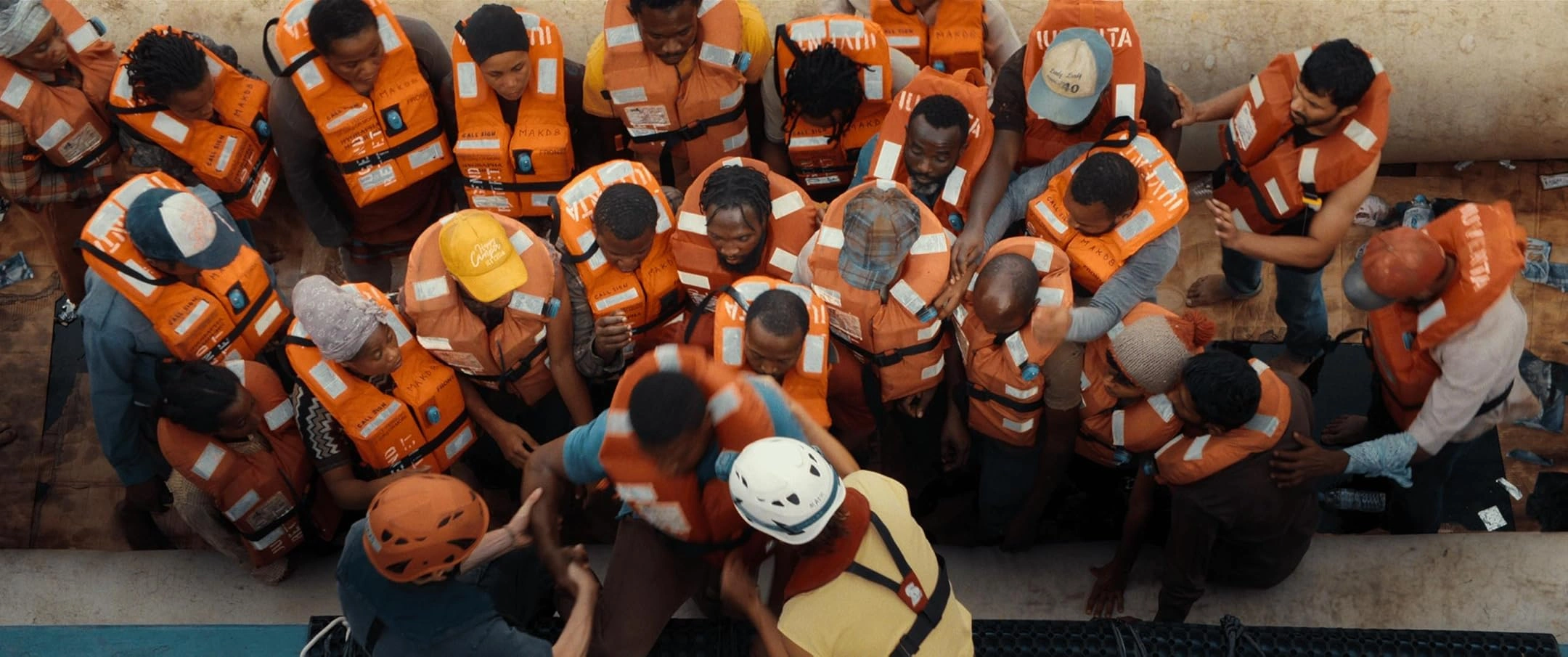
The Iuventa’s first mission gives the film the physical urgency its opening promises. The crew approaches an overcrowded inflatable, distributes life jackets, and transfers passengers while the sea keeps both vessels in restless motion. Handheld camerawork traps us among bodies, ropes, engines, and shouted instructions. The sound mix fills every pause with water slapping against rubber or radios carrying news of another boat in danger.
These sequences work because rescue becomes a chain of specific actions. Captain Viola must position the ship. Soren directs the operation. Doctor Su assesses the passengers. Lukas steadies frightened people as they climb aboard. Humanitarianism is no longer a slogan spoken at a fundraising event. It is a hand reaching across unstable water.
Kathy Etoa brings quiet fear to Rose, a mother protecting her six-month-old baby, while Trevor Magaya gives Lamin an immediate warmth that survives the chaos around him. His connection with Lukas offers the film one of its few sustained relationships with a rescued person. Later phone calls reveal that Lamin has built a life after reaching Europe, though the script sometimes treats his gratitude like evidence in Lukas’s defense.
A later mission ends in death, and the emotional rhythm changes. Mauro develops panic attacks. Lukas has nightmares and drifts away from Kitty, whose university life continues while his mind remains on the boat. One striking image places seawater inside his apartment, turning trauma into a flood he cannot contain.
The film leaves that image too quickly, yet Hofmann carries its meaning through his posture. His early eagerness narrows into concentration, exhaustion, and the guilt of knowing that every successful rescue implies another boat that was never found.
Compassion Becomes Evidence
The film becomes colder once the crew returns to land. Hostile callers attack them over the radio. Fascists arrive at their door. Armed Libyan groups threaten them at sea, while Italian authorities impose restrictions that make each operation harder to complete. The same actions that saved lives are gradually reframed as signs of criminal cooperation.
This shift contains the story’s sharpest idea. A rescue can feel morally immediate on the water and politically suspicious inside an office. The crew must cooperate with authorities capable of delaying their movements, seizing the Iuventa, or accusing them of encouraging migration. Following procedure may cost lives. Ignoring procedure may destroy the organization.
Goller stages these disagreements through meetings, television appearances, and confrontations between exhausted volunteers. Yet the dialogue often loses the natural friction found aboard the ship. Characters begin speaking in polished arguments, explaining policy and morality directly to the audience. The Italian investigation also receives little complexity. Officials function mainly as barriers, leaving the film with righteous anger but a limited picture of the legal machinery behind the case.
The trafficking charges should become a second source of tension equal to the rescues. Instead, years of proceedings arrive as a series of compressed checkpoints. Prison threats, enormous fines, seized equipment, and courtroom testimony pass quickly. The sea sequences force us to experience danger second by second. The legal battle is delivered as information.
Who Gets to Be Seen
23,000 Lives is careful to show the cost paid by its young German activists, yet the people they rescue remain harder to know. Rose and Lamin emerge as individuals because Etoa and Magaya give their limited scenes patience and emotional precision. Many others appear as frightened faces waiting to be pulled from dinghies, then vanish once the immediate danger has passed.
That imbalance creates a tension the film never fully resolves. Its European characters receive friendships, romances, disagreements, trauma, and ideological growth. The refugees often supply the event that produces those changes. Later testimony from rescued passengers restores some agency, but it is framed mainly through its effect on the crew’s legal case.
The film avoids turning Lukas into a flawless hero. He is naive, overwhelmed, and sometimes unable to communicate with those closest to him. Crew disputes reveal that shared compassion does not produce shared strategy. These details keep the story from becoming a clean celebration of benevolent rescuers.
Still, the camera feels most alive when nobody is explaining what the mission means. A life jacket is passed across the water. A baby is lifted onto the deck. A volunteer freezes after seeing a body. In those moments, 23,000 Lives trusts action, sound, and frightened faces to carry its moral argument. Once its characters begin defending that argument in speeches, the emotional current weakens.
This German drama premiered on Netflix on July 17, 2026. Inspired by the true story of the NGO Jugend Rettet, the film follows a group of young volunteers who launch a sea rescue mission in the Mediterranean to save refugees, ultimately facing intense political pressure and legal scrutiny.
Where to Watch 23 000 Lives (2026) Online


Full Credits
Title: 23 000 Lives
Distributor: Netflix
Release date: July 17, 2026
Running time: 1 hour 52 minutes
Director: Markus Goller
Writers: Oliver Ziegenbalg, Michele Cinque
Producers and Executive Producers: Christopher Zwickler, Oliver Ziegenbalg, Markus Goller
Cast: Louis Hofmann, Mala Emde, Katharina Stark, Frederick Lau, Maria Dragus, Trevor Magaya, Kathy Etoa, Felice, Saibon Wang, Joone Dankou, Merlin von Garnier, Luisa-Céline Gaffron, Omid Memar
Director of Photography (Cinematographer): Frankie DeMarco
Composer: Volker Bertelmann
The Review
23,000 Lives
23,000 Lives finds its emotional force on the Iuventa, where shouted instructions, unstable dinghies, and frightened passengers turn humanitarian duty into immediate physical action. Louis Hofmann gives Lukas a quiet progression from hopeful organizer to exhausted activist, while Trevor Magaya and Kathy Etoa lend the rescued passengers a humanity the screenplay too rarely develops elsewhere. Once the ship is seized, years of political and legal conflict are compressed into speeches and checkpoints. The film’s compassion remains sincere, yet its argument carries greater depth at sea than in court.
PROS
- Urgent, immersive rescue sequences
- Louis Hofmann’s restrained performance
- Strong handheld camerawork and sound
- Clear humanitarian conviction
- Memorable work from Trevor Magaya and Kathy Etoa
CONS
- Rushed legal storyline
- Refugees receive limited perspectives
- Supporting crew lacks development
- Dialogue becomes overly explanatory
- Political conflict is simplified