
























![Kingdom Hearts Collection [I-III] Review](https://gazettely.com/wp-content/uploads/2026/10/Kingdom-Hearts-Collection-I-III-1-360x180.webp "Kingdom Hearts Collection [I-III] Review: KHII Holds Steady as Newer Entries Fluctuate 37")




Teen romance television usually treats mutual commitment as the finish line. Here, the finish line becomes a waiting room filled with university forms, therapy appointments, half-spoken fears, and the knowledge that love cannot freeze a school timetable. Heartstopper Forever places Nick Nelson and Charlie Spring inside that pause after three seasons of first kisses, coming out, recovery, and intimacy.
Alice Oseman’s feature-length farewell, directed by Wash Westmoreland, keeps the series’ familiar softness. Animated hearts still flicker around the boys, hands still find each other with near-magnetic certainty, and every room appears prepared to protect a vulnerable confession. The pressure has changed. Nick is finishing his final year at Truham, Charlie is building a public life of his own, and university threatens the daily closeness that has made their relationship feel permanent.
Earlier chapters turned queer happiness into a corrective image, answering television’s long appetite for punishment with sweetness, patience, and mutual care. The film inherits that cultural purpose, then exposes its limitation. Safety can become a dramatic shelter. Nick and Charlie are permitted fear, drinking, sex, silence, and miscommunication, yet those choices rarely acquire lasting disorder. Its faith in tenderness remains affecting. Its resistance to mess makes adulthood look suspiciously well supervised.
A Year Without an Easy Shape
The film divides Nick and Charlie’s final school year into Autumn, Winter, Spring, and Summer, followed by an epilogue. The seasonal design gives graduation the rhythm of an approaching weather front. Leaves fall, snow returns, and the calendar keeps moving while the boys try to preserve a relationship built on shared corridors.
This structure reveals the cost of replacing a season with a film. Each chapter carries material that could sustain an episode: Charlie’s Head Boy campaign and queer club, Nick’s university anxiety and increased drinking, Tao and Elle’s disagreement about their future, and Elle’s fear over attacks on trans rights. The film can touch each pressure. It cannot always let one alter the next.
Charlie’s development is the clearest example of what the compressed format gets right. His meetings with Geoff show a teenager who has learned to name danger before it consumes him. Therapy is presented as work rather than a revelation. Charlie remains capable of relapse, yet he now speaks with a precision that the earlier version of the character could not manage. His Head Boy campaign and queer club proposal extend private recovery into public action. He is no longer waiting for Nick to make the world safe.
Joe Locke catches this change in small adjustments. Charlie sits firmly during school conversations, moves through his friend group without scanning for reassurance, and brings measured honesty to Geoff’s office. Around Nick, that confidence becomes caution. Nick’s silence forces Charlie back into reading mood as threat.
Nick’s decline receives rougher handling. His fear of leaving home, losing Charlie, and arriving at university without a ready identity gathers through withdrawal and drinking. Work at an animal rescue offers a space where care is useful without becoming romantic obligation. Nick has spent much of the series equating love with vigilance. The seasonal jumps hurry his recovery, turning a crisis into a sequence of symptoms, conversations, and soft landings.
Who Are Nick and Charlie Alone?
The film’s sharpest reversal places emotional fluency with Charlie and emotional concealment with Nick. Charlie has spent years being treated as the fragile half. Nick has been the steady hand, the person who notices a missed meal or a shift in tone. Once Charlie recovers, Nick discovers that being needed had become part of his identity.
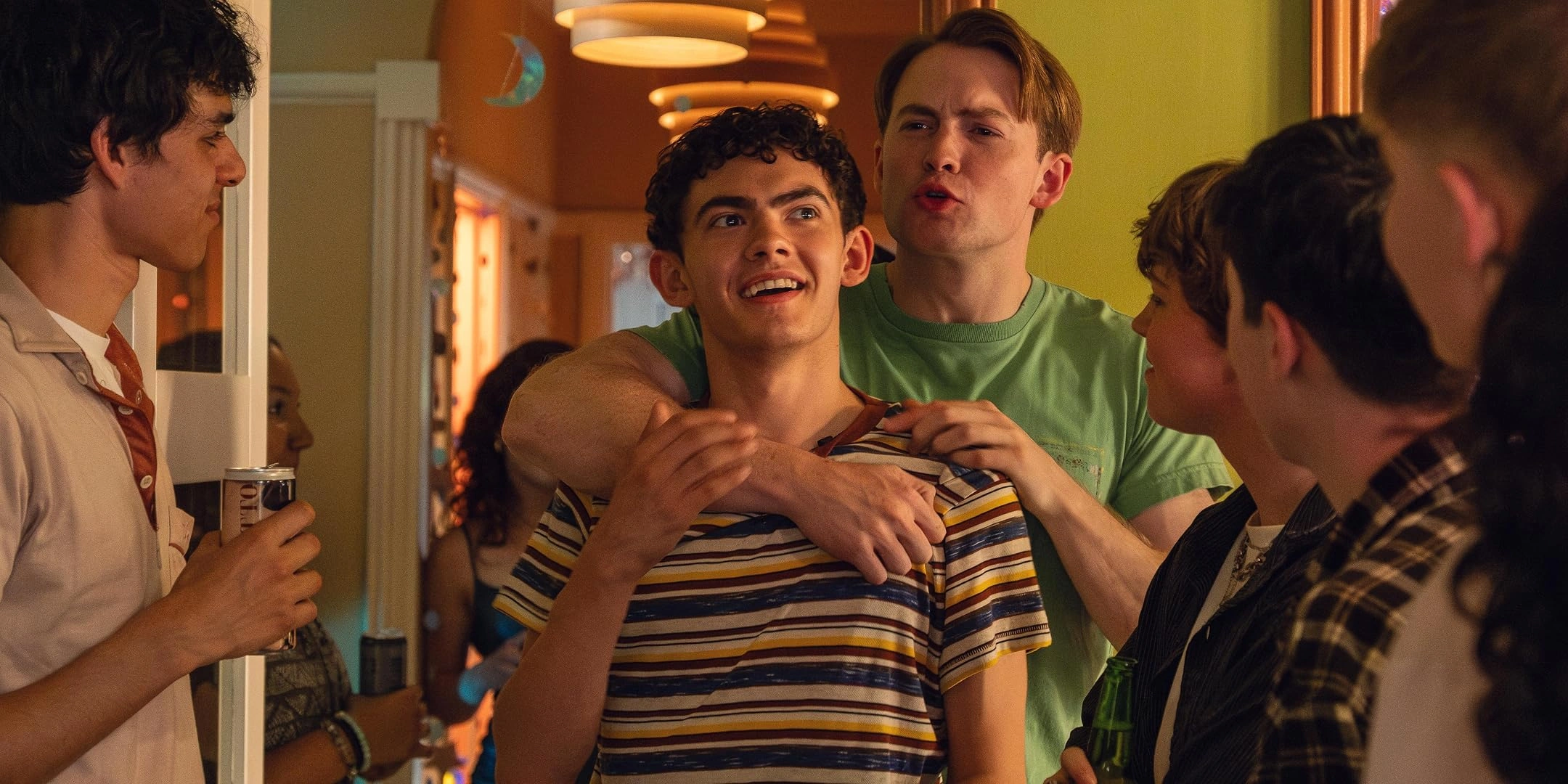
That dependence is visible whenever Charlie talks about school plans with real excitement. Nick smiles, listens, and then seems to recede behind his own expression. Connor plays the retreat through pauses that last slightly too long and answers that arrive after the conversation has moved on. The warmth remains on his face, yet no longer reaches the scene around him.
The conversations with Nick’s mother, Sarah, give the anxiety its clearest language. Anna Maxwell Martin steps into the role previously played by Olivia Colman, a change that inevitably disturbs the emotional continuity of a relationship built across several seasons. The scenes work because they place Nick in a room where competence has no value. He cannot solve university, distance, or adulthood by being kind enough. Connor lets physical confidence collapse into the posture of a frightened son.
Charlie’s response is equally important. He does not become Nick’s therapist, and the film is careful to show why that would repeat the same unhealthy structure in reverse. He asks, waits, presses, and sometimes misreads. Their conflict grows from two people protecting each other by withholding the truth. Love remains present in every argument, making the silence crueler.
Their sexual relationship carries the same mixture of progress and protection. Nick and Charlie are comfortable enough to initiate sex, joke about it, and pull over for an impulsive outdoor encounter. The staging stays coy. Aerial framing assures the audience that no stranger is nearby, bodies remain discreetly arranged, and awkward logistics disappear. The choice preserves the franchise’s gentle register, yet cleans teenage sexuality until it resembles an approved educational illustration.
Anna Peronetto’s animated sparks and floating hearts continue to translate feeling into graphic signs. They link the film to Oseman’s source material and suggest that attraction changes the physical world. By this stage, the doodles also function as emotional guarantees. Even during uncertainty, the image insists that the bond is intact. The romance never loses its halo.
The Friends Left Outside the Frame
That halo once extended across a community. Season three gave Tara, Darcy, Tao, Elle, Isaac, Imogen, Tori, and Mr. Ajayi enough space to make friendship feel like a queer survival system. The film returns Nick and Charlie to priority, leaving those relationships as updates, declarations, and brief crises.
Tao and Elle suffer most from the contraction. Their disagreement over future plans mirrors the central fear of separation, yet the script offers little sense of how the conflict accumulated. They appear unable to adjust their ambitions around each other, then move through the possibility of a breakup with limited room for anger, resentment, or relief. A relationship that once had texture becomes thematic evidence for Nick and Charlie’s problem.
Elle receives a scene about living as a Black trans girl while political institutions restrict trans rights and access to hormone blockers. The urgency is real, and Yasmin Finney gives the speech a controlled anger that resists pity. The writing treats the moment like a public statement inserted into a private story. The film moves away before policy becomes daily life, before fear changes a school choice, family conversation, or her plans with Tao. Representation is present, yet presence alone cannot perform development.
Tori’s account of her asexual relationship lands with greater force because it grows from a specific bond. She explains that her version of togetherness may not resemble the model other people expect, then claims it without apology. Jenny Walser keeps the speech quiet, almost guarded, which gives it the texture of something lived rather than prepared for an audience.
Imogen’s announcement that she is a lesbian lands as a sharper comic beat, delivered like a personal rebrand. Darcy’s new haircut, Tara’s limited presence, and Isaac’s marginal role reveal how much collective life has been lost in the move to feature length. The series once argued that queer adolescence becomes bearable through a network of imperfect witnesses. The finale leaves too many of those witnesses waiting offscreen.
The Series Looks Back at Itself
Westmoreland gives the film a cooler, reflective mood compared with the series’ early seasons. Autumnal light, winter coats, and longer silences replace some of the breathless excitement attached to first love. The camera often holds Nick and Charlie together while the dialogue points toward separation, turning physical closeness into a temporary arrangement.
Familiar locations intensify that feeling. Nick and Charlie revisit their first kiss. Snow recalls them making angels together. Flashbacks interrupt new scenes with old milestones, ensuring that every present fear carries an archive of reassurance. For devoted viewers, the recognition has emotional power. It can also feel like the film is checking its own scrapbook during a crisis.
Those repeated images expose the finale’s uncertain relation to change. The story asks Nick and Charlie to imagine a relationship that can survive distance, separate ambitions, and shifting needs. Its form keeps pulling them back toward the moments that made the audience love them. Memory becomes both proof and restraint.
The older gay couple, including Derek Jacobi, offers another kind of reassurance. Their presence gives the boys a visible future, a life beyond school uniforms and coming-out conversations. The scene is tender, yet arrives with the symbolic function of a promise: queer love can last, and here is the evidence. The film prefers proof to uncertainty whenever the latter becomes uncomfortable.
The epilogue follows that instinct. It offers a carefully arranged glimpse of what Nick and Charlie may become, preserving the emotional contract that has defined the series from the first “Hi.” The image closes the door softly, with every object placed where affection can find it again.
This feature-length film serves as the final conclusion to the Heartstopper television series, premiering on Netflix on July 17, 2026. The story follows Nick and Charlie as they navigate the emotional challenges of adulthood, including Nick’s transition to university and Charlie’s growing responsibilities, ultimately reaffirming their bond after facing significant personal hardships.
Where to Watch (2026) Online


Full Credits
Title: Heartstopper Forever
Distributor: Netflix
Release date: July 17, 2026
Rating: TV-14
Director: Wash Westmoreland
Writers: Alice Oseman
Producers and Executive Producers: Brett Thomas, Alice Oseman, Kit Connor, Joe Locke, Patrick Walters, Iain Canning, Emile Sherman, Euros Lyn
Cast: Kit Connor, Joe Locke, William Gao, Yasmin Finney, Corinna Brown, Kizzy Edgell, Tobie Donovan, Jenny Walser, Rhea Norwood, Leila Khan, Eddie Marsan, Anna Maxwell Martin
The Review
Heartstopper Forever
Heartstopper Forever preserves the tenderness that made Nick and Charlie’s romance culturally significant, then shields them from much of the disorder adulthood promises. Joe Locke and Kit Connor give the relationship emotional credibility, especially as Charlie gains independence and Nick loses the security of being needed. The seasonal structure compresses several major conflicts, while the supporting ensemble is reduced to speeches, cameos, and unfinished arcs. Its reassurance remains moving, though the film’s carefully arranged safety can feel less like queer possibility than queer life placed behind glass.
PROS
- Locke and Connor’s assured chemistry
- Charlie’s convincing personal growth
- Sensitive reversal of caregiving roles
- Warm, recognizable visual language
- Earnest portrait of queer joy
CONS
- Supporting characters receive little space
- Political themes feel compressed
- Nick’s crisis resolves too quickly
- Heavy reliance on nostalgic flashbacks
- Teenage intimacy feels overly polished







