






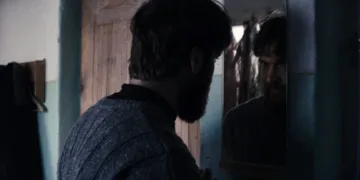











Human Specimens approaches murder with the dry precision of a lecture. Up in the quiet heights of Nagano, a man stumbles onto an image that refuses easy answers: six glass cases holding the bodies of young men. The dead are out in the open. They sit on display.
Shiro Sakaki, a biology professor, soon admits what he has done. His son, Itaru, is among the victims. Shiro talks about the killings with a cold academic remove, then goes a step further by offering a formal research paper as his justification. Across five episodes, the series tracks his interrogation and folds in his memories of childhood. His father was an artist who met rejection after arguing that human bodies could serve as specimens, and that past bends Shiro’s view of life into something warped and unrecognizable.
He frames the victims as biological samples for a Butterfly Kingdom. The story comes from a novel by Kanae Minato, and the series features Hidetoshi Nishijima and Rie Miyazawa. Shiro looks at his son as a specimen, not a person. He convinces himself that he is sending these boys into a state of permanent beauty. The narrative keeps returning to the dark side of creative passion and the damage caused by an obsession with preservation. Shiro wraps his crimes in the language of science and art, then speaks as if he is presenting findings.
Seeing Through Many Lenses
The series uses a Rashomon approach to examine the lives caught in its wake. Each of the five episodes shifts perspective, letting every character contribute a piece of what happened. It becomes a story about how truth changes shape depending on the eye that holds it.

Shiro Sakaki is a lepidopterist whose life revolves around butterflies, and his connection to Rumi Ichinose anchors the human side of the puzzle. Rumi was his childhood friend, and she has tetrachromatic vision. She perceives millions of colors that most people never see. Their histories tangle through Shiro’s father, who once painted Rumi’s mother.
That attention to perception is one of the show’s most absorbing ideas for me, because it links theme to craft in a clean, legible way. Itaru, Shiro’s son, is a talented photographer who shoots on film cameras. He insists film cannot be edited or retouched. His devotion to analog photography makes sense to me. Film locks in a specific truth, and it carries a kind of permanence that digital files can quietly reshape.
The story draws these families together at an art retreat in Shiro’s ancestral home. Rumi’s daughter, Anna, is part of that gathering too, and these relationships ignite the chain of events that leads to the final murders. Hidetoshi Nishijima delivers a performance that lingers after the screen goes dark. The supporting cast registers as smaller next to his gravity. His Shiro is methodical and steady, never cracking his calm surface, which makes the horror feel grounded. The series shows how competing visions of beauty can end in total destruction.
The Taxonomy of Violent Ambition
Shiro’s idea of beauty reads like a case study in ambition drained of warmth. He describes the Butterfly Kingdom as a place of eternal preservation. In his mind, killing the boys makes them permanent. He draws no line between a human being and a butterfly. The logic is biological taxidermy dressed up as principle.
He believes life passes quickly. He believes art lasts. He wants to capture beauty before it fades, and that desire traces back to his father. The elder Sakaki fixated on using humans for his artwork, and people shunned him for it. Shiro takes those failed dreams and turns them into reality, carrying a damaged inheritance from one generation to the next. The series treats that inheritance as generational trauma, showing how a parent’s warped desires can be handed down and reassembled into something worse.
Shiro does not move through this story in a heat of anger. He moves with a need to define beauty by rules he writes for himself. The series brings in themes of filicide and betrayal, and it keeps pressing on how obsession can distort any sense of what art should be. Shiro hides behind his intellectual status, presenting murder as a necessary step in research. His calm explanations land like ice next to the glass cases. He uses a scientist’s vocabulary to flatten the reality of what he has done. Every act feels planned. Remorse never enters the frame. He treats his son as his greatest work.
Horrors Under the Bright Sun
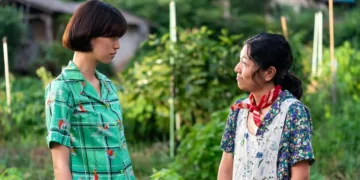
Director Ryuichi Hiroki gives this horror story a visual strategy built on clarity. The lighting stays bright and sunny, and the macabre becomes harder to distance. Sunlight hits the glass cases out in the forest, and the clean brightness makes the death inside them feel immediate. The production design leans into a carefully arranged, almost gallery-like presentation. The cases sit with deliberate care. The effect turns the show surreal, and it feels deeply wrong to watch violence placed inside such a beautiful setting.
The pace moves fast. The writers compress an entire novel into five episodes, and that compression gives the story the feeling of a sprint toward an end you can sense coming. Visual effects help frame the character interactions by suggesting what it means to see the world through different eyes. I liked the visual clarity here. The series stays away from familiar genre camouflage. Bright color ties to Rumi’s vision, and it also mirrors Shiro’s belief that his work carries beauty.
The show plays like a dream that curdles into a nightmare. The mountains offer natural beauty, while the specimens broadcast a manufactured idea of preservation. Hiroki avoids the desaturated look common to mainstream television, and the sickness of the story lands with sharper force. The series presses on how we look at crime and art, then leaves a lingering unease. The landscape remains beautiful, and that beauty keeps the horror impossible to ignore.
Human Specimens is a dark Japanese psychological thriller that premiered globally on December 18, 2025. Adapted from the acclaimed novel by Kanae Minato, the series centers on Professor Shiro Sakaki, a lepidopterist whose obsession with beauty leads to a horrific confession of filicide and artistic murder. The series explores the fine line between creative passion and clinical madness through a fragmented, multi-perspective narrative. You can currently watch all five episodes exclusively on Amazon Prime Video.
Full Credits
Title: Human Specimens (Ningen Hyōhon)
Distributor: Prime Video, Amazon MGM Studios
Release date: December 18, 2025
Rating: TV-MA
Running time: 5 episodes, approximately 45–60 minutes per episode
Director: Ryūichi Hiroki
Writers: Kanae Minato (Original novel)
Producers and Executive Producers: Erika North, James Farrell, Amazon MGM Studios
Cast: Hidetoshi Nishijima, Somegorô Ichikawa, Rie Miyazawa, Aoi Ito, Towa Araki, Jyutaro Yamanaka, Kodai Kurosaki, Leo Matsumoto, Ikuho Akiya
Director of Photography (Cinematographer): Mizuki Nishida
Editors: Shoichi Onizuka
Composer: Shinichi Osawa
The Review
Human Specimens
Human Specimens provides a chilling look at the price of artistic obsession. It avoids common thriller tropes by using bright visuals to highlight a dark narrative. Hidetoshi Nishijima gives a powerful performance. While the fast pace might feel rushed for some, the focus on perception and generational trauma provides depth. This series is a haunting experience for those who appreciate stories that challenge the meaning of beauty. It is a disturbing study of a father’s cold descent.
PROS
- Striking lighting choices.
- Strong lead performance.
- Focused storytelling.
- Deep exploration of trauma.
CONS
- Underdeveloped supporting cast.
- Pacing feels too fast.
- Emotional distance may alienate viewers.