






























Adult Swim’s latest twenty-minute special plays like a hands-on experiment in collaborative storytelling, built around the exquisite corpse method. In that surrealist setup, artists contribute in sequence without seeing what came before, and the film wears that constraint on its sleeve. The pacing lurches and pivots because the structure demands it. A nameless protagonist spills out of a sterile robotic factory, then runs into a mysterious cat-like guide nudging her toward self-discovery. From that first encounter, the story commits to constant change, both physical and internal, as if transformation is the only stable rule.
The film breaks into three acts, linked by a single character who never stays visually consistent for long. Her body shifts, her form updates, and the continuity comes from presence more than appearance. The narrative logic favors the immediate feeling of arrival and discovery. Linear progression takes a back seat to sensation, to the raw experience of being dropped into a world and trying to make sense of it. The special’s surrealist DNA shows up in each moment where the lead tries to understand her sudden entry into existence, and the film keeps returning to that impulse: to look around, ask questions, and keep moving.
Three Visions of One Being
The relay starts with Pendleton Ward, who lays down a sci-fi aesthetic anchored by a stark palette. Grays and black-and-white dominate, then sharp splashes of color cut through to highlight specific character movements. His world has the feel of a retro video game, where shapes undulate and shift without warning, and reality seems eager to redraw itself mid-scene. That foundation sets the tone for a story that treats stability as optional.

Rebecca Sugar and Ian Jones-Quartey take the second act and swing into a New Wave angularity inside a cyberpunk urban setting. Their segment softens the look with pastel colors, then adds a defining detail: a music button embedded on the protagonist’s chest. When it’s pressed, disco parties erupt on impulse, pushing the episode into a rhythmic, neon-lit energy that arrives like a switch being flipped. The tonal shift reads as part of the film’s design, a new set of rules imposed on the same central figure, then tested to see how she reacts.
Patrick McHale closes the final act by moving the story into urban realism. The style turns gentle and painterly, like a Little Golden Book come to life, and the setting resembles a snowy New York City. Here, the protagonist meets a lonely inventor, and the tempo calms into something quieter and more observational. Through all three aesthetic swings, Jack Pendarvis and Kent Osborne hold a thin thread of thematic consistency, keeping the character recognizable even while everything around her changes.
That tension carries into the character design itself, which becomes a collage of mismatched parts. The protagonist might have a cactus for an arm, a television for a torso, or oversized robot legs. Each piece feels borrowed from a different reality, stitched together into a body that looks functional only by stubborn insistence. The effect makes her feel singular and strange, a person assembled out of contradictions who still needs to move forward.
The Search for the Right Form
The narrative leans on the parable of the blind men and the elephant, using it as a metaphor for subjectivity and the broken-up nature of perception. Each segment offers a different way of seeing the same soul, and the film treats that fragmentation as the point rather than a problem to solve. The protagonist wrestles with agency as she moves through different lives and bodies, and the story keeps circling back to her desire to find the right form. It lands as a direct expression of self-actualization, stated plainly and tested repeatedly.
That search feels most grounded in the second act, where she faces heavy pressure to perform for a hedonistic crowd. The role being demanded of her does not match her internal state, and the tension comes from watching her try to hold onto herself while the environment insists on a performance. These scenes offer a clear view of how people get boxed in by expectations, then judged for failing to fit the box comfortably. The film touches on the labor involved in aligning a physical self with an internal identity, and it refuses to treat that alignment as quick or clean.
Across the full arc, the transformation from factory product to a being with a soul becomes the spine of the story. Her body shifts from gears to flesh-and-blood, and the protagonist stays the protagonist through every redesign. The special keeps returning to continuity of self as an active process, carried by curiosity and persistence. The film frames identity as something held in motion, sustained by the questions she keeps asking through each new shape.
Art Without the Strings
The special arrives as an unusual sight in a media environment shaped by brand management. It’s presented as a creative experiment, and it carries itself like one. It stands apart from existing properties, and it isn’t positioned as a merchandise engine. That stance matters because the piece depends on risk: three acts, three visual languages, one character asked to survive the handoffs.
The production required a high level of trust between the network and the creative teams at Rudo, Dinamita, and Titmouse Vancouver. With corporate interference kept to a minimum, the animators get room to play with the medium and follow strange ideas to their natural endpoints. The companion documentary, Behind the Elephant, shifts focus to the technical side of that collaboration, including the music and the specific challenges of the producer’s role inside a project built on controlled chaos.
The finished work can feel like a television salon, a place where established voices get to ignore commercial demands for twenty minutes and see what happens. By foregrounding the human element of animation, the special pushes back against the idea of art as a mechanical or automated output. The film’s very existence argues for imagination as something messy, fallible, and worth protecting, especially when artists are allowed to fail, pivot, and surprise themselves. It champions human effort in a time of calculated content, and it treats that effort as the point, not a pleasant side effect.
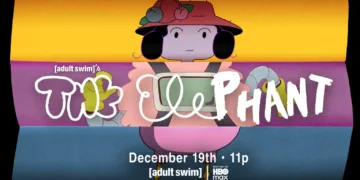
Adult Swim’s The Elephant is a groundbreaking animated special that premiered yesterday, December 19, 2025, on the Adult Swim cable network. Following its television debut, the project became available for streaming today, December 20, 2025, on Max. The special is a creative “exquisite corpse” experiment featuring the combined talents of the most influential figures in modern animation. You can currently watch the special along with its companion behind-the-scenes documentary, Behind the Elephant, on the Max streaming platform or via Adult Swim’s on-demand services.
Full Credits
Title: Adult Swim’s The Elephant
Distributor: Adult Swim, Max
Release date: December 19, 2025
Rating: TV-MA
Running time: 23 minutes
Director: Pendleton Ward, Rebecca Sugar, Ian Jones-Quartey, Patrick McHale
Writers: Pendleton Ward, Rebecca Sugar, Ian Jones-Quartey, Patrick McHale, Jack Pendarvis, Kent Osborne
Producers and Executive Producers: Chris Prynoski, Shannon Prynoski, Antonio Canobbio, Ben Kalina, Vishnu Athreya, Kelly Crews
Cast: Pendleton Ward, Rebecca Sugar, Ian Jones-Quartey, Patrick McHale, Jack Pendarvis, Kent Osborne
Director of Photography (Cinematographer): Pendleton Ward, Rebecca Sugar, Ian Jones-Quartey, Patrick McHale
Editors: Titmouse Production Team
Composer: Dolphin Hyperspace, Nicole McCabe, Logan Kane, Rebecca Sugar, Patrick McHale
The Review
Adult Swim's The Elephant
This special is a triumphant exercise in creative trust. By embracing a fragmented structure, it captures the messy, shifting nature of self-discovery. While the plot remains secondary to the sensory experience, the emotional weight of the final act provides a satisfying anchor. It is a rare, vibrant example of what happens when artists are allowed to play without the burden of commercial expectations.
PROS
- A striking display of diverse animation styles from industry leaders.
- Deeply resonant themes regarding identity and personal agency.
- A unique, experimental structure that rewards multiple viewings.
- Excellent musical integration that enhances the atmosphere of each act.
CONS
- The loose, non-linear plot may feel disjointed to some viewers.
- Its short duration leaves some fascinating world details unexplored.