


























Susan Kucera treats the wolf as a historical document. Its body carries the marks of settlement, agriculture, mythology, commerce, and fear. That approach gives In the Company of Wolves: An American Journey a reach far beyond wildlife observation, placing one species inside the struggle over what America believed its land should become.
Kucera directs, edits, shoots, and produces the 83-minute documentary, while Jeff Bridges narrates its movement from European settlement to contemporary conservation. His weathered voice fits material built around canyons, open plains, railroads, cattle, and disappearing herds. The tone remains reflective rather than accusatory, even as the film describes campaigns that displaced Indigenous communities, decimated bison, and turned wolves into state-sanctioned enemies.
The documentary’s most persuasive idea concerns cultural translation. European settlers brought farming traditions shaped by livestock ownership and fenced property. Indigenous communities had developed different relationships with the same terrain. Once the wolf passed from one worldview into the other, it ceased to be a fellow inhabitant and became an obstacle.
Folklore prepared the ground. Stories cast wolves as cunning monsters long before ranching interests placed financial value on their destruction. Kucera draws a clear line between the fairy-tale predator and the animal later hunted across the West. America did not encounter a villain in the wilderness. It imported one.
Selling the Empty West
Historian Jon Coleman connects anti-wolf campaigns to frontier mythology, showing how attitudes toward predators echoed larger fantasies about conquest and control. The film’s archive material and reenacted wagon trains frame expansion as a national enterprise that required the landscape to appear open, unmanaged, and available.
Jason Baldes, an Eastern Shoshone leader, challenges that image directly. The so-called wilderness was already inhabited and understood by Native peoples whose stewardship was erased once settlers appointed themselves its managers. Kucera places this argument beside images of Mount Rushmore, national parks, railroad construction, and cattle moving across open range. Familiar symbols of American progress begin to look less neutral.
One of the documentary’s sharper historical claims concerns public land. Early conservation was tied to railroad tourism and commercial development, with protected landscapes marketed as destinations. The national park became a place where the scenery could remain wild enough to attract visitors while animals deemed inconvenient were removed from it. Beauty was preserved. Ecological relationships were negotiable.
This section widens to cover Manifest Destiny, beef production, fenced settlements, and the collapse of bison populations. Each thread carries weight, yet their accumulation exposes the film’s structural weakness. Kucera moves across centuries at such speed that some connections receive a striking image and a few lines of commentary before the next chapter arrives. The scale is impressive. The stitching is visible.
When the Wolves Return
Kucera’s wildlife photography supplies the documentary with its clearest evidence. Wolves move through snow and grass without performing the menace assigned to them by folklore. Their behavior appears social, communicative, and learned. One expert explains that older wolves teach younger members of the pack, making the killing of experienced animals a disruption that reaches beyond a single death.
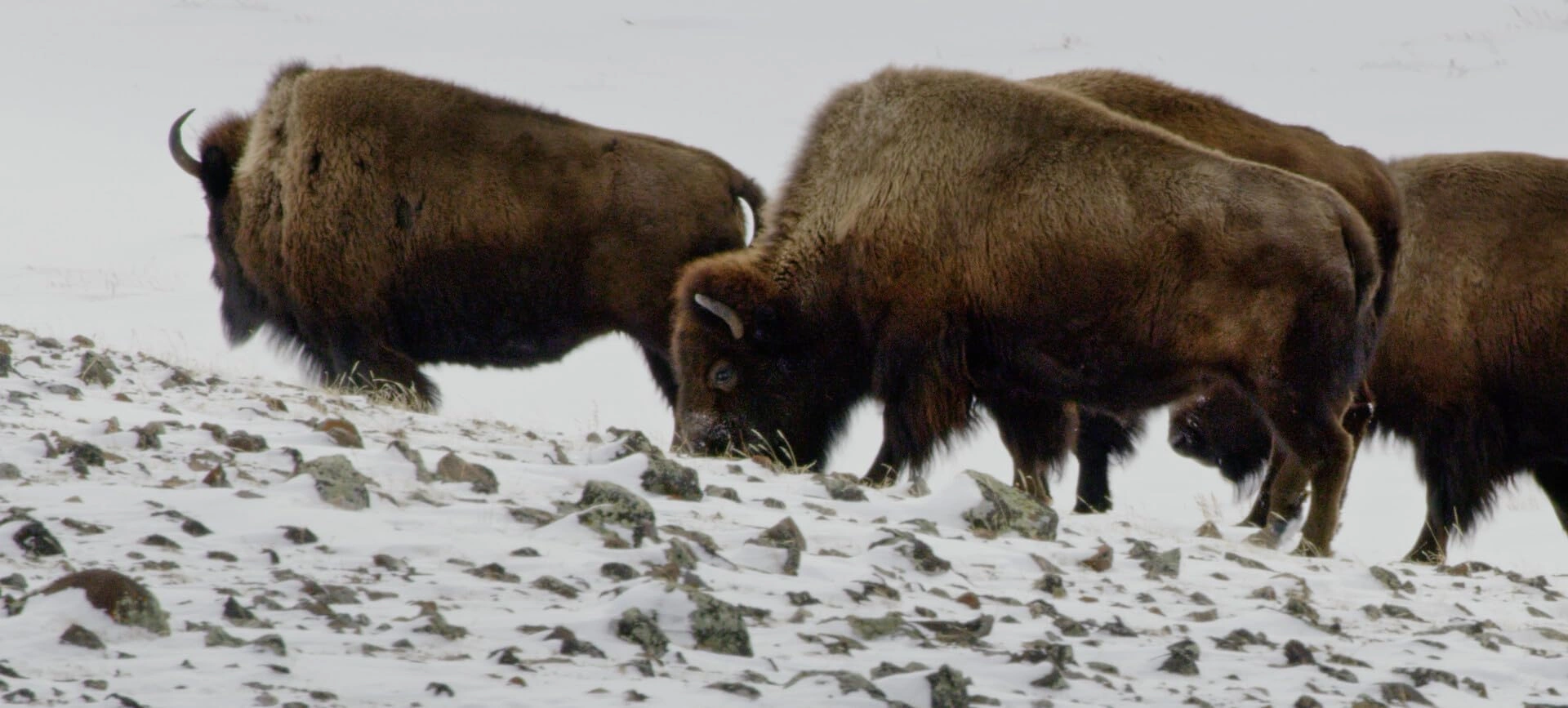
The film also shows how wolf kills sustain birds and scavengers. A carcass becomes food distributed across species, turning predation into participation within a larger ecological system. Removing wolves changes the behavior and survival of animals that may never encounter one alive.
These observations are among the documentary’s strongest, which makes the wolves’ frequent absence frustrating. Interviews about railroads, ranching, public land, and national identity dominate long stretches. The history remains relevant, but the title animals sometimes feel like an organizing metaphor borrowed by a broader film about America.
Bridges helps keep the transitions coherent. His narration carries scientific details, literary history, and political argument without flattening them into a lecture. Kucera also cuts regularly from speakers to bison, horses, elk, cattle, and wide Western landscapes, allowing physical environments to interrupt human certainty.
One interviewee argues that people tend to approach animals through culture rather than meeting them on their own terms. The film recognizes the problem. It does not always escape it.
A Different Kind of Cowboy
The contemporary ranching material gives the documentary its most useful cross-cultural shift. Fifth-generation sheep rancher Cameron Krebs speaks from inside a profession often treated as the natural enemy of wolf conservation. His use of science, technology, and non-lethal livestock protection presents coexistence as practical work rather than an abstract moral position.
This portrait revises the cowboy myth built earlier in the film. Modern ranchers operate under grazing rules, market pressures, wildlife policy, and environmental limits. The open frontier has given way to negotiated land, where cattle, sheep, predators, conservationists, and local communities compete for space.
Kucera avoids turning ranchers into relics or conservationists into flawless guardians. Christine Eisenberg, David Quammen, Michelle Paver, and Elizabeth Marshall bring ecological, literary, and spiritual perspectives that expand the conversation around animal behavior. Their contributions show how the wolf changes meaning across disciplines and cultures: predator, teacher, symbol, economic threat, relative.
The film’s chapter structure keeps this extensive material moving, yet its brief running time cannot fully develop every dispute it raises. Hunting practices, political priorities, Indigenous stewardship, commercial agriculture, and reintroduction each deserve room the documentary cannot provide.
Still, the ranching sequences locate a possible future in daily choices rather than grand declarations. Coexistence appears in fencing decisions, livestock protection, pack knowledge, and the willingness to stop treating control as the only form of safety. The American relationship with wolves was built through culture. Kucera suggests it can be rebuilt the same way.
This thought-provoking environmental documentary premiered at the 2026 Cannes Film Festival and became available on video-on-demand platforms in July 2026. Narrated by Academy Award winner Jeff Bridges, the film traces the complex historical relationship between humans and wolves to examine how these animals have shaped American folklore, conservation efforts, and national identity.
Where to Watch In the Company of Wolves: An American Journey (2026) Online







Full Credits
Title: In the Company of Wolves: An American Journey
Distributor: Vision Films
Release date: May 15, 2026 (Cannes Film Festival premiere)
Rating: G
Running time: 83 minutes
Director: Susan Kucera
Writers: Jon Coleman, Anna Kirsch
Producers and Executive Producers: Susan Kucera, Anna Kirsch, Jim Swift
Cast: Jeff Bridges, Michelle Paver, David Quammen, Jon Coleman, Cristina Eisenberg, Jason Baldes, Cameron Krebs
Director of Photography (Cinematographer): Susan Kucera
Editors: Susan Kucera
Composer: Keefus Ciancia
The Review
In the Company of Wolves: An American Journey
In the Company of Wolves: An American Journey turns the wolf into a witness to America’s transformation, tracing how European farming ideals, Indigenous stewardship, frontier mythology, and commercial expansion reshaped the land. Susan Kucera’s wildlife photography and Jeff Bridges’ measured narration give the history weight, while the ranching segments offer a practical vision of coexistence. Its wide scope occasionally scatters its argument, and the wolves themselves disappear for stretches. Still, the documentary finds a sharp cultural truth: societies reveal their values through the animals they choose to protect, exploit, or fear.
PROS
- Striking wildlife cinematography
- Rich Indigenous and historical perspectives
- Calm, effective narration
- Nuanced portrait of modern ranching
- Strong ecological observations
CONS
- Frequently drifts from its title subject
- Historical threads lack full development
- Several dialogue-heavy passages
- Ambition exceeds the compact runtime