


















1960 hangs over Leon Prudovsky’s story like a low ceiling. In the Colombian countryside, Marek Polsky tends black roses with the care of someone keeping watch over a grave. A Polish Jew, he carries a life erased by the death camps, and he moves through his days with the quiet persistence of a man already half gone. News that the Mossad has captured Adolf Eichmann in Argentina sparks a buried obsession. The headline detonates inside him.
Then Herman Herzog arrives next door. A new fence line, a new set of footsteps, a new pair of eyes peering back. Marek studies him through the slats and decides he recognizes a monster. Those chilling blue eyes, he believes, belong to the man he once glimpsed at a 1934 chess championship in Berlin. The conviction lands with the force of a visitation. Herzog is left-handed. He spends long afternoons painting lonely landscapes. He keeps an Alsatian. Each mundane habit seems to mirror what Marek has stored as the private routines of the fallen dictator.
A ruined rose bush and a petty property-line dispute ignite the feud. What begins as neighborly irritation hardens into a crusade powered by suspicion and memory. Marek takes his theory to the Israeli embassy, where young officials meet him with polite dismissal and a look that treats him as a relic from an old catastrophe. He returns home alone, sealed inside his own certainty.
The mountains stretch wide, yet the space feels pinched, as if the valley has contracted around his mind. Paranoia becomes his primary companion. In this quiet corner of South America, history stays near the surface here, waiting for a neighbor to move in.
A Friction of Ghosts: Hayman and Kier
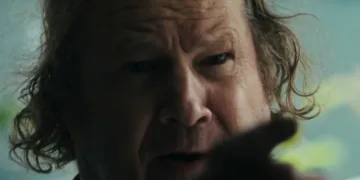
David Hayman and Udo Kier take a premise that risks thinness and give it heft through texture, timing, and the tiny abrasions of daily contact. Hayman’s Marek is jagged and bristling, a man shaped by decades of grief into something sharp enough to cut the hand that reaches out. He scowls at the world with permanent betrayal etched into his posture. His English rolls forward with a rough cadence, as if the language itself has to fight its way past harder ones.
Kier answers with unsettling stillness. He stands in frames like a figure pinned to the wall, fragile in a way that invites both pity and suspicion. He can look predatory, then suddenly exposed, and the shift plays like a trick of the light. Their dynamic nods to the “grumpy old men” setup, only the subtext carries lethal historical charge that keeps the room tense even during a chuckle. They bicker over fence height and canine deposits, insults tossed with the petty precision of men who have decided manners are wasted effort.
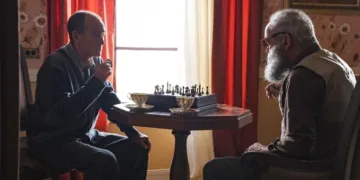
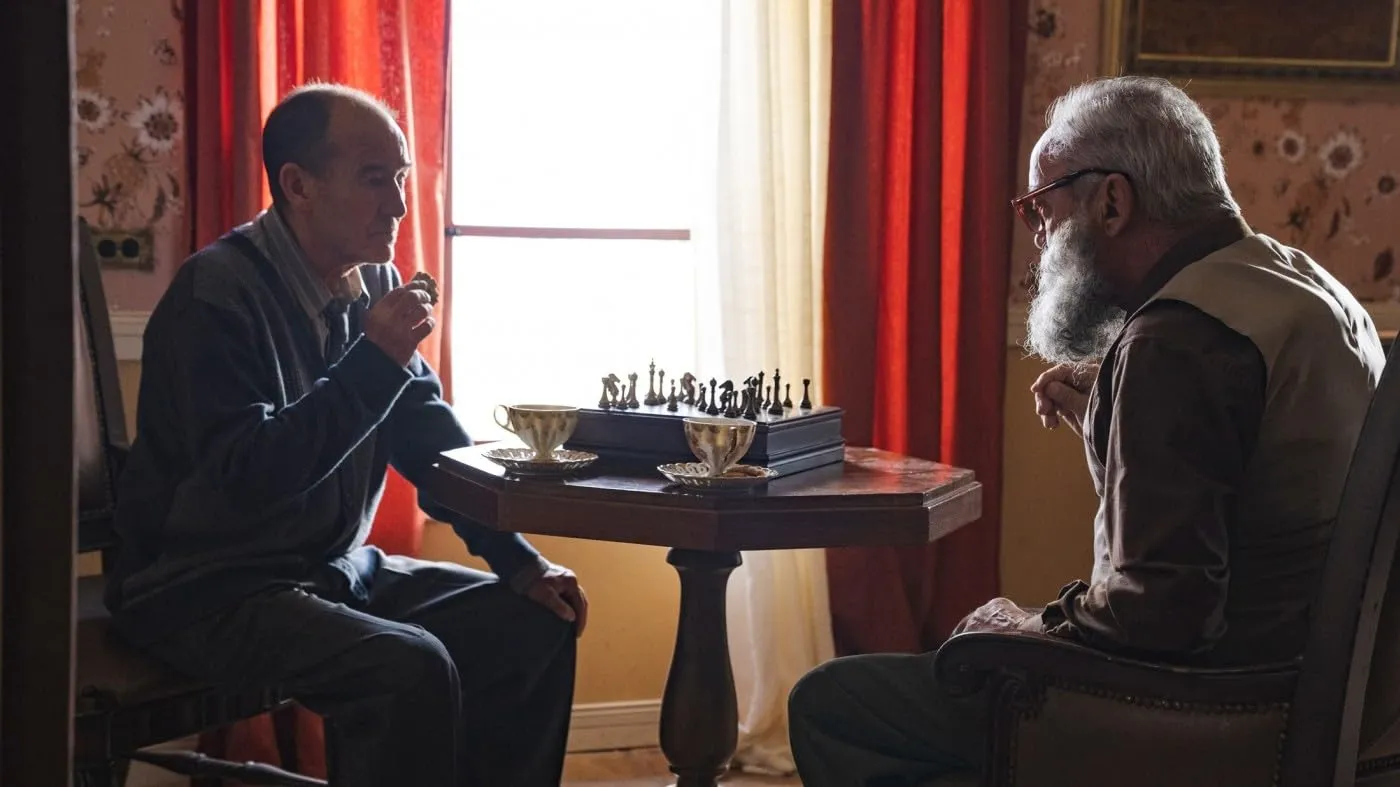
As the enmity escalates, an odd companionship begins to form, less a friendship than a shared solitude with rules neither man names aloud. They find a common syntax in the clean geometry of a chessboard. They trade pickles and potent spirits on dim porches, faces lit like weary sentries. The porch scenes play like low-key duels: two bodies angled toward each other, two minds running ahead, each move measured for advantage.
For Marek, the closeness serves two purposes. He cultivates access. He treats intimacy as reconnaissance. Heavy telephoto lenses turn domestic space into a surveillance post, and he studies Herzog for physical signs that might confirm his obsession. He watches Herzog from afar as the man undresses, hunting for the rumored absence of a testicle like a private proof text, grotesque and strangely procedural. The film’s jokes arrive bone-dry here, and they sting. The absurdity sits in plain view: a survivor reaching for contact with a presumed executioner, then turning that contact into a trap.
The performances keep the film steady at moments when the writing risks feeling constructed. Their chemistry drives the narrative’s pulse, shifting from visceral hatred to a fragile understanding that refuses a neat label. Sometimes the silence carries the weight the dialogue cannot lift. Sometimes it carries a punchline. Kier and Hayman let both registers coexist without flinching.
Chromatic Desolation and Hitchcockian Voyeurism
Prudovsky stages the film in the visual grammar of the psychological thriller, borrowing from noir’s old toolbox while keeping the screws tight in a modern frame. Cinematographer Radek Ladczuk works with a desaturated palette that makes the world look drained, as if color has been rationed. That chromatic austerity mirrors Marek’s inner landscape, where joy registers as an old rumor. Flat, frontal compositions arrive with the rigidity of theatre blocking, then the camera breaks into handheld close-ups that twitch with nervous intimacy.
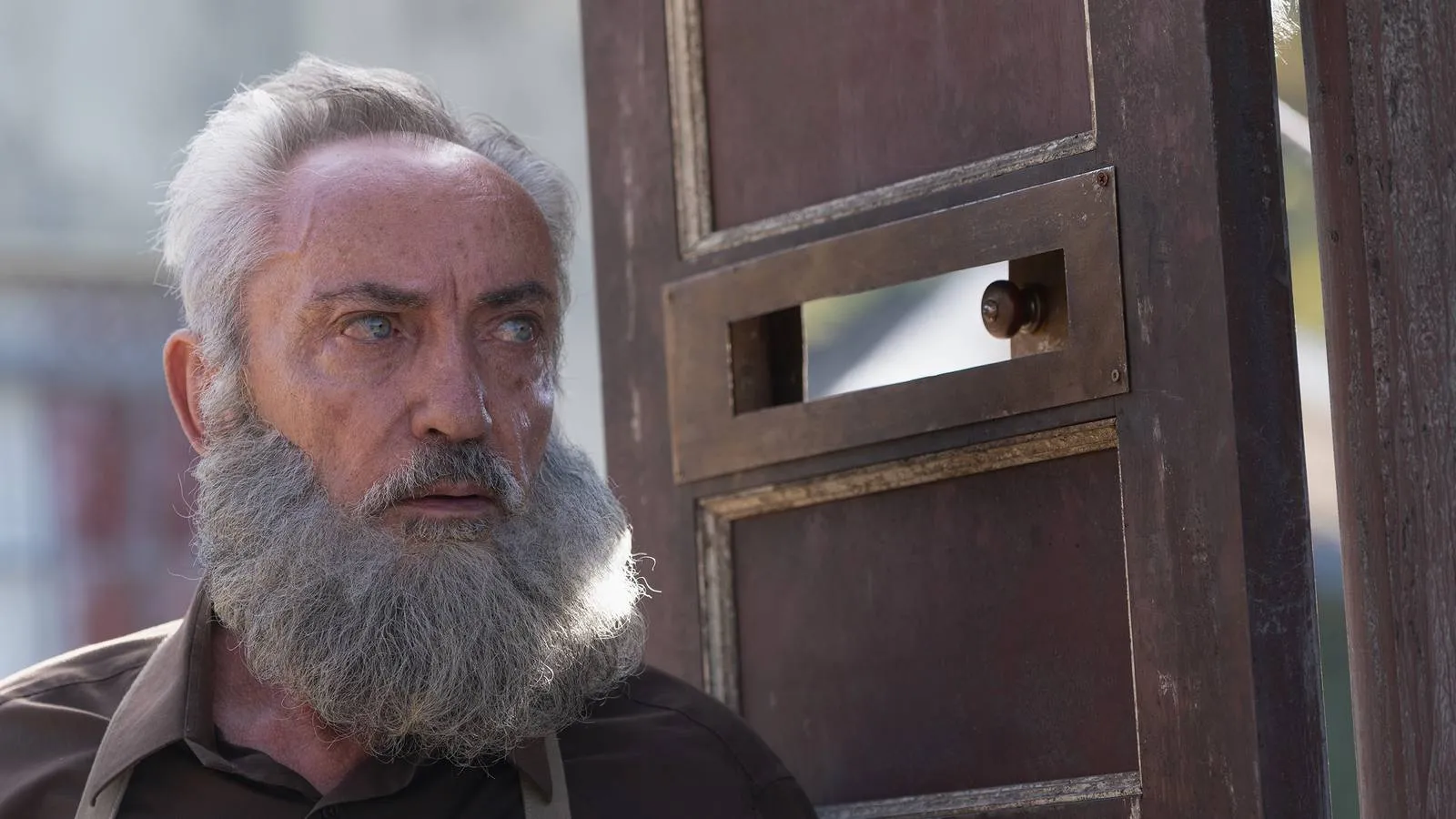
Expressionistic framing turns houses into traps. Doorways and window frames carve the men into compartments, a practical lesson in how architecture can imprison without bars. The film’s noir lineage shows in its voyeurism. Marek becomes the watcher, a surrogate for the classic thriller protagonist who sees too much and trusts too little. He peers, he listens, he constructs a narrative from scraps, and the audience gets pulled into the same compulsive pattern. The camera keeps placing you behind him, aligning your gaze with his fixation, then daring you to call it insight.
The tone pivots between slapstick and somber reflection with jarring speed. Clumsy spying sits beside the suffocating weight of the Holocaust, and the clash plays like a deliberate test of the viewer’s stomach. Strings and woodwinds keep time with a whimsical rhythm that sounds faintly mocking, as if the score is raising an eyebrow at the spectacle. The music undercuts the gravity on purpose, and that undercut forces a second look at Marek’s certainty. Is he tracking truth, or building a story that trauma wants to be true?
The black rose garden holds steady as a visual anchor, a patch of lost beauty under guard. The chessboard, filmed with crisp technical precision, becomes a miniature battlefield where identity is contested move by move. Lighting leans into chiaroscuro, throwing harsh shadows that obscure Herzog’s features and keep doubt itchy and alive. This is classic noir craft pressed into psychological service: the image refuses certainty, and the refusal becomes its own form of suspense. The mystery stays hot because the film keeps forcing you to see through Marek’s eyes, even as those eyes strain under the weight of memory.
The Impersonator and the Ethics of Empathy
The final act arrives with a revelation that snaps the moral problem into a new shape. Herzog admits he worked as a professional impersonator, serving as a stand-in for the Führer at minor events the dictator wished to skip. The confession rewrites the ethical equation in motion. A man performed the mask of evil, and the film asks how much guilt clings to the performer once the mask comes off. The question hangs in the air like smoke from an old fire, irritating and persistent.
Prudovsky keeps the ethical space gray and unsettled. Herzog still carries antisemitism in casual speech, delivered with the ease of someone repeating an old reflex. He calls Marek a good neighbor and then tacks on a remark that reduces Marek to his Jewishness. The line lands like a quiet slap. It shows prejudice that survived intact, tucked into everyday manners, still capable of doing damage with a smile.
Marek faces an existential choice and chooses to warn Herzog about approaching Israeli authorities. The decision reads as a wager on immediate human contact, even when that contact feels contaminated. It is an act of empathy that risks looking reckless, even dangerous. It also fits the film’s bleak curiosity about free will. Marek acts, and his action refuses the clean track of vengeance or civic duty. He chooses something messier, something recognizably human, and the film lets the discomfort remain.
The two men register as wreckage from the same historical storm. One remains a haunted survivor. The other stands as a discarded tool of the regime, hollowed out by proximity to power and by the roles he agreed to play. Shared trauma becomes a strange bridge between them, and the bridge sways under every step. The resolution stays quiet and somber, while avoiding the easy warmth of a standard Hollywood buddy comedy. The ending leaves forgiveness and the persistence of hate suspended in the mountain air, unresolved and stubborn. The final frames circle a bleak idea: you can live fence-to-fence and still fail to know the person living on the other side.
My Neighbor Adolf is a poignant comedy-drama that explores the psychological scars of the Holocaust through the lens of neighborly suspicion. Originally premiering at the Locarno Film Festival in 2022, the film is scheduled for its official US theatrical release on January 9, 2026, through Cohen Media Group. Set in the Colombian countryside during the 1960s, the story follows a lonely survivor who becomes convinced that his new German neighbor is actually Adolf Hitler. As of early 2026, viewers can watch the film in select theaters or find it on digital platforms such as Google Play and specialized streaming services like SBS On Demand.
Full Credits
Title: My Neighbor Adolf
Distributor: Cohen Media Group
Release date: January 9, 2026
Running time: 96 minutes
Director: Leon Prudovsky
Writers: Leon Prudovsky, Dmitry Malinsky
Producers and Executive Producers: Estee Yacov-Mecklberg, Haim Mecklberg, Stanislaw Dziedzic, Klaudia Smieja, Yigal Mograbi, Laura Franco
Cast: David Hayman, Udo Kier, Olivia Silhavy, Kineret Peled, Jaime Correa, Tomasz Sobczak, Danharry Colorado Cortés, Dorian Alexis Zuluaga Seguro
Director of Photography (Cinematographer): Radek Ladczuk
Editors: Hervé Schneid
Composer: Łukasz Targosz
The Review
My Neighbor Adolf
The film functions as a brittle, uncomfortable character study that thrives on the tension between its two leads. While the tonal shifts between slapstick humor and Holocaust trauma occasionally feel clumsy, the central performances by Hayman and Kier provide a necessary gravitas. It is a film about the ghosts we carry and the impossible nature of forgiveness. Despite a script that sometimes leans too heavily on artifice, the exploration of shared isolation remains haunting. It is an imperfect but deeply affecting look at the scars of history.
PROS
- Exceptional chemistry between David Hayman and Udo Kier.
- Striking, desaturated cinematography and visual style.
- Provocative exploration of empathy and moral ambiguity.
- A unique, intimate perspective on post-war trauma.
CONS
- Uneven tonal shifts between comedy and tragedy.
- A plot twist that may feel far-fetched to some viewers.
- Slapstick elements occasionally undermine the gravitas.
- The supporting characters lack significant depth.