



















Tall Tales arrives as a somber triptych of creative willpower, joining the sonic alchemy of Mark Pritchard and Thom Yorke to the visual futurism of Jonathan Zawada. The project takes shape as a run of pixelated parables, images and sound stacked in layers like a fever dream exhaled by the cooling fans of a tired server.
It exists as a visual album, a form that sidesteps the easy comforts of cinema and embraces fracture. A limited one-night cinema engagement came before the album release, throwing these shadows across a grand screen before they returned to the private glow of personal displays.
From the opening moments, dystopian reverb sits heavy in the air. That weight births a strange nostalgia, as though echoes of the past have been sealed inside digital amber. The work offers no traditional narrative to grasp. The viewer drifts through a sensory ritual, watching the wreckage of contemporary life refracted through abstract sight and sound. It plays like a fairy tale for a modern world that has forgotten how to dream outside high-definition light. The invitation leads into a void where the synthetic and the sacred share the same airless space.
The Boschian Ghost in the High-End Render
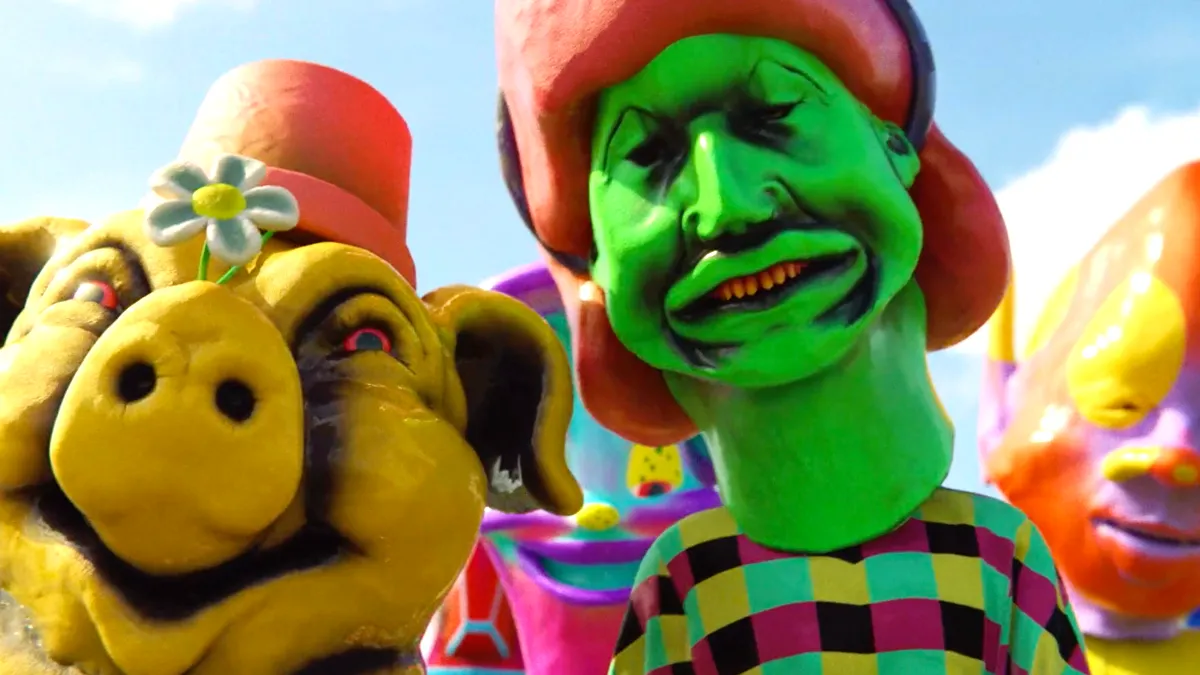
Jonathan Zawada’s visual language traces a direct, haunting line back to the grotesque moralism of Pieter Bruegel and Hieronymus Bosch. Triptych influences surface as digital monsters, roaming technicolor CGI landscapes that feel lush and diseased at once. The screen fills with a carnival of eerie figures that seem born from a medieval nightmare, then refined by a rendering engine until their horror gleams.
Unsettling townspeople with contorted limbs dance against saturated backdrops, stirring friction between beauty and deformity. The film keeps shifting its point of view, leaning on the cold gaze of drones and surveillance cameras as they watch massive construction sites and global shipping hubs.
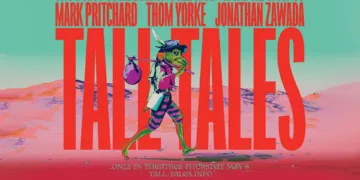
Under that gaze, the human world becomes a set of logistical motions inside a vast, indifferent apparatus of commerce. Between these industrial-scale episodes, a gamified world map appears. A small, bird-like traveler crosses its interface, guiding the viewer toward the next stage. The creature carries a sense of recognition while remaining profoundly unhomelike, a Boschian figure wandering a digital hellscape.
The meeting of organic texture and synthetic precision leaves a lingering uncanny mood. The boundary between the natural and the manufactured seems to melt into one shimmering surface of uncertainty. Lighthouses strain under rising tides. Robotic limbs perform tasks with a grace that feels predatory. Each pixel works to unsettle our sense of where we stand inside an environment shaped by artifice.
Echoes from the Lockdown Void
The music of Tall Tales carries the chill of its origin, forged during the forced isolation of global lockdowns. Mark Pritchard moves like an electronic alchemist, handling machines with a reverence that borders on monastic. His compositions slide between clear melodic routes and formless ambient waves that roll over the listener like a gray tide.
Inside this architecture, Thom Yorke’s voice hovers like a ghost. An anxious falsetto and wordless chants arrive as heartbreak filtered through a failing hard drive. In “Back in the Game,” the track becomes an anti-anthem for a society worn down by its own expectations. “This Conversation Is Missing Your Voice” turns toward a delicate elegy for lost connection, its melodies flickering like dying embers in a cold hearth.
The soundscape shifts from danceable undercurrents into abrasive, prickly electronica that mirrors the industrial brutality on screen. That harshness finds an uneasy harmony with the visuals’ natural beauty, leaving the sense that human longing still clings to the machinery.
Drums lock into mechanical precision, the heartbeat of a factory rendered as rhythm. The vocals reach for something ancient and exposed. The record holds the memory of a time when we stayed inside our rooms, staring out at a world that kept running without us, powered by silent algorithms and heavy machinery.
Forgeries in the Infinite Mirror
The project’s thematic weight rests on authenticity in an era of effortless reproduction. A central sequence, “A Fake in a Faker’s World,” shows an endless row of mechanical arms painting landscapes with terrifying rhythmic precision. The image presses questions about artistic labor and the worth of a human hand inside a field of generative tools. The arms move in unison, producing images that register as separate works while carrying a sameness that feels drained of spirit.
The title points to a world built on tall tales, false stories laced with enough truth to injure. The viewer moves through an unreal place where the medium critiques its subject, using automation to examine the erosion of the soul. Generative textures in backgrounds and organic forms sharpen the tension between the artist’s intent and the machine’s output. Zawada acknowledges the ethical complications of these tools, then uses them to map the trap we have constructed.
Cold digital mirrors dominate, and emotional hooks of curiosity and awe still persist through the chaos. Spinning motifs carry a quiet nostalgia, calling up the physical presence of a vinyl record and the memory of art as something with weight. The film offers a meditation on the human spirit enduring inside the machine. It argues for a truth that can live between the human mind and the silicon circuit, a place where imperfection becomes part of the signal. The machine turns into a mirror for displacement, a way to picture the static of a world moving too fast to register.
Released globally on May 8, 2025, Tall Tales is a surreal, feature-length visual album that serves as a companion to the collaborative musical project by Thom Yorke and Mark Pritchard. Directed by visual artist Jonathan Zawada, the film premiered in select theaters for a special one-night-only engagement before the album’s official release on Warp Records the following day. It features a hypnotic series of animated parables and experimental vignettes that blend digital landscapes with existential themes. While its theatrical run was limited, the experience can currently be explored through physical media and digital platforms associated with the artists’ discographies.
Full Credits
Title: Tall Tales
Distributor: Pivot Pictures, Oscilloscope Laboratories, Warp Records
Release date: May 8, 2025
Rating: PG
Running time: 65 minutes
Director: Jonathan Zawada
Writers: Jonathan Zawada, Mark Pritchard, Thom Yorke
Producers and Executive Producers: Mark Pritchard, Thom Yorke, Jonathan Zawada
Cast: Mark Pritchard, Thom Yorke
Director of Photography (Cinematographer): Jonathan Zawada
Editors: Jonathan Zawada
Composer: Mark Pritchard, Thom Yorke
The Review
Tall Tales
Tall Tales exists as a haunting artifact of our digital displacement. It captures the friction between human vulnerability and the cold precision of the machine, offering a sensory ritual for those willing to lose themselves in abstraction. While the fragmented structure and technological ghosts may alienate some, the work succeeds as a somber meditation on authenticity. It is a beautiful, unsettling forgery of reality that lingers long after the screens dim.
PROS
- Visually arresting landscapes that bridge classical art and modern CGI.
- A deeply atmospheric score that captures the isolation of the lockdown era.
- Provocative exploration of artistic ethics and the nature of artificiality.
- Innovative use of surveillance aesthetics to critique global industrialism.
CONS
- The fragmented nature can feel repetitive or lack a cohesive throughline.
- Languid pacing may challenge viewers expecting a traditional narrative.
- Controversial use of generative tools occasionally creates a sense of soullessness.