



















Auk Isle drops the viewer onto a wind-scoured slab of Scottish coast where weather and isolation define the rules. The film keeps its focus tightly on Isla and Sandy, siblings who have lived as orphans on the island for three decades. Their world is built from a private mythology: they claim descent from the local gulls and live to match that myth.
They wear feathered suits they make by hand, shriek at the sky and train with sandbags to repel outsiders. That careful, idiosyncratic order collapses when Daniel appears, a nervous land recovery coordinator from the mainland whose remit is to evict the pair to make way for government plans.
He brings paperwork, procedures and a bureaucratic logic that reads as threatening to the siblings. The island’s beauty reads as a form of protection and a source of danger for anyone who carries an eviction notice. From the first encounter the film frames the conflict as immediate and tactile, a collision between oral lore and modern property rules.
The Dynamics of an Unlikely Trio
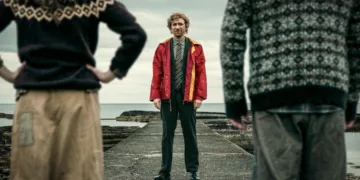
Domhnall Gleeson composes Daniel with a shaky, polite energy that keeps him on the defensive. Small physical details, such as his eczema, underline his status as an outsider under strain. The performance suggests a character who feels like a low-level functionary dropped into a survival scenario. Gayle Rankin’s Isla is all hard edges and guarded motion.
She performs protectiveness through a scowl and the threat of violence that covers a deeper fear of change. Her delivery carries a wild, witchlike intensity that anchors the siblings’ belief in island magic. Grant O’Rourke’s Sandy operates as a soft center, an adult who remains emotionally childlike. He shadows Isla with loyal affection and registers a quiet curiosity about the small items Daniel brings from the mainland.
The three-way chemistry propels the piece. Gleeson’s deadpan reactions to the siblings’ manic behavior make him an effective foil and provide much of the film’s comic rhythm. He gains their trust by presenting his smartphone as a talisman, a device he frames as a wizard’s tool that captures souls through photography.
That moment reveals how power imbalances are negotiated while also functioning as a bridge between two realities. Michelle Gomez appears in a brief but pointed role as Roz, Daniel’s icy supervisor. Her presence performs the institutional pressure bearing down on him and turns his emergent empathy into a minor act of resistance against his own systems.

Visual Storytelling and Mythic Elements
Pat Golan’s camera treats the island with slow attention. Long takes on grey cliffs and green, mossy patches let the location read like an active character rather than mere backdrop. Those grounded images sit beside pencil animations by Selina Wagner that visualize the siblings’ oral histories and translate their gull-based origin tales into playful sketches. The film adds a supernatural tint with the Fin Man sequence.
John Hannah plays a seal-human hybrid with an unsettling stillness that functions as a visible emblem of Isla’s grief and a pull toward the dark water that mirrors her urge to escape pain. The humor ranges from physical set pieces to drier observational beats. One scene has Daniel recast The Lord of the Rings as his own personal history, a small lie that serves to compress the scale of the mainland for the siblings.
Comic beats often come from misunderstandings about ordinary objects such as electric toothbrushes or plastic toys recovered from the surf. Those jokes relieve the isolation without ridiculing the siblings’ ignorance. The score, built from light strings and brass, keeps the tone buoyant and prevents the survival elements from becoming oppressive. Music cues guide the film through shifts from tense survival material to a gentler, character-focused study.
The Struggle for Connection and Change
The siblings’ insistence on staying is rooted in long-standing emotional damage. Their birdlike rituals act as protective armor against the trauma of parental loss. Remaining on Auk Isle freezes them in a childhood-shaped shelter, keeping adult responsibilities at bay. The script refuses to elevate the mainland as an inherently better option.
It uses the siblings’ bewilderment to make everyday modern life appear as strange as their gull rituals. Daniel’s attempts to explain the internet and supermarkets render our systems peculiar through the siblings’ eyes. Connection moves forward in small, concrete exchanges of story. Daniel adapts his own experiences into forms the siblings can accept, which becomes the practical work of trust-building. Narrative momentum follows a conventional arc of rapprochement, yet it gains force through quiet, detailed moments of change.
Tension rises when outside assistance arrives from the mainland. The climax centers on Isla’s internal reckoning: she must weigh the safety of ritual against the demands of an adult life that would require her to let go. The core conflict is the fear of losing identity. That tension makes the film’s resolution feel earned and frames leaving home as an act that requires courage to meet a future without past ghosts.
The Incomer is a whimsical and offbeat Scottish comedy that made its world premiere at the Sundance Film Festival on January 22, 2026, where it quickly became a standout in the NEXT section, eventually winning the NEXT Innovator Award. The film follows the collision between isolated island folklore and modern bureaucracy when a socially awkward council official is sent to evict two siblings who believe they are descended from seagulls. Following its successful festival run, the film was made available for limited online streaming through the Sundance at-home program in late January 2026. Audiences can currently look for it on the independent film circuit as it secures wider international distribution.
Full Credits
Title: The Incomer
Distributor: Charades, BFI, Screen Scotland
Release date: January 22, 2026
Rating: NR (Not Rated)
Running time: 102 minutes
Director: Louis Paxton
Writers: Louis Paxton
Producers and Executive Producers: Emily Gotto, Shirley O’Connor, Mia Bays, Kieran Hannigan, Steven Little, Trevor Noah, Sanaz Yamin, Lindsay Hicks, Moby, Phil Hunt, Compton Ross, Katie Holly
Cast: Domhnall Gleeson, Gayle Rankin, Grant O’Rourke, Emun Elliott, Michelle Gomez, John Hannah, Adam McNamara, Paddy Kondracki
Director of Photography (Cinematographer): Pat Golan
Editors: Brian Philip Davis
Composer: Tom Kingston
The Review
The Incomer
The Incomer succeeds through its commitment to a specific, eccentric vision. It handles themes of grief with a light touch, avoiding the heavy-handedness often found in mainstream dramas. The chemistry between the leads provides a grounded center for the more absurd folkloric elements. While the plot follows a standard path, the emotional sincerity makes the experience memorable. It is a heartfelt look at the fear of change.
PROS
- Strong performances by Domhnall Gleeson and Gayle Rankin.
- Charming use of animation to explain island folklore.
- Beautifully captured Scottish scenery.
- Genuinely funny culture-clash humor.
CONS
- Predictable narrative structure.
- Some supporting character roles feel underused.
- Whimsical tone might feel excessive for some viewers.