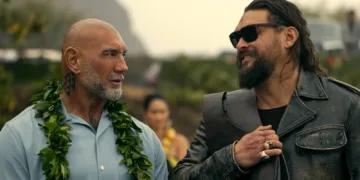














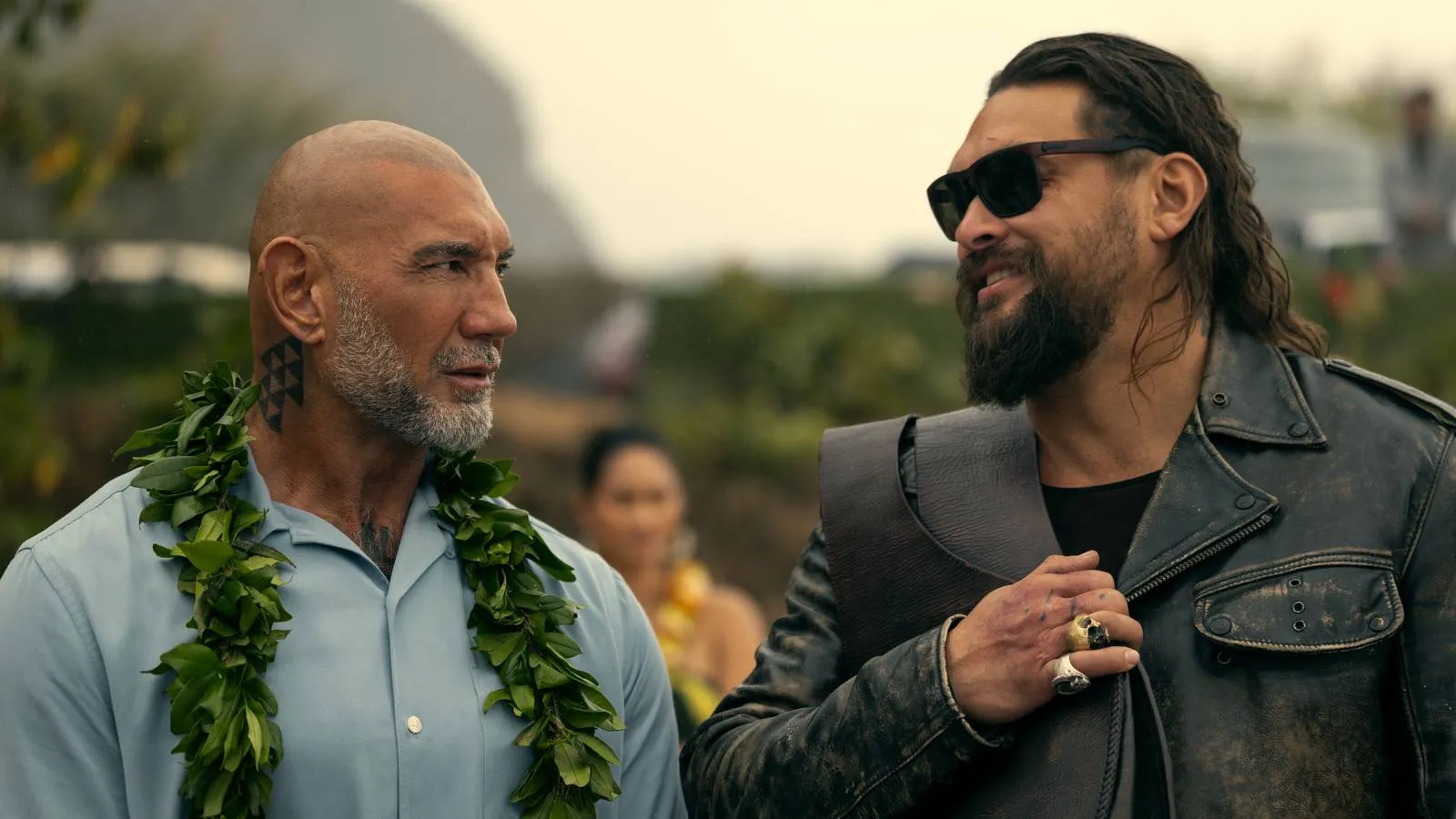

The Wrecking Crew lands on Prime Video on January 28, 2026, and it opens by letting two physical monoliths do the talking. Dave Bautista and Jason Momoa fill the frame with a kind of gravitational pull. The story sparks in Honolulu during the bright commotion of Chinese New Year, where Walter Hale, an elderly man wrapped in mystery, dies in a suspicious hit and run. His death triggers an uneasy homecoming for his estranged half-brothers.
James Hale, a disciplined Navy SEAL commander with roots in Hawaii, arrives carrying order like a second skin. Jonny, a volatile detective from an Oklahoma reservation, brings a hotter, less containable energy. Both men share a deep contempt for their absentee father, and they return to sift through the circumstances of his end.
The film frames itself as a visceral, R-rated throwback to late-twentieth-century buddy cop cinema, powered by high-velocity action, abrasive humor, and the raw friction of a family that never learned how to speak plainly. Paradise sits in the background like an accusation, its beauty cutting against the bloody investigation that follows.
The Architecture of Masculine Friction
The film’s mass comes from the clashing charge of its central duo. James Hale moves through the world with strict structure. Bautista plays him with stolid, analytical poise, a man anchored to home, a father whose children address him with military deference. That interior design shows up in his combat. His strikes read as decisions. Each movement lands with purpose.
Jonny lives by a different logic. Momoa shapes him into a relic of 1970s excess, a chaotic presence sealed in biker leather. He carries himself like a perpetual adolescent who finds balance through intoxication. His fights spill_toggle into improvisation, a riot of limbs and opportunistic timing. Put these two energies in the same room and the result feels less like scripted banter and more like a private argument that has been running for decades.
The film treats their physical collisions like a primitive form of psychoanalysis. Violence becomes their shared language. Each blow stands in for the conversation they keep dodging. James stays locked behind emotional restraint. Jonny covers instability with reckless charm.
Their deteriorating outer lives, especially Jonny’s fraying relationship with Valentina, echo the cracks inside them. The camera often lingers on their towering silhouettes against Hawaiian sunsets, framing them as isolated giants who still cannot locate a safe place to put their anger.
Bautista’s stillness and Momoa’s constant motion create a visual argument that runs through the film. The tension between order and entropy sits right there in the blocking and the cadence of bodies in space. Their relationship changes across the runtime, moving from hostility toward a shared front.
The framing tracks that evolution. Early sequences lean on separate close-ups that keep them divided. Later scenes place them together in wider compositions, the lens finally willing to hold both men in the same breath. Reconciliation arrives through geometry first, feelings later. That is a very James Hale solution, and Jonny looks mildly annoyed by it. Fair.
Excavating the Sins of the Father
Jonathan Tropper’s script gives the film a chassis sturdy enough for pulp aggression and modern psychological sensitivity. The writing works on two planes. One plane follows the demands of the mystery, pushing the investigation into Walter’s death through municipal corruption and predatory property development. Foreign interests circle the islands, trying to commodify Hawaii’s aesthetic value while local inhabitants absorb the cost. That thread plants the story in a concrete socio-economic reality, keeping the conspiracy from floating away into abstract villainy.
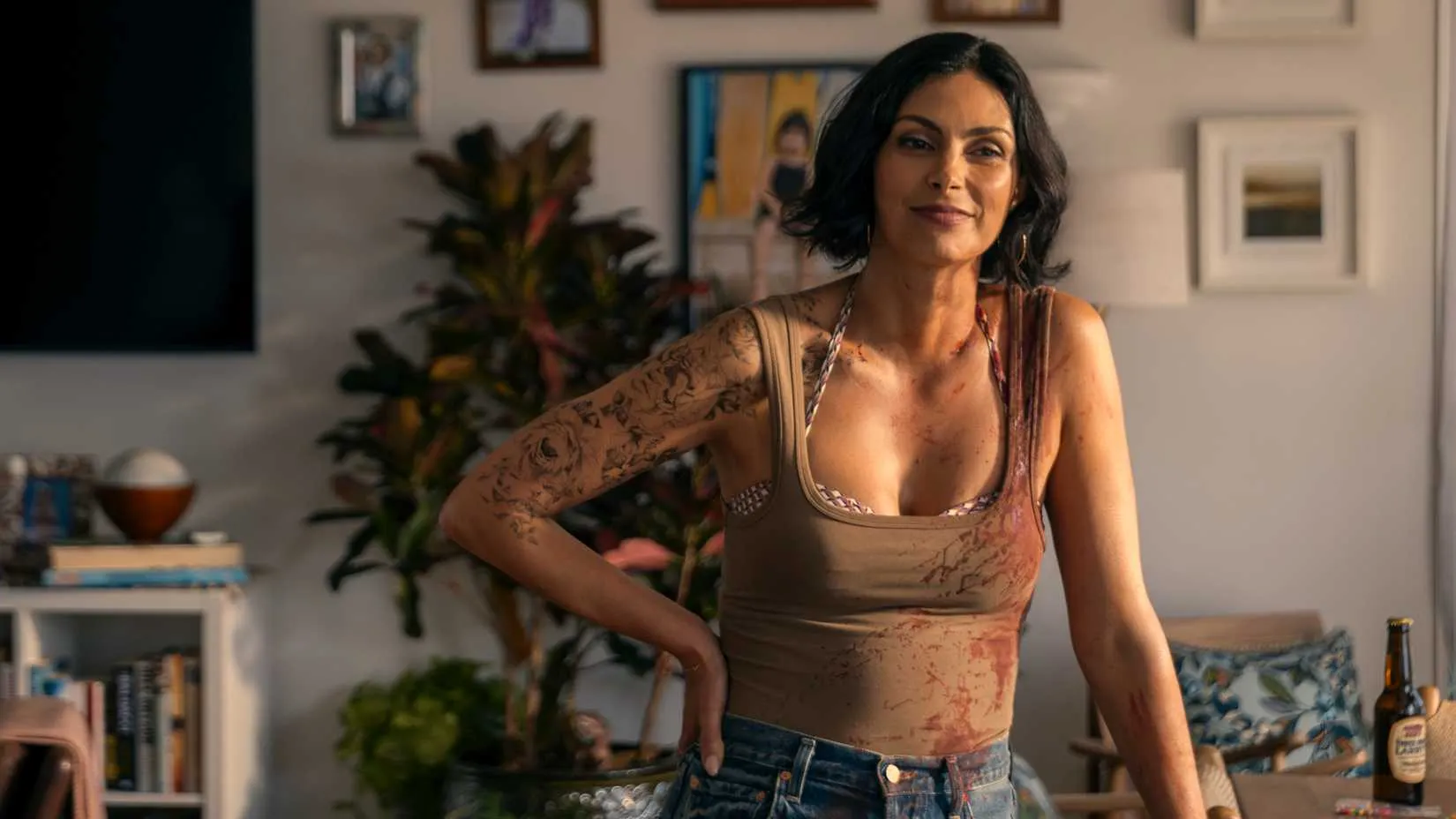
The second plane carries the ontological weight of the Hale family history. The script studies how paternal neglect hardens into a mold, shaping the sons without asking permission. James runs toward military hierarchy, treating it as sanctuary and correction. Jonny chooses instability and becomes a reflection of the unreliability he claims to despise. Their identities read like competing answers to the same wound, and the film keeps asking what control either man truly has over the shape of his own life.
The narrative pays attention to the cultural terrain of indigenous Hawaiian communities, presenting Hawaii as a place of immense beauty under pressure from organized crime and cynical capital. Dialogue swings with abrasive profanity and self-aware pop-culture nods, including insults that gesture toward the iconography of action cinema itself. Those meta winks bring a dry breeze through heavier material about ethical gray zones. The brothers face the moral ambiguity threaded through their father’s past, and the truth carries a cost. They have to decide what they are willing to break in order to know it.
The script refuses tidy closure. It leaves the brothers with tentative reconciliation, not a neat emotional bow. The film circles inherited guilt, asking if either man can step out from the shadow of a father who feels like a ghost haunting tropical brightness. The mystery’s solution matters, yet the story keeps steering back to identity, to the way the sons define themselves when the man who shaped them never stayed long enough to be known.
The Geometry of Carnage
Ángel Manuel Soto directs the action with sharp spatial clarity. He keeps the frame readable even as bodies fall, sidestepping the shaky-cam haze that turns impact into noise. The R-rating arrives with grim enthusiasm, and the film insists that violence has weight. Flesh bruises. Bodies break. People look fragile.
One sequence involving the industrial disposal of antagonists lands with revulsion and a streak of dark amusement. The choreography varies in texture and scale. A highway pursuit becomes a centerpiece of practical engineering, full of steel crunch and motorcycles threading through a chaotic motorcade. The emphasis stays on tactile stunts and kinetic momentum, letting physical dynamics carry the spectacle.
The film then pivots to closer quarters. A domestic skirmish puts Jonny in a traditional lavalava, dispatching Yakuza assassins with nonchalant brutality that frames him as casually lethal. James receives his own signature passage in a narrow corridor, staged as a nod to expressionistic framing associated with classic South Korean thrillers. For a stretch, he reads as a singular force against impossible numbers. Short corridor. Hard angles. A body moving like a metronome.
A visual discordance surfaces later. The film’s gritty realism weakens in the final act, where the climax leans into computer-generated environments that take on a weightless, video-game sheen. The earlier sequences hit with bone-crushing heft, so this shift trims some of that sting.
Lighting does heavy thematic work across the first segments. Heavy shadows and saturated hues generate a neo-noir mood aligned with the moral murkiness of the conspiracy. Sound design joins the lighting in the manipulation of perception. Impacts land with jarring clarity. Bone snaps and gunshots echo like punctuation marks that refuse subtlety. Soto treats tension as a craft built from image and sound moving in lockstep. Low-angle shots regularly inflate the protagonists into mythic scale, a choice that turns fistfights into something closer to ritual.
During the Chinese New Year sequence, red lanterns wash the combatants in a bloody glow. The color feels purposeful, tying violence to rebirth, and letting the festival’s beauty sharpen the ugliness on display. The film knows how to make celebration look like threat. Neo-noir loves that trick. Audiences do too, even if they pretend they don’t.
Tropical Noir and the Faces of Malice
The antagonists supply a needed counterweight to the leads’ sheer physical dominance. Claes Bang plays Marcus Robichaux with chilling detachment and polished refinement, a man surrounded by wealth and artifice. His English accent and meticulous topknot telegraph distance from street-level brutality. He operates like an architect of local misery, a figure who can treat suffering as an externality.
Nakamura moves as his kinetic shadow. Miyavi brings jagged, frenetic energy to the Yakuza enforcer, a predator driven by chemical stimulants and a deadened sense of empathy. The pair give the film a villainy palette that ranges from icy control to feral acceleration, which is a useful spectrum in a story preoccupied with moral compromise.
Supporting players thicken the Hawaiian texture. Jacob Batalon’s Pika offers a grounded presence and a bumbling foil to the brothers’ hyper-competence. Stephen Root settles into familiar territory as the beleaguered police superior, delivering ultimatums with weary authority that feels earned. Temuera Morrison carries the political weight of the plot as the Governor, his presence signaling the seriousness of corruption in play.
Locations shape tone as much as character. The cinematography captures Hawaii’s lush verdancy and New Zealand’s rugged terrain, and drone photography pulls back for expansive topographical views that frame the characters as small figures caught inside larger systems of power. Indigenous cultural elements keep the setting from sliding into postcard fantasy, and the presence of local veteran actors anchors the narrative inside a specific community. The story acknowledges life in neighborhoods like Kalihi, steering away from a sanitized paradise.
Sun-drenched surfaces coexist with ethical compromise, and the visual design leans into noir grammar. Chiaroscuro lighting in urban scenes evokes classic noir, with shadows stretching across pavement during the Chinese New Year chase. Darkness shows up in the brightest spaces. The Yakuza thread adds international intrigue, hinting at the global reach of Robichaux’s greed. The film’s cultural specificity becomes its sharpest edge, the thing that makes its tropical noir feel lived-in rather than decorative.
The Wrecking Crew premiered at the Regal Times Square in New York City on January 15, 2026, followed by a global streaming debut on January 28, 2026. This action-comedy features the highly anticipated pairing of Jason Momoa and Dave Bautista as estranged half-brothers navigating a conspiracy in Hawaii. Viewers can watch the film exclusively on Prime Video.
Full Credits
Title: The Wrecking Crew
Distributor: Amazon MGM Studios, Prime Video
Release date: January 15, 2026 (Premiere), January 28, 2026 (Prime Video)
Rating: R
Running time: 122 minutes
Director: Ángel Manuel Soto
Writers: Jonathan Tropper
Producers and Executive Producers: Jeffrey Fierson, Jason Momoa, Dave Bautista, Matt Reeves, Lynn Harris, Angela Laprete
Cast: Jason Momoa, Dave Bautista, Claes Bang, Temuera Morrison, Jacob Batalon, Frankie Adams, Miyavi, Stephen Root, Morena Baccarin, Maia Kealoha, Roimata Fox, Branscombe Richmond
Director of Photography (Cinematographer): Matt Flannery
Editors: Mike McCusker
Composer: Bobby Krlic
The Review
The Wrecking Crew
The Wrecking Crew succeeds as a bruising revival of the classic buddy cop genre. While the narrative treads familiar ground, the undeniable chemistry between Bautista and Momoa grants the film a heavy emotional center. It thrives on visceral stunts and a raw, sibling friction that elevates the material. The jarring shift toward digital artifice in the final act slightly diminishes the gritty impact established earlier. Ultimately, it is a loud, confident piece of action cinema that respects its lineage.
PROS
- Exceptional physical chemistry between Dave Bautista and Jason Momoa.
- Sharp, high-velocity action choreography with impressive practical stunts.
- Vivid use of Hawaiian locations and indigenous cultural context.
- A script that provides unexpected psychological depth regarding family trauma.
CONS
- Predictable mystery plot with a visible antagonist.
- Inconsistent visual effects, specifically the video game style climax.
- The two hour runtime feels slightly bloated in the middle.