























The pavement in Watts takes in midday heat the way a sponge takes in water, holding it alongside the low-frequency churn of nearby industry. In the Nickerson Gardens housing projects, the sky can feel like a concrete lid (a plain fact for anyone living under the LAX flight path). Wide-body jets sliding toward the airport form a steady aerodynamic ceiling (my name for that specific pressure, physical and psychic). Under it lives twelve-year-old Lil Ant, a kid who studies clouds with hungry concentration.
His father, Big Ant, has just come home from a cage (the carceral shadow stays close to this family, like the jet-fuel scent that hangs around the blocks). That return becomes the hinge for the Harris household. The apartment learned how to function around absence. Now his presence arrives with a hard, unfamiliar weight, crowding a space that had sealed itself around a memory. People outside these streets watch them through televised peril. Inside, the place carries a quieter vibration, more specific than sensational.
Lil Ant’s inner world feels too big for the concrete that contains him. He lives in sketches and silence. Big Ant’s reentry turns the home into a new fault line. He tries to inhabit a place that has already tightened.
Myth Shielding and the Pegasus Protocol
Lil Ant filters his world through Hellenic gods. He calls it myth shielding (my term for using ancient stories to metabolize modern trauma). In his private epic, Big Ant becomes Odysseus coming back to Ithaca (and the Trojan War takes the shape of years spent behind bars). The neighborhood streets shift into the Aegean Sea. The boy draws his father as Poseidon and draws himself as Pegasus with wings, a creature built for escape and survival.

The drawings function like insulation. They give him distance from the blunt record of his father’s mistakes. The film watches neighborhood boys stand with arms outstretched like wings, copying the planes above. It plays like runway choreography (an image of shared desire for elevation). These kids turn upward mobility into body language. Flight stays on the mind. It means a literal exit and a spiritual climb.
The airplanes never fade into wallpaper. They keep announcing a world that passes over Watts and keeps moving. Lil Ant wants the horse that flies. He wants the god who survives the sea. His skyward hunger presses against the heavy gravity of Big Ant’s lived experience, and the pressure shows.
Big Ant looks at the sketchbook with suspicion shaped by old wounds. In his view, myths can pull a Black boy’s attention into danger. He wants Lil Ant’s eyes on the ground, where safety can be measured in small choices and quick scans.
The Predator Lure of Sensitivity
Alphonse Nicholson plays Big Ant with jagged, nervous energy, like a man who keeps bumping into his own reflection. He sees his ghost in his son. Big Ant had his own creative adolescence before the carceral system took his youth (a cycle with a nearly gravitational pull). He reads Lil Ant’s sensitivity as a predator lure (my term for traits that draw systemic violence). The effort to harden the boy comes out clumsy, then painful.
He tries to crush the dreamer as a way of protecting the child (a strategy you hear at the tensest holiday dinners, when “love” shows up carrying a blunt instrument). The film lets that contradiction stand: care expressed as damage, fear translated into control.
Danielle Brooks plays Lozita as the household’s silent architect. She carries the physical and emotional load. Her weariness lands on the scene (a fatigue many mothers of color will recognize). She watches the two males in her home hunt for a shared language and keep coming up with fragments.
A shift comes when Big Ant studies a papier mâché Pegasus Lil Ant made for school. For a brief moment, his face softens. The hardness of his history thaws. He recognizes the beauty his son can make. The connection feels crystalline, clean, and almost shocking in its clarity. Then his unhappiness returns, right on schedule.
The camera pays attention to hands. Father and son both fidget with matching A necklaces. That shared tic points to an unspoken tether. Their bodies echo each other even while they shout. The bond reads like a structural fact, equal parts cage and sanctuary.
Vignette Logic and the Soil of Grace
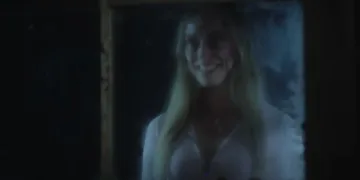
Walter Thompson Hernández avoids the standard mechanical plot and works in vignette logic (my term for a story assembled from emotional fragments). The film plays like visual meditation (the kind of piece that asks the audience for a slower pulse). Michael Fernandez photographs the community with warmth and reverence, using static compositions that resemble oil paintings. Faces get treated with real respect, held in frame long enough to matter.
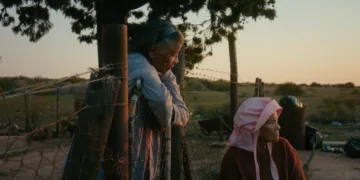
Many people on screen are not professional actors, and their presence brings a raw truth to the image. The film threads in surrealism with a light touch. Animated drawings jump from Lil Ant’s notebook and soften the border between the projects and the heavens. Horses at local stables sit as a grounded counterpoint to the planes, symbols of a different freedom, one tied to land that feels ancient and restorative.
Malcolm Parson’s score leans on wistful piano that echoes falling rain. Jon Batiste’s rendition of “This Bitter Earth” frames the narrative, reminding us the world stays harsh and the soil can still grow beauty. Hernández refuses tragedy as an easy lever for emotion. He stays with quiet scenes of a family trying to heal, suggesting grace lives in the effort to stay aloft under that aerodynamic ceiling.
This motion picture made its debut at the Sundance Film Festival on January 24, 2026. It premiered in the NEXT section of the event. Viewers currently find the film on the festival’s digital platform for limited screenings. The story focuses on a family in the Watts neighborhood of Los Angeles. It presents a look at the lives of a father and son living under the flight path of a major airport.
Where to Watch If I Go Will They Miss Me (2026) Online
Full Credits
Title: If I Go Will They Miss Me
Distributor: Spark Features, Further Adventures, Cedar Road, Merino Films, LinLay Productions
Release date: January 24, 2026
Running time: 95 minutes
Director: Walter Thompson-Hernández
Writers: Walter Thompson-Hernández
Producers and Executive Producers: Josh Peters, Saba Zerehi, Ben Stillman, Jennifer J. Pritzker, Robina Riccitiello, Isaac Ericson, Meredith Crowley, Jonathan Weiner, Grace Lay, Sakurako Fisher, Tyler Bagley, Jon Batiste, Ryan Lynn
Cast: J. Alphonse Nicholson, Danielle Brooks, Bodhi Dell, Myles Bullock, Bre-Z, Kelvin Adekunle, J.J. Boone
Director of Photography (Cinematographer): Michael Fernandez
Editors: Walter Thompson-Hernández, Daysha Broadway
Composer: Malcolm Parson
The Review
If I Go Will They Miss Me
The film is a soulful, visually arresting exploration of the "aerodynamic ceiling" that constrains marginalized dreams. While its mythic metaphors occasionally collide with its realistic grit, the emotional core remains steady through powerful performances. It is a rare work that chooses to gaze upward with wonder rather than downward with pity.
PROS
- Michael Fernandez turns the urban landscape into a series of warm, reverent portraits.
- The chemistry between Nicholson and Brooks provides a grounded emotional ballast.
- Dream sequences and animated sketches enhance the story without feeling forced.
CONS
- The Greek mythology sometimes competes for space with the aviation motifs.
- The vignette style might feel too slow or unfocused for audiences seeking a traditional plot.
- Some supporting character dynamics feel slightly schematic or truncated.