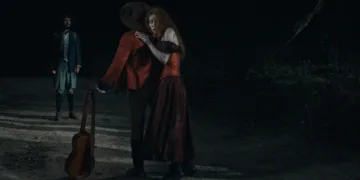































João Nicolau adapts a 19th-century Robert Louis Stevenson short story as the starting point for a film that holds the manners of a period piece while behaving like a contemporary formal game. Leon and Elvira enter first, high-spirited troubadours drifting through rural villages.
They live as partners and work as collaborators, staging two-person plays in any tavern or public square that tolerates their presence. The 19th-century setting sketches a romantic countryside of military jackets, rustic inns, and stubborn local officials, all suspended inside a theatrical unreality.
Then the film drops a central puzzle into place and snaps to contemporary Lisbon. Leon fronts a punk-influenced band called Desgraça, while Elvira works as a radical political activist. The film’s temperament stays quirky and absurdist, committed to its own oddities without apology.
Nicolau’s deadpan comedy carries a surrealist edge that keeps the viewer slightly unsteady. The story moves across a landscape that feels half-imagined and still legible as romantic terrain. This historical thread sustains a mock-epic tone while threading a present-day story shaped by tension inside a modern indie band.
The Quixotic Manifesto of Integrity
The film argues for the artistic life without attaching it to financial success or mainstream talent. Creativity arrives as its own reward in a world that greets artists with indifference, sometimes with hostility. Friction runs through every era.
In the past, that pressure takes the form of a boorish village police commissioner standing in for authority. In the present, the conflict takes shape through market forces, fiscal persecution, and a widening gap between rich and poor. The Lisbon material reflects the period struggle through modern institutions and modern language.
Radio interviews with the band and Elvira’s radical bill in parliament place artistic expression beside social concern as adjacent acts. A tense question hangs over the film’s view of integrity and talent. Leon performs in a way that reads as intentionally poor. Traditional skill never becomes his calling card, yet taste and integrity remain visible in his choices.
A poignant scene with the painter’s wife points toward dignity found inside a quixotic pursuit of fulfillment. Fame never drives these characters, and corporate approval never becomes a destination. They want permission to live on terms they can recognize.
The screenplay gains particular richness when Elvira sits with the painter’s wife by the fireplace, sharing a weary clarity about their partners. They acknowledge a lack of talent and still recognize integrity, tied to men who remain in thrall to artistic targets. The film treats creativity as a salve during hard times, a stubborn practice that keeps breathing even while the world tightens its grip.
The Theatricality of the Absurd
Nicolau’s direction favors sparse movement and master shots that linger for minutes at a time. The rigid blocking carries the stamp of the stage and keeps attention on performance as an act, a labor, a compulsion. Lisbon scenes play with a cleaner realism, while the 19th-century sequences arrive with a fairytale charge. The past carries a Technicolor look and over-amplified sound design. Every click of a heel across a tavern floor lands with sharp clarity, and that clarity intensifies the artifice.

Magical realism enters through unexpected images: a sky that violates expectation, water that screams with a force that can bring tears. These surreal intrusions interrupt narrative flow and insist on contact with the film’s unruly spirit. The soundtrack becomes a defining signature, moving through troubadour prog-rock and acoustic singalongs. Salvador Sobral appears as an English student on a walking tour, bringing contemporary Portuguese culture into the historical space through presence alone.
Joao Lobo’s music toys with the film’s temporal slips and gives the distribution of flyers the feeling of a modern gesture of rebellion. Frontal framings and night scenes keep the theatrical labor visible, as if the film wants each image to admit the staging that holds it upright.
The Temporal Möbius Strip
The two eras overlap and press on one another in a way that implies circular existence. The puzzle structure lets scenes slide into each other without immediate explanation. The narrative seems to twist back on itself like a ribbon, repeating forms while changing their surfaces. The film eventually hints that one timeline inspires the other. A song lyric in the present can act as a seed for the past. A story coming from Elvira’s pen can conjure the historical world into being.
Pacing stays loose, with little interest in standard plot propulsion. Attention shifts toward art itself: how it gets made, how it survives, how it rewrites the lives around it. The temporal jumps may land as jarring, yet they serve the characters’ absurd adventure as a governing rhythm.
The final act gathers the threads through symbols rather than clean explanation. A tidy wrap-up never arrives, and a standard resolution remains out of reach. The film turns toward meta-commentary about history’s fluidity and creative expression’s refusal of a straight line.
Leon and Elvira appear as reincarnations of themselves, searching for a place to sleep after getting locked out of their hotel. The Möbius-strip logic keeps past and present in constant exchange, each shaping the other without hierarchy. The result opens fresh angles on public discourse and love, treated as forces that survive through repetition, mutation, and performance.
Providence and the Guitar premiered as the opening film of the 55th International Film Festival Rotterdam on January 29, 2026. This Portuguese production, directed by João Nicolau, offers a whimsical and absurdist exploration of the artistic life by blending a 19th-century period piece with a contemporary narrative set in Lisbon. Following its festival debut, the film is expected to be available through its distributor, Shellac, in select arthouse cinemas and potentially on specialized streaming platforms later this year.
Full Credits
Title: Providence and the Guitar (A providência e a guitarra)
Distributor: Shellac
Release date: January 29, 2026
Running time: 125 minutes
Director: João Nicolau
Writers: João Nicolau, Mariana Ricardo
Producers and Executive Producers: Luís Urbano, Sandro Aguilar
Cast: Pedro Inês, Clara Riedenstein, Salvador Sobral, Isaac Graça, Jenna Thiam, Américo Silva, Beatriz Brás, Leonardo Garibaldi, João Pereira, José Raposo, Miguel Lobo Antunes
Director of Photography (Cinematographer): Mário Castanheira
Editors: Alessandro Comodin
Composer: João Lobo
The Review
Providence And The Guitar
João Nicolau’s work stands as a defiant celebration of the artistic spirit. It rejects the cold logic of the market in favor of a messy, beautiful integrity. While the temporal jumps might confuse those seeking a linear path, the film rewards the patient viewer with its wit and surrealist charm. It treats art as a necessity for survival. This is a bold experiment in style and substance. It succeeds by remaining true to its own strange rhythm and refusing to conform to standard expectations.
PROS
- Bold commitment to an absurdist and theatrical aesthetic.
- Thoughtful exploration of art as a political act.
- Strong, committed performances from the lead actors.
- Inventive use of magical realism and surreal imagery.
- Memorable musical score and song sequences.
CONS
- Jarring transitions between historical and modern timelines.
- A narrative structure that occasionally feels aimless.
- Theatrical acting style may alienate viewers seeking naturalism.
- Specific political themes feel underdeveloped.







