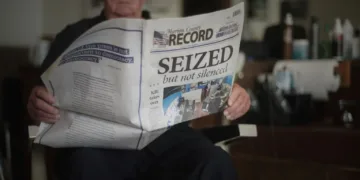




















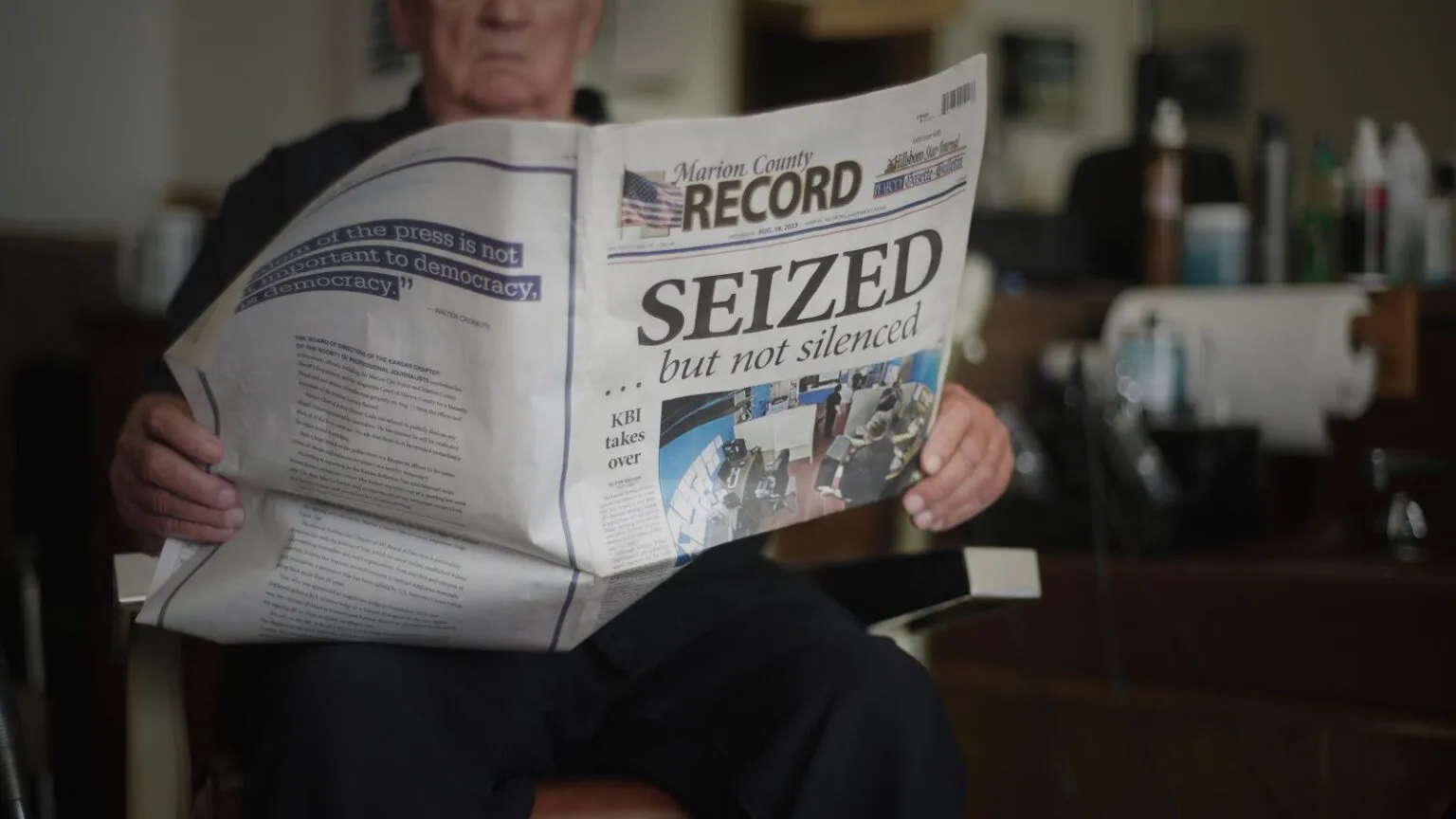

Marion, Kansas, looks like the kind of place where the loudest sound is a screen door shutting. Fewer than 2,000 people, a small downtown, the sense that big conflicts happen somewhere else. On August 11, 2023, that illusion shattered when local police raided the offices of the Marion County Record.
Officers seized computers and phones from staff, then went to the home of editor Eric Meyer and his 98-year-old mother, Joan. Sharon Liese’s documentary rebuilds those hours with a steadiness that keeps the focus on what happened, who held power, and who paid for it.
Body-camera footage places you in the middle of the confrontation, close enough to feel the pressure in every command and every pause. Joan Meyer’s resistance becomes the film’s emotional center, and her words land with the force of someone who has lived long enough to recognize intimidation when it walks into a living room. She compared the tactics to authoritarian regimes, then died of a heart attack the next day.
That timing turned a local dispute into a national flashpoint about the First Amendment. From there, the documentary tracks the year that followed, watching a family paper fight to keep going under political pressure. Liese keeps the story inside Marion’s limits, showing how personal grudges and civic authority can collide with constitutional protections. It also sketches the daily reality of journalism in places with thin resources and thick tensions.
The Raw Lens of State Authority
The film opens by dropping you directly into the raid through unfiltered body-camera footage. It’s a blunt technical choice, and it works because it strips away the comfort of distance. You see what the newsroom saw: officers demanding personal cell phones, the mechanics of a workplace being taken apart, and staff trying to keep their footing while the ground shifts under them.
Liese leans on modern surveillance technology to reconstruct the morning with urgent realism, and the perspective carries the feeling of intrusion. The footage captures confusion in real time, plus the immediate emotional resistance from people who refuse to be cowed.
Also Read





When the cameras reach the Meyer residence, the film finds its moral anchor. Joan Meyer sits in her chair and meets the intrusion head-on, shouting at the officers and calling their actions “Nazi stuff” with startling clarity. The stated justification circles around a complicated dispute involving a local restaurateur’s driving records.
Through editing and sequencing, Liese frames that official explanation as a surface story, with deeper personal motives among town officials pressing from underneath. As a viewer, I kept thinking about how documentaries about press freedom often start with abstract ideals, then snap into focus the moment you hear a door open and a badge announce itself. This one begins with that snap.
Friction in the Heartland
Eric Meyer comes through as a veteran newsman who treats journalism like a calling. He also comes through as someone who smokes outside his office and refuses to sand down his prickly edges for approval. The documentary stays clear-eyed about him and about the paper.
It does not paint the Record as a spotless civic saint. It shows a newsroom that can create friction all on its own, including a moment when Meyer used the front page to criticize the grammar in children’s letters to Santa. That choice alienated local parents and reveals a man who prizes precision and facts, even when social grace would smooth things over.
The film makes room for the town’s resentment. Many residents see the paper as a source of unwanted agitation. They want uplifting stories. They dislike police logs and embarrassing public records appearing in print. Liese uses that tension to sharpen the documentary’s central argument: constitutional protections matter most when the people using them are irritating, stubborn, or unpopular.
The Record carries a reputation as a community bully, and the documentary does not dodge that label. It shows how messy integrity can look in a small town where everyone remembers every slight and every headline.
A New Generation in Old-School Kansas
A year after the raid, Finn Hartnett arrives as a young transplant from New York, and his presence gives the documentary a fresh set of eyes. He belongs to a social media-savvy generation, yet he steps into an office where newspapers still get folded by hand and landlines still matter.
Through him, the film lingers on the unglamorous grind of local reporting: city council meetings, small events, cautious conversations at parades where people weigh every word before they offer a quote. Those scenes catch the slow work of trust-building in a place where everybody knows everybody’s business.
The film also tracks the strain between Finn and Eric Meyer. Finn worries about the paper’s reputation and what backlash can do to a fragile operation. Eric appears energized by confrontation, almost comforted by it. The generational gap becomes a learning curve written in real time. Finn comes to understand that in a small community, a committed local reporter can easily get cast as the villain, even while doing the job the First Amendment exists to protect.
The Chilling Effect of Checked Power
As the documentary widens its view of Marion’s conflict, it reveals a web of grievances involving the police chief, the mayor, and local business owners. Liese shows how small resentments can stack up until they produce something that looks like organized retaliation. The raid appears tied to abuses of authority, and it likely crossed federal laws meant to shield the press from this kind of overreach. Eric Meyer’s $10 million civil suit against the county underlines how serious the alleged violations are and how high the stakes remain.
The film treats Marion as a warning sign for other towns across the country. Many communities are losing their local watchdogs as newspapers vanish. In a place like this, the absence of the Record could leave power unchecked and misconduct unseen, tucked away in the routines of local politics.
Liese also reflects on a cultural shift: plenty of people no longer expect a newspaper to sit in their backyard, asking inconvenient questions week after week. The Marion County Record keeps working after Joan Meyer’s death, and the documentary frames that persistence as essential to slowing the quiet erosion of rights in rural America.
Seized premiered at the Sundance Film Festival on January 25, 2026, where it stood out in the U.S. Documentary Competition. Directed by Emmy-winner Sharon Liese, the film provides a gripping account of the 2023 police raid on the Marion County Record and the ensuing battle for press freedom. Currently, the documentary is traveling through the festival circuit—including an appearance at the Big Sky Documentary Film Festival in February 2026—and is in the process of securing a major distributor for a wider streaming or theatrical release.
Where to Watch Seized (2026) Online
Full Credits
Title: Seized
Distributor: Seeking Distribution (World Premiere at Sundance Film Festival)
Release date: January 25, 2026 (Sundance Premiere)
Running time: 94 minutes
Director: Sharon Liese
Writers: Sharon Liese
Producers and Executive Producers: Sharon Liese, Sasha Alpert, Paul Matyasovsky, George R. Hearst III, Jonathan Logan, Megan Gelstein, Debbie L. McLeod, Jonathan Murray, Harvey Reese, Ruth Ann Harnisch, Ann Baum, Steven Rosenthal, Trudy Jacobson, Jenny Raskin
Cast: Eric Meyer, Joan Meyer, Finn Hartnett, Phyllis Zorn, Cheri Bentz, Mike Powers, Gideon Cody
Director of Photography (Cinematographer): Jackson Montemayor
Editors: Derek Boonstra
Composer: Nicholas Semrad
The Review
Seized
Seized delivers a sharp look at the fragility of the First Amendment in rural America. Sharon Liese avoids simple heroism, choosing instead to present a gritty, honest portrait of a newspaper that prioritizes truth over popularity. The use of raw body-camera footage creates a visceral experience that highlights the dangers of unchecked local authority. It is a necessary watch for anyone concerned about the survival of local journalism and the personal costs of standing up to power.
PROS
- Use of authentic police footage creates a high-stakes, immersive atmosphere.
- Honest characterization of Eric Meyer avoids typical documentary cliches.
- Strong focus on the importance of local reporting in modern society.
- Effective contrast between veteran newsroom tactics and the outsider perspective of Finn Hartnett.
CONS
- The complex web of local grievances can feel slightly confusing for outsiders.
- Limited focus on the broader national political figures mentioned briefly in the narrative.