

























![Kingdom Hearts Collection [I-III] Review](https://gazettely.com/wp-content/uploads/2026/10/Kingdom-Hearts-Collection-I-III-1-360x180.webp "Kingdom Hearts Collection [I-III] Review: KHII Holds Steady as Newer Entries Fluctuate 37")



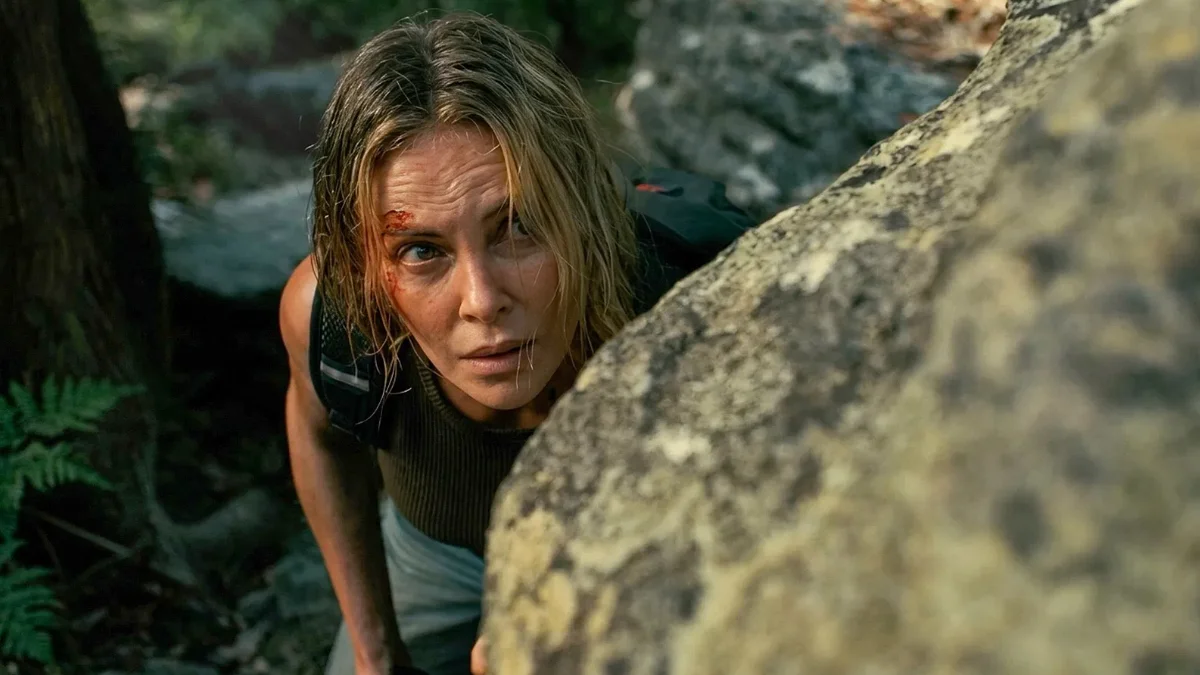

Baltasar Kormákur has made a career out of placing human bodies in confrontation with inhospitable terrain, and with Apex, arriving on Netflix on April 24, 2026, he returns to that territory with characteristic intensity and a clarity of purpose that distinguishes the film from the crowded field of streaming action product. The premise is direct: Sasha (Charlize Theron), a grieving extreme sportswoman, heads into the remote Australian wilderness to scatter her boyfriend’s ashes and finds herself hunted by a psychopathic local named Ben (Taron Egerton). There is nothing ornate about this setup, and the film makes no apologies for its simplicity.
What Apex offers is a lean, sun-scorched thriller built on craft and performance rather than conceptual ambition. Kormákur, whose filmography includes Everest, Beast, and Adrift, understands physical jeopardy as a cinematic language, and here he speaks it fluently. The film runs a tight 95 minutes and wastes none of them. Shot with the scope and visual grandeur of a theatrical release, it arrives on a platform where the scale of Lawrence Sher’s cinematography will be appreciated but somewhat diminished. That irony is real, though it does little to blunt the film’s impact.
From Troll Wall to the Outback: How Apex Earns Its Tension
The film opens on Norway’s Troll Wall, one of Europe’s most sheer and punishing rock faces, where Sasha and her boyfriend Tommy (Eric Bana) have made camp in a portaledge tent fixed to the cliff. The image of that tent, suspended against nothing, a paper lantern on a vertical wall, is an immediate statement of intent. These are people who live at the outer edge of what the human body can withstand, and Kormákur frames their world without sentimentality.
Their dynamic is drawn quickly and efficiently. Sasha pushes; Tommy pulls back. He has reached his threshold with extreme sport and says so plainly, expressing concern that Sasha has a habit of rushing at danger without fully accounting for the cost. His caution is vindicated in the worst possible way when a storm and avalanche during their descent lead to his death. Forced to release him to save herself, Sasha carries that guilt forward into the film like weight in a pack.
Five months later, she drives alone into the New South Wales wilderness to scatter Tommy’s ashes in his homeland. She registers at a ranger station whose noticeboard is dense with missing persons flyers, a detail the film deposits quietly and moves on from without underlining it. At a rural supply store she encounters two menacing kangaroo hunters whose names, Diesel and Ripper, do a great deal of characterisation work on their own. A friendlier local, Ben, intervenes and offers directions to a scenic camping route.
Screenwriter Jeremy Robbins handles this setup with admirable economy. The world feels populated enough to carry threat before it gradually empties out around Sasha. Her decision to follow a stranger’s directions reads as a small misjudgment for an otherwise sharp character, and the film acknowledges it as such without belaboring the point.
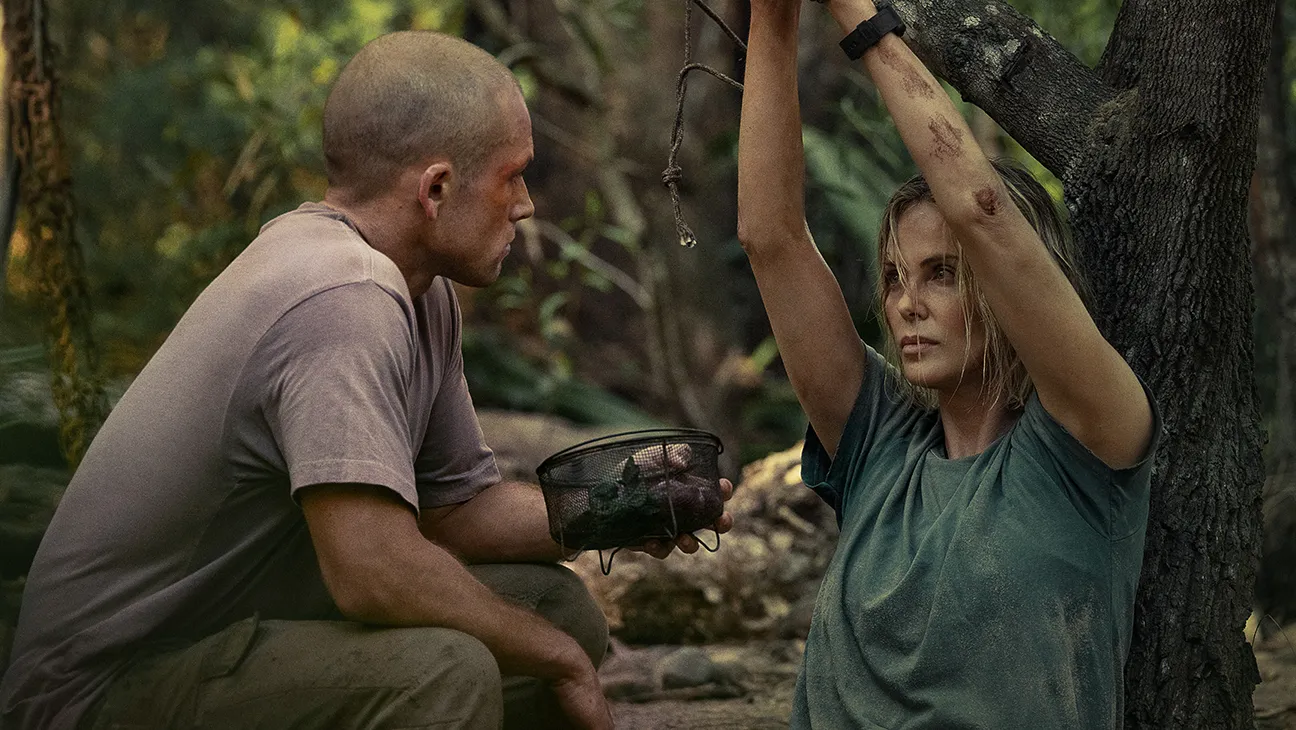
Ben’s villainy is revealed in stages. He steals her backpack, reappears offering replacement gear and breakfast, then drops the facade entirely, revealing himself as a practiced serial killer whose cave hideout is lined with the remains of previous victims. He grants Sasha a head start timed to a song blasting from a portable speaker, a touch of theatrical cruelty that tells us everything about who he is. From that point, the film locks into its central mechanism and never releases it.
Coiled and Unhinged: Two Performances That Hold the Line
Charlize Theron has built one of cinema’s quietly remarkable action careers, and Apex offers her a role that draws on that physicality while grounding it in grief. Sasha is not a superhero. She is a disciplined, experienced outdoorswoman who suffers, tires, bleeds, and adapts in that order, and Theron plays each stage of that process with tightly wound pragmatism. The performance is built on restraint and body language rather than dialogue. When Sasha assesses a rock face, a river rapid, or her pursuer’s position, the calculation behind Theron’s eyes is visible and specific.
Her stunt work is integral to the film’s credibility. The cliff climbing, white-water kayaking, and close-quarters scrambling through dense bush feel performed rather than manufactured, and that physicality gives the film its authenticity. Theron established Sasha’s rock-climbing capability in the prologue, and the film pays that investment back in the third act, where those skills become her only viable option for survival. It is a satisfying structural echo, the kind of narrative callback that signals a screenplay more considered than its genre positioning might suggest.
Taron Egerton is, by some distance, the more immediately surprising element here. Cast against the warmer, more accessible persona he has cultivated in previous work, Egerton plays Ben with a cheerful, can-do energy that renders the horror of his behaviour far more unsettling than brooding malevolence would. Ben is jovial, practical, and enthusiastic, a man who has found his calling. That cheerfulness is the dread.
Egerton calibrates Ben carefully, balancing rough charm with boyish lapses, cunning with matter-of-fact sadism. The dancing before the hunt begins, the theatrical use of the crossbow, the pride he takes in his cave of trophies: each beat is played with full commitment and without tipping into parody. What Egerton suggests quietly is that Ben represents a certain kind of male psychology taken to its furthest possible point, the instinct to dominate an environment and everything in it, left entirely unchecked. Together, the two leads generate productive friction. Theron’s coiled economy against Egerton’s unhinged extroversion is a pairing that works precisely because neither performance strains for effect.
Old-School Muscle: The Craft Behind Apex’s Survival Machine
Kormákur has made films about mountain disasters, ocean survival, and animal predation, and Apex feels like it draws on all of it. His direction is assured and unpretentious, rooted in a commitment to practical, on-location filmmaking that gives the action sequences a textural weight that CGI-dominant productions rarely achieve. Actors and stunt teams are placed in real conditions, and the landscape is treated as a genuine participant in the drama rather than a decorative surround.
His pacing is one of the film’s most underrated achievements. At 95 minutes, Apex contains no filler. Every scene earns its place by advancing either threat or geography, and the two are frequently the same thing. Caves, river rapids, dense bush, and cliff faces are each deployed as distinct arenas of tension, and Kormákur moves between them with a confidence that speaks to a filmmaker who has spent years thinking seriously about how physical space generates fear.
Lawrence Sher’s cinematography is the film’s most consistent and considerable pleasure. His work on the Norwegian Troll Wall sequence establishes physical dread through framing alone, forcing the eye downward along the cliff face in a way that produces a visceral stomach response. In Australia, he renders the wilderness in saturated, specific detail: lush river valleys, dense canopy, claustrophobic rock gorges. This is not the arid red desert of postcard Australia. It is green, dense, and oppressive, an environment that closes in.
Sigurdur Eythorsson’s editing is crisply purposeful, serving geography and tension without announcing itself. Sound design carries significant weight throughout: the jungle’s ambient noise, the deep roar of the rapids, the sharp report of a crossbow bolt, each mixed to register physically rather than decoratively. Högni Egilsson’s score stays appropriately below the action, ominous and functional, never swelling to cue responses the visuals are already generating on their own. The stunt work deserves explicit recognition as well. The white-water kayaking sequences, the vertical climbing, the close-quarters physical confrontations all feel earned. Consequence is visible throughout. Bodies accumulate damage. The film earns its action by showing the cost of it.
One tonal miscalculation lands at the very end: the credits song, “Nasty Boy” by Icelandic electropop act Trabant, strikes a register so discordant with the film’s closing scenes that it functions almost as an editorial accident. It is the one moment where Apex loses its footing.
Familiar Ground, Covered Well: Apex and the Survival Thriller Tradition
Apex belongs to a well-populated tradition: the wilderness survival thriller in which an isolated protagonist faces predation from environment and human antagonist alike. Deliverance, The River Wild, Wolf Creek, The Most Dangerous Game: the lineage is clear, and Kormákur makes no effort to obscure it. The film is genre-literate without being self-referential, drawing on established conventions with craft rather than apology.
The Australian setting contributes its own layer of cultural weight. Cinema has long treated the Outback as a space where civilised order dissolves and something older and more brutal takes over. Ben can be read as that tradition’s logical product: a man so thoroughly shaped by isolation and an unforgiving environment that he has shed any pretence of social identity and replaced it with something purely predatory.
Grief runs beneath the film as a quieter current. Sasha’s guilt over Tommy’s death gives her survival a specific emotional stakes beyond the instinctive. She has something to survive toward as well as away from. Robbins’ screenplay handles this lightly, which is the right call. The film would buckle under the weight of sustained psychological exploration. What it gives instead is a character whose emotional damage is legible without being laboured.
The film’s interest in male behaviour in isolated spaces is quiet but persistent. The hunters, the ranger’s unspoken concern, Ben as an extreme endpoint of a recognisable type: there is a reading of Apex as a film about what certain masculinity becomes when the social structures that nominally contain it are removed. Kormákur does not press this point, but he does not discourage it either.
The script’s limitations are real. Robbins writes efficiently, but efficiency is not depth, and several narrative beats arrive exactly when expected. Character development beyond the two leads is minimal, and the hunter-versus-hunted structure occasionally traces back over its own steps. These are the costs of a film that prioritises momentum above all else. The film knows precisely what it is, and it does that thing well.
Apex is an intense survival action thriller that premiered today, April 24, 2026. Directed by Baltasar Kormákur, the film stars Charlize Theron as Sasha, a rock climber seeking solace in the rugged Australian Outback while grieving a personal loss. Her journey for peace turns into a terrifying fight for survival when she is targeted by a ruthless, unhinged hunter played by Taron Egerton. Filmed on location in New South Wales, the movie is a high-octane chase against both human and natural elements. You can stream it exclusively on Netflix starting today.
Where to Watch Apex (2026) Online


Full Credits
Title: Apex
Distributor: Netflix
Release date: April 24, 2026
Rating: R
Running time: 96 minutes
Director: Baltasar Kormákur
Writers: Jeremy Robbins
Producers and Executive Producers: Ian Bryce, Peter Chernin, Jenno Topping, David Ready, Charlize Theron, Beth Kono, AJ Dix, Baltasar Kormákur
Cast: Charlize Theron, Taron Egerton, Eric Bana, Caitlin Stasey, Bessie Holland, Matt Whelan
Director of Photography (Cinematographer): Lawrence Sher
Editors: Sigurður Eyþórsson
Composer: Högni Egilsson
The Review
Apex
Apex is a survival thriller that knows its lane and stays in it with discipline. Kormákur directs with muscular efficiency, Theron and Egerton form a genuinely charged pairing, and Lawrence Sher's cinematography lends the film a grandeur its streaming home cannot fully honour. The screenplay is functional rather than inspired, and the genre beats are familiar throughout. Taken as a piece of craft-forward, pulpy genre cinema executed with seriousness and skill, it delivers squarely on its promise.
PROS
- Theron's physical, emotionally grounded lead performance
- Egerton's unsettling, against-type villainy
- Lawrence Sher's stunning cinematography
- Lean, disciplined 95-minute runtime
- Practical, largely CGI-free filmmaking
- Strong sense of location and atmosphere
CONS
- Predictable genre beats throughout
- Thin character development beyond the two leads
- Script lacks depth and originality
- Jarring end credits song undercuts the finale
- Hunter-versus-hunted structure grows repetitive







