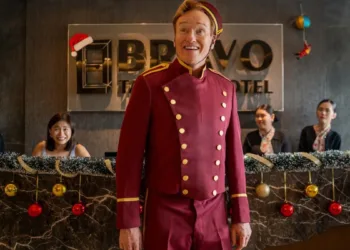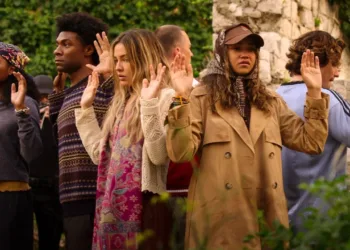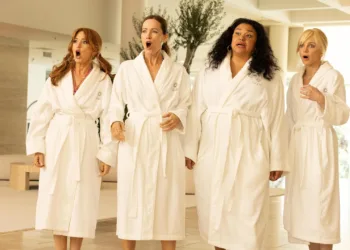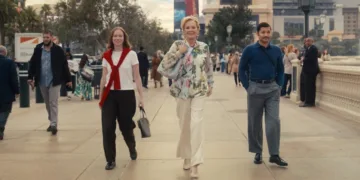

















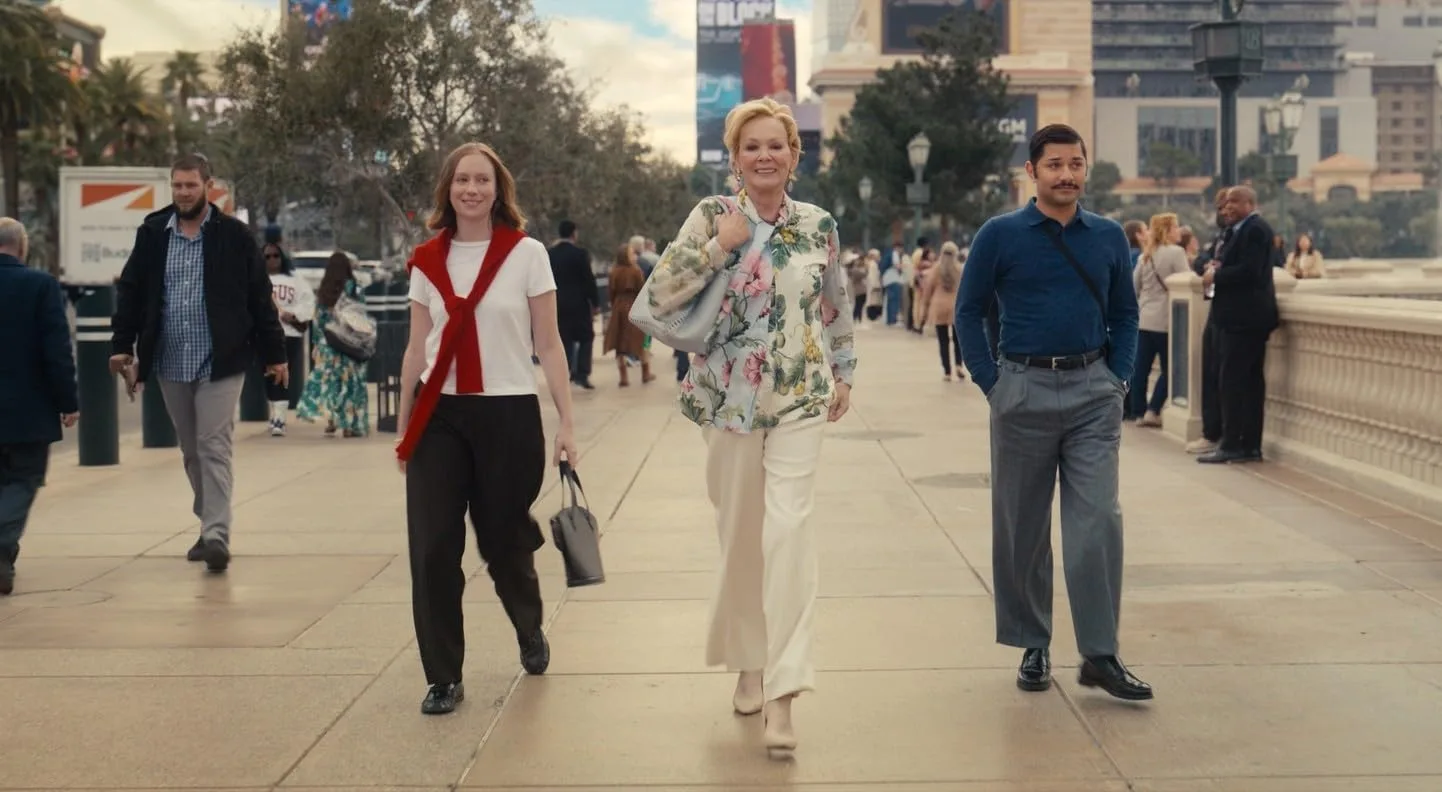

Hacks returns for its fifth and final season on HBO Max with the particular confidence of a show that knows exactly what it is and has decided, graciously, to go out on its own terms. Deborah Vance (Jean Smart), last seen drinking herself into a stupor in Singapore while performing through a translator to honour the letter, if not the spirit, of a punishing non-compete clause, is back in Las Vegas. TMZ has falsely reported her dead. Reading her own obituaries, she is, predictably, furious.
That fury is the season’s ignition. Across 10 episodes, co-creators Lucia Aniello, Paul W. Downs, and Jen Statsky use Deborah’s brush with fictional mortality to ask a question that sounds simple and lands like a weight: what do you want people to say about you when you’re gone, and what are you prepared to do to shape the answer? The gag order imposed by media mogul Bob Lipka (Tony Goldwyn) bars her from performing, from self-promotion, and from workshopping new material. The season’s central pleasure is watching a woman who has spent five seasons refusing to be stopped find increasingly inventive ways of not being stopped.
This is simultaneously the funniest and most emotionally honest Hacks has ever been.
The Ropes Have Never Looked Better on Her
Playing a recurring comedy protagonist is a trap. Character evolution too rapid and audiences feel cheated out of the person they signed up for. Too little change and the performance calcifies into self-parody. Jean Smart has spent five seasons walking that wire, and in Season 5 she does it with the ease of someone who has forgotten the wire is there.
The accolades (four Primetime Emmy Awards, with a fifth seeming almost bureaucratically inevitable) speak to the consistency of her work, but numbers flatten what Smart actually achieves in this final season. Deborah is at her most cornered here, legally prohibited from the one thing that defines her, and that constraint seems to liberate Smart entirely. She plays Deborah’s scheming with the giddy momentum of someone who treats obstacles as aesthetic challenges: pursuing an EGOT, courting a younger musician (Christopher Briney) for publicity value, considering reality television with the resigned pragmatism of a chess grandmaster sacrificing a bishop.
What the performance captures with particular clarity is the distinction between vulnerability and weakness. These are not the same thing, and Hacks understands that in ways much of prestige television does not. Deborah allows people in this season in ways she never has before. She leans on her team, on longtime companion Marty (Christopher McDonald), on her daughter DJ (Kaitlin Olson). This is a woman who spent the better part of four seasons treating emotional availability as a tactical error. The shift feels earned rather than imposed because Smart never plays it as a conversion. Deborah has not become a different person. She has become more fully herself.
Also Read




Season 5 also makes explicit what the series has always threaded through its storylines: Deborah has spent her entire career fighting men (husbands, executives, media moguls) who sought to exploit her talent, claim credit for her work, or simply erase her from the record. Bob Lipka’s gag order is the latest in a long line of such attempts. The difference is that this time, Deborah has an audience watching her refuse.
Two Women, One Frequency
The Deborah-Ava relationship has cycled through so many configurations (employer and employee, mentor and protégé, feuding adversaries, reluctant allies) that Season 5’s chosen mode feels like a genuine surprise: peers. Creative equals. Women who have decided to trust each other with their eyes open rather than in spite of themselves.
Season 4’s finale in Singapore left a bruise. Deborah’s dismissal of Ava as a person with no friends and no life beyond her was cruel in the specific way that Deborah’s cruelties have always been: accurate enough to sting, exaggerated enough to be unfair. Season 5 does not paper over this. It uses it. Ava’s choices in the final season are deliberate and self-aware. She is not staying out of dependency but out of genuine, freely given loyalty, and the difference registers in Hannah Einbinder’s performance as a kind of quiet confidence that her earlier seasons did not quite have.
The comedy that flows from their dynamic remains sharp. A physical altercation over a phone lands with the precise timing of a set piece that knows its characters well enough to trust them to be funny without extensive setup. Deborah’s commentary on Ava’s fashion choices (a jumpsuit described in terms that involve grandchildren and bathroom logistics) is the kind of line that works because the relationship has earned the right to be that specific.
The trade-off, and it is worth naming honestly, is that some of the show’s earlier, more corrosive energy has softened. The dynamic that once made scenes feel like watching two people defuse a bomb with insults has given way to something warmer. Less volatile, occasionally less surprising. That reads as a loss or a gain depending entirely on what you came for.
Episode 7, which HBO has kept under close embargo regarding specifics, gives Einbinder room to demonstrate a comedic range that the show has sometimes underused. It is a series highlight by any measure.
The Ensemble, the Algorithm, and the Humans in Between
Television comedy ensembles are frequently described as “strong” in the same automatic way that airline food is described as “fine.” Hacks’ supporting cast actually earns the word. Marcus (Carl Clemons-Hopkins), Damien (Mark Indelicato), Josefina (Rose Abdoo), Kayla (Megan Stalter), Jimmy (Paul W. Downs), and Randi (Robby Hoffman) constitute a group of people whose professional and personal stakes the show treats with real seriousness, and Season 5 makes good on that investment.
Jimmy’s arc this season is the most substantive he has been given. His fledgling agency, propped partly by Kayla’s trust fund and newly assisted by Randi’s peculiar brand of hyper-competent deadpan, becomes a vehicle for examining what it means to build something fragile and call it yours. Randi, Emmy-nominated for her Season 4 guest work, is deployed with the restraint the character requires. She appears at precisely the right moments, a hyper-specific fact here, an unexpected solution there, and the show’s discipline in not overexposing her is part of why she works.
The season’s standout supporting showcase belongs to Kaitlin Olson. A bottle episode centred on Deborah and her daughter DJ functions simultaneously as broad physical comedy and genuine emotional reckoning. It provides closure for one of the series’ most intractable relationships, and Olson’s fearless timing makes it feel spontaneous even when it is clearly the result of careful construction.
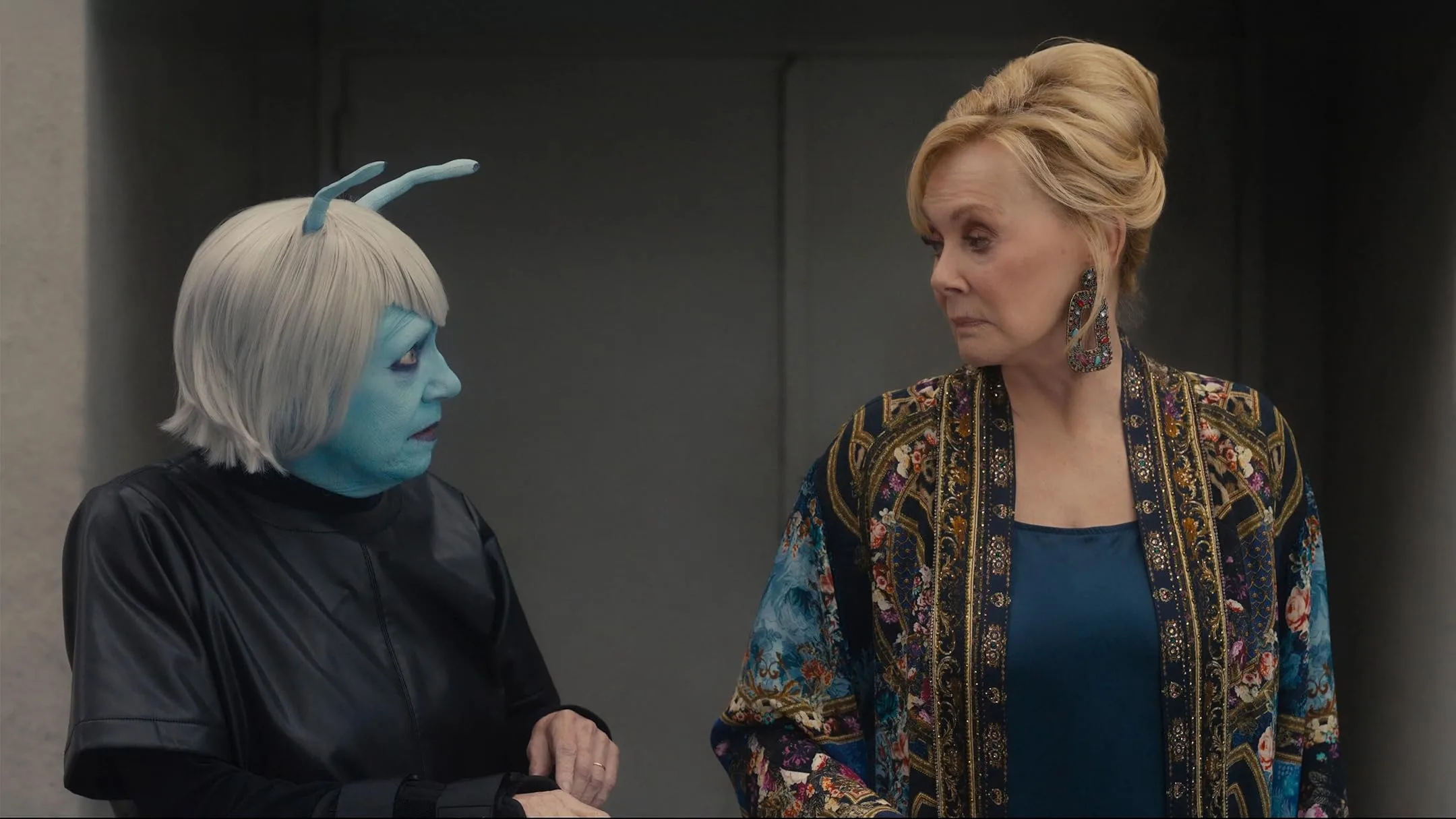
The artificial intelligence episode arrives with considerable force and a transparent agenda. The creative team’s anger on the subject is evident and, frankly, grounded. The episode anchors its argument in Deborah’s relationship with her fans (the “Little Debbies”), framing the threat of AI as an assault on the irreducibly human transaction between an artist and an audience. This is the episode’s genuine insight, and it lands. Where it occasionally loses its footing is when the argument tilts from impassioned to instructional. There is a difference between a polemic that pulls you in and one that assigns you a seat.
Going Out Like You Mean It
The season’s structural architecture is deliberate. The first three episodes are propulsive and funny in the mode of Season 1’s scrappiest hours: Deborah scheming, her team scrambling, everyone working angles with the resourcefulness of people who have nothing to lose. The middle stretch maintains momentum while quietly planting seeds that only become legible later. Then, around episode eight, the show shifts register.
The final three episodes are the season’s most daring. The tonal gear-change is noticeable. These are chapters that trade some of the season’s comic velocity for emotional weight, and they do so with enough confidence that the trade feels chosen rather than forced. The penultimate episode rushes through its climax in a way that initially reads as a structural lapse. In retrospect, given what the finale does with the time reclaimed, it reads more like a strategic compression.
Season 5 was written with long-term viewers in mind, and the callbacks, returning faces, and full-circle moments land with the specificity of a show that has kept its own receipts. Recurring jokes resurface with new contexts. Sidelined storylines, including the sitcom Who’s Making Dinner?, return carrying consequence their earlier appearances barely hinted at. These moments reward attention without punishing those who have not memorised every prior season.
The finale delivers emotional wish fulfillment of the earned variety. A late development, hinted at in the season’s quieter passages, reframes what has come before in ways that feel genuinely surprising rather than engineered. The show’s central argument, that legacy is built through relationships as much as achievements, through the people who believed in you and the people you chose to believe in, arrives with clarity and genuine feeling.
Hacks maintained its quality across five seasons. That is a rarer achievement than the industry tends to acknowledge.
Hacks is an American dark comedy-drama that explores the complicated mentorship between Deborah Vance, a legendary Las Vegas stand-up comedian, and Ava Daniels, an outcast Gen Z comedy writer. Season 5, which premiered on April 9, 2026, serves as the series’ final chapter, following Deborah’s continued evolution and her ever-shifting professional partnership with Ava. New episodes are currently being released weekly on the Max streaming platform, with the grand series finale scheduled for May 28, 2026.
Where to Watch Hacks Season 5 Online





Full Credits
Title: Hacks (Season 5)
Distributor: Max (formerly HBO Max)
Release date: April 9, 2026 (Season 5 Premiere), May 13, 2021 (Series Premiere)
Rating: TV-MA
Running time: 26–35 minutes per episode
Director: Lucia Aniello, Paul W. Downs, Desiree Akhavan, Trent O’Donnell
Writers: Lucia Aniello, Paul W. Downs, Jen Statsky, Andrew Law, Pat Regan, Samantha Riley, Ariel Karlin
Producers and Executive Producers: Jen Statsky, Paul W. Downs, Lucia Aniello, Michael Schur, David Miner, Morgan Sackett, Melanie J. Elin
Cast: Jean Smart, Hannah Einbinder, Carl Clemons-Hopkins, Megan Stalter, Paul W. Downs, Rose Abdoo, Mark Indelicato, Kaitlin Olson, Christopher McDonald
Director of Photography (Cinematographer): Adam Bricker
Editors: Jessica Brunetto, Rob Paglia, Susan Vaill
Composer: Carlos Rafael Rivera, David Stal
The Review
Hacks Season 5
Hacks Season 5 is a finale that respects its audience, its characters, and its own history. Jean Smart delivers a career-best performance in a season that is funny, emotionally precise, and structurally confident. The softening of Deborah and Ava's dynamic costs the show some of its earlier voltage, but what replaces it feels true. This is a series that knew when to leave, and left well.
PROS
- Jean Smart's performance is extraordinary
- The Deborah and Ava dynamic reaches its most satisfying resolution
- Strong, generous treatment of the supporting ensemble
- Consistently funny, especially in the opening episodes
- The finale earns its emotional weight
CONS
- The loss of the show's earlier acidic energy is occasionally felt
- The AI episode tips into didactic territory
- The penultimate episode rushes its climax
- Ava's life outside of Deborah remains underdeveloped