





















![Kingdom Hearts Collection [I-III] Review](https://gazettely.com/wp-content/uploads/2026/10/Kingdom-Hearts-Collection-I-III-1-360x180.webp "Kingdom Hearts Collection [I-III] Review: KHII Holds Steady as Newer Entries Fluctuate 40")


The Star Spores mark the beginning of Earth’s biological collapse, introducing a parasitic infection that transforms the planet’s landscape into the hostile expanse known as The Encroachment. Sergeant Varlette, the lone survivor of a fallen squad, is kept alive through a forced symbiosis with an alien parasite grafted to his body.
This parasite links him psychically to the ChainStaff, and its bug-like visual attached to his head serves as a stark reminder of his fading humanity. While Varlette gains significant power through this connection, he remains on the brink of erasure, his existence a constant battle for survival against the spores sustaining him.
His mission centers around finding a cure while combating the very forces that keep him alive. The game world reflects a grim vision of nature turned hostile, evoking bio-horror aesthetics found in global cinema, where the body becomes a battleground for external forces. Varlette’s survival presents a high-risk struggle against extinction as he traverses a world that no longer recognizes him as part of it.
The Mechanical Dialect of Hook and Gun
The ChainStaff is a multifunctional tool and weapon, serving as both a hook to latch onto surfaces and enemies and a spear for combat. This allows Varlette to swing through chaotic environments with agility, while the staff can also be embedded into the ground to create temporary platforms or brace against heavy objects. In combat, it transforms into a spear that inflicts significant damage and stuns enemies with armor.
It also functions as a defensive shield, blocking incoming projectiles. The gunplay complements this rhythm of destruction, where the player adopts a focused stance to fire with high precision at specific weak points. The pacing of gunplay contrasts with the fast-moving hook, creating a deliberate flow that stands apart from the rapid motion.
The sound design amplifies this connection, with the “crunchy” reports of gunfire and the visceral squelching of alien carapaces adding to the immersive experience. The gun’s attachments, such as homing rockets and parabolic bombs, provide tactical variety for dense encounters.
Despite the additions, the ChainStaff remains central to the experience, dictating how the player moves and fights within the 2D plane. It turns the environment into a playground, its synergy with combat and movement rewarding players who master precision and momentum. The ability to adjust the staff’s length or Varlette’s height while suspended offers the player multiple approaches for attacking.
Spatial Literacy in a Fractured Landscape
“Lite-vania” is the structural backbone of ChainStaff, organized across nine or ten distinct stages, diverging from the sprawling interconnected worlds typical of the genre. The level-based format invites exploration and backtracking, with visual cues and landmark recognition compensating for the lack of a real-time mini-map. The pause screen provides blurred indicators showing areas where secrets may lie, guiding the player’s curiosity.

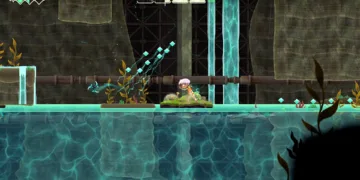
The game’s progression hinges on finding spore eggs to unlock new stages, alongside discovering new equipment that offers transformative abilities. The fish tail allows swimming up waterfalls, and the jellyfish parasite grants hovering through dense clouds. These tools open up previously inaccessible paths and reward curiosity, while collecting staff pieces provides permanent upgrades.
The verticality of the levels encourages swinging through the air, with hidden areas offering wounded soldiers and key items. Drone stations serve as teleportation hubs, facilitating quicker movement within larger stages. The game remains concise, ensuring the frequent backtracking does not become tiresome, instead offering a focused experience of discovery.
The design of the levels emphasizes height and depth, allowing players to engage with every nook of the environment. This condensed structure highlights a more intentional approach to level design within the indie scene, where new abilities change how players perceive the game world.
Artistic Excess and the Weight of Choice
The game’s aesthetic channels a demented sketchbook filled with colored pencil drawings and magazine cutouts, drawing significant inspiration from the surrealist works of Roger Dean. Creature designs reflect the grotesque transformations often seen in the films of John Carpenter, with aliens visibly damaged as they are shattered into viscera.

The heavy metal and prog-rock soundtrack enhances the game’s aggressive energy, with guitar riffs accompanying action sequences and full rock songs with vocals intensifying key moments. This audio-visual package complements a system of moral consequence, where players encounter stranded soldiers across levels. Saving these survivors provides tech points for gear upgrades at droid stations, while devouring their hearts or brains offers immediate health and firepower boosts.
These decisions have significant consequences, affecting character interactions and influencing one of six possible endings. The darker path symbolizes the increasing influence of the alien parasite over Varlette’s mind. This moral choice system serves as a compelling reason to revisit the game, with New Game+ modes allowing players to explore various outcomes and experience the full narrative range.
The game uses its “metal” energy to frame these heavy choices, forcing players to confront whether survival justifies the loss of humanity. The interplay between the art style and mechanical choices results in a cohesive and memorable identity, where the decaying enemies mirror the potential decay of the protagonist’s own spirit.
The Review
ChainStaff
ChainStaff succeeds as a heavy metal love letter to side-scrolling action. The mechanical depth of the staff provides a refreshing layer to the combat and movement. Its visual identity feels raw and intentional. The moral choice system adds weight to a relatively brief experience. While the map system requires patience, the sheer creativity of the world makes every encounter significant. It delivers a concentrated blast of adrenaline and body horror.
PROS
- Visceral 80s metal aesthetic
- Deep hooking and staff mechanics
- Meaningful moral choice system
- High-energy soundtrack
CONS
- Ambiguous map system
- Short total playtime
- Chaotic enemy density