



























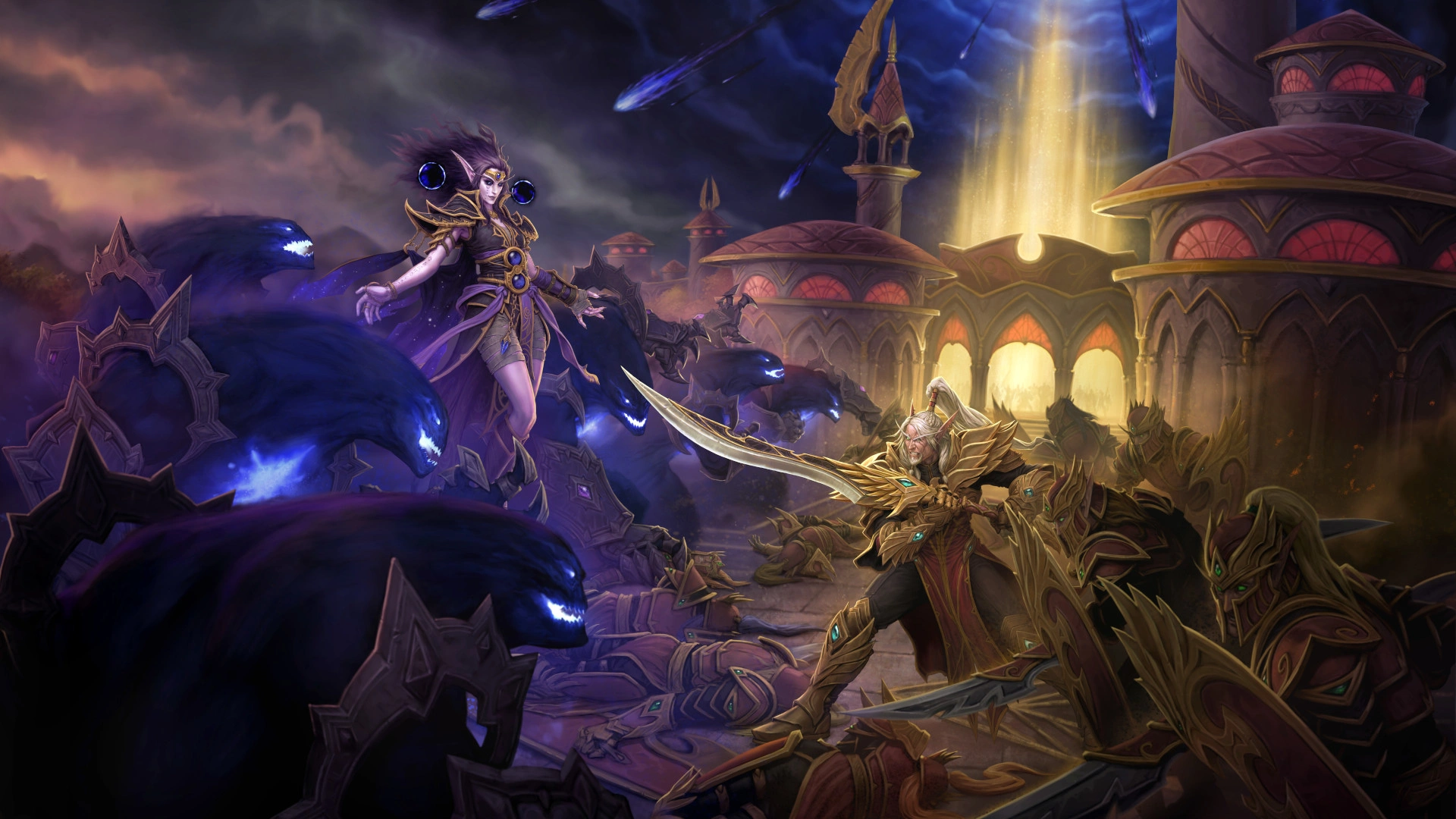
World of Warcraft: Midnight functions as the middle chapter of the Worldsoul Saga, sending the player into the elven kingdom of Quel’thalas during a full-scale emergency. Xal’atath drives a Void army through a huge portal above the Sunwell, putting that source of power in immediate danger.
The opening conflict gives the expansion a clear strategic frame: defend Silvermoon City with Arator, the half-elf child of Turalyon and Alleria Windrunner, then work to unite elven factions before Xal’atath’s plan can come into focus.
The setup works best through its visual design. Silvermoon’s bright elven architecture clashes with the purple spread of the Void, creating a clean readable image of a culture under siege. The contrast between polished spires and creeping darkness gives the threat a physical presence.
The Sunwell’s holy light seems to push against the shadows, which helps the stakes feel constant across the early chapters. The narrative frames the invasion as a possible cultural extinction event, and that focus gives the player’s actions a firm emotional shape. From the first stretch of Midnight, the survival of the blood elves depends on holding the line against forces that feel larger than any single skirmish.
Old Spires and New Shadows
The return to familiar places gives Midnight one of its strongest hooks. Silvermoon City and Eversong Woods have been rebuilt with a full physical overhaul, and the redesign pays particular attention to height. Flight changes the way these locations are read. Towers, roofs, and raised platforms become part of exploration, letting the player move through elven architecture with a sense of scale that the early version of the region could never fully support.
The surrounding zones broaden that structure with mixed success. Zul’Aman has moved from dungeon space into a large outdoor zone, trading enclosed progression for a rugged forest identity that feels far removed from the refined capital.
The Voidstorm takes the opposite approach, offering a cold, hostile wasteland built around a stronger concept. Harandar, home of the Haranir race, feels less connected to the central elven conflict. Its tone fits the previous expansion’s style better than the current war in Quel’thalas, which makes it feel slightly displaced within Midnight’s main arc.
The writing shows the same uneven pattern. Side stories carry much of the emotional force. The tale of two estranged troll siblings facing their shared past lands with real impact because it narrows the stakes to a personal wound. The main storyline moves at a faster pace, which leaves less room for character motivation to breathe. Arator, in particular, receives development through direct dialogue, a method that feels clearer than subtle.
The environmental storytelling elsewhere often says more with less friction. New factions such as the Domanaar give the setting a sharper edge. Their cutthroat behavior plays against elven pride, helping the expansion present a world in transition through cultural tension, regional design, and faction identity. For players who enjoy lore-driven exploration, that texture gives the map plenty of reward.
Streamlined Combat and Technical Evolution
Midnight makes several technical changes that reshape everyday play. Blizzard has folded key user interface tools into the game itself, reducing the need for external programs. The Cooldown Manager and built-in damage meters give players essential information through a cleaner interface.
That change matches the encounter design. Dungeons and bosses now rely on clear visual indicators, so mechanics can be understood by watching the action on screen without studying guides or leaning on complex addons.
The Den of Nalorakk dungeon shows this philosophy in practical form. One sequence has players racing predators for food. Another asks them to hide from powerful winds. These objectives communicate their rules quickly and turn the space into a readable challenge. The Voidspire raid uses a higher-pressure version of the same idea, with an arena floor that changes during combat. Positioning becomes a constant task as hazards shift around the group.
Class design follows the same streamlining. Many classes have fewer active abilities and reduced utility spells, cutting down the number of buttons needed for regular play. This helps new or returning players understand their toolkit faster.
Longtime players may find some rotations too plain. The Devourer specialization for Demon Hunters fits that tension. Its Void-themed attacks, including Consume and Reap, are easy to grasp, yet the specialization lacks some of the kinetic force found in other melee options.
The new mini-dungeons support players who prefer solo content. Their scenarios vary enough to keep the loop from feeling rigid. One mission sends the player into an underground fighting pit for mushroom people, giving the format a playful identity without breaking the larger structure of progression. Compared with earlier versions of this content, these activities show a clearer sense of variety and pacing.
Home Ownership and the Hunter’s Path
Two major systems shape progression outside raids and dungeons. Player housing gives the player a personal foothold in Azeroth. The building tools provide generous control, with options to rotate and clip furniture so each home can feel deliberately arranged. Decorations come from many activities, including quest completion and crafting. That structure turns a house into a record of the player’s history, tying customization to long-term play.

The Prey system adds pressure to outdoor zones. Players choose a target from a list, complete zone tasks to track it, then stay alert because the enemy can ambush them at any time. This restores a sense of danger that has been absent from open-world play for a long stretch.
The three difficulty levels give the feature a useful range. Nightmare mode offers powerful gear and difficult debuffs, asking the player to manage defensive skills with care. Death during a hunt sets back progress, which makes each encounter carry weight.
Both systems benefit from account-wide progression. Work completed on one character helps the rest of the roster, which makes experimentation across roles feel smoother. This design respects player time by keeping effort valuable after a character switch. Housing and Prey give Midnight a steadier endgame rhythm beyond the familiar raid and dungeon cycle, with one system built around expression and collection and the other built around risk, tracking, and outdoor combat discipline.
The Review
World of Warcraft: Midnight
World of Warcraft: Midnight successfully revitalizes classic locations while introducing essential modern features. The visual redesign of Silvermoon is a triumph. While the main plot occasionally rushes through its beats, the side quests provide significant emotional depth. The removal of mandatory addons through better UI tools makes combat more accessible. Player housing offers immense creative freedom. The Prey system introduces a needed level of risk to world exploration. It is a confident step forward for the franchise that balances nostalgia with functional evolution.
PROS
- Exceptional visual redesign of Silvermoon City.
- Intuitive and deep player housing tools.
- Improved built-in UI reduces reliance on external programs.
- High-quality side quest narratives.
- Dynamic world challenge through the Prey system.
CONS
- Pacing issues in the main campaign.
- Simplistic class design in certain specializations.
- The Harandar zone feels narrative-wise out of place.
- Technical glitches with new features at launch.