





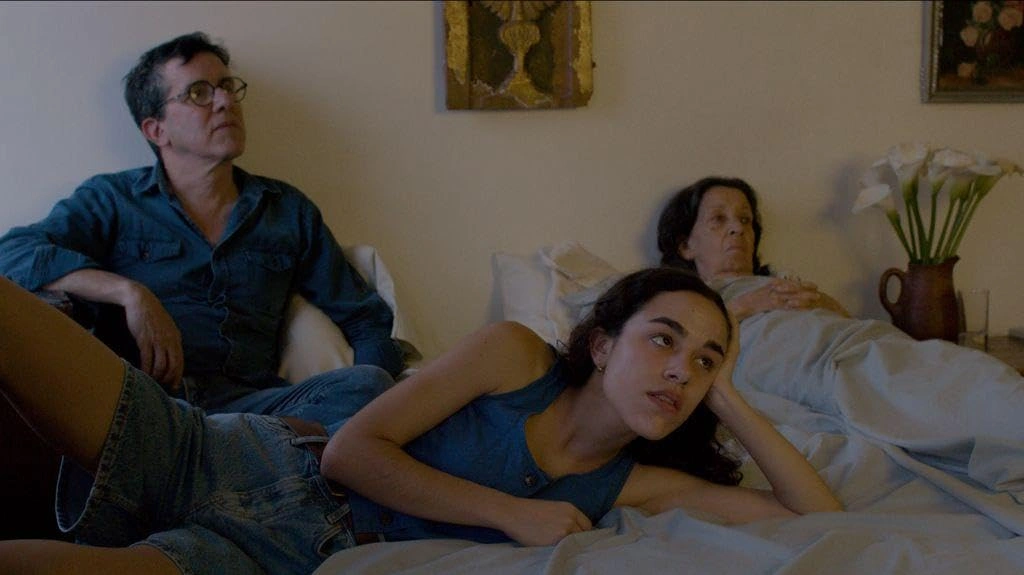

Memory in Lorena Alvarado’s film behaves less like an inner faculty than a failing public service. It depends on unpaid caretakers, decaying institutions, private rooms, and the stubborn belief that keeping something nearby counts as saving it. Sometimes it does. Sometimes it merely postpones disappearance.
Lost Chapters places this idea inside a quiet family visit. Ena returns to Caracas and stays with her father, Ignacio, a former bookstore owner, and Mamama, her grandmother, whose memory has begun to fracture. A written clue found among the family’s books sends Ena and Ignacio searching for an obscure Venezuelan novel that may have been published under a pseudonym.
Their investigation provides the film with the outline of an adventure, though nobody appears interested in behaving adventurously. There are no revelations delivered beneath cathedral floors. There are booksellers, crowded rooms, uncertain references, and people trying to remember who wrote what.
The other search is smaller and considerably harsher. Ena attempts to recover the complete poem Mamama learned during childhood, prompting her through lines that still surface between periods of confusion. One mystery asks if a book survives somewhere. The other asks how long a person remains herself when language begins leaving first.
The Books Outlive the Bookstore
Ignacio’s closed bookstore is the film’s finest political argument because Alvarado never turns it into a speech. The books are still there. The commercial and civic structure that gave them circulation has vanished. Shelves, corners, and storage spaces fill with volumes that have become culturally valuable and economically weightless, which may be the modern definition of heritage.
Ignacio continues collecting them. Friends who have left the country permit him to remove books from abandoned personal libraries. Other collections arrive because their owners need space or money. He speaks of preserving Venezuelan literature and imagines a museum that may never possess a building, visitors, or institutional support. His project occupies the uneasy territory between scholarship and compulsion. A nation unable to protect its cultural record has outsourced the work to a man with a crowded house.
The film refers obliquely to the country’s “situation,” a phrase large enough to contain economic collapse, political repression, emigration, and the exhaustion produced by having to explain any of it again. Masks at book markets retain traces of the pandemic. Dark aisles and precarious towers of secondhand volumes reveal a cultural economy surviving through improvised exchange. The absence of direct political exposition is partly honest. Families living through prolonged crisis rarely narrate it to one another for the audience’s convenience.
Yet Alvarado’s discretion creates a problem. The world outside the family home can feel sealed behind glass. Ignacio’s collecting clearly responds to public collapse, but the film leaves the pressure itself faint enough that viewers must reconstruct much of the connection. Call this archival insulation: history is everywhere in the room, while history as lived conflict remains down the hall.
Ignacio Alvarado gives these passages their pulse. His presence combines intellectual appetite with an unmistakably paternal ease. When he follows a dubious lead or carries another collection home, the act feels ridiculous and necessary at once. He cannot rescue the literary life of a country by accumulating its books. He collects anyway.
A Poem Against Oblivion
Mamama’s scenes refuse the comforting lie that memory loss reveals some purer emotional truth beneath language. Her confusion is not mystical. It is frighteningly specific. She forgets that Ignacio is her son. She misremembers which relatives remain alive. She wanders away into the neighborhood, leaving Ena and Ignacio searching without finding her.
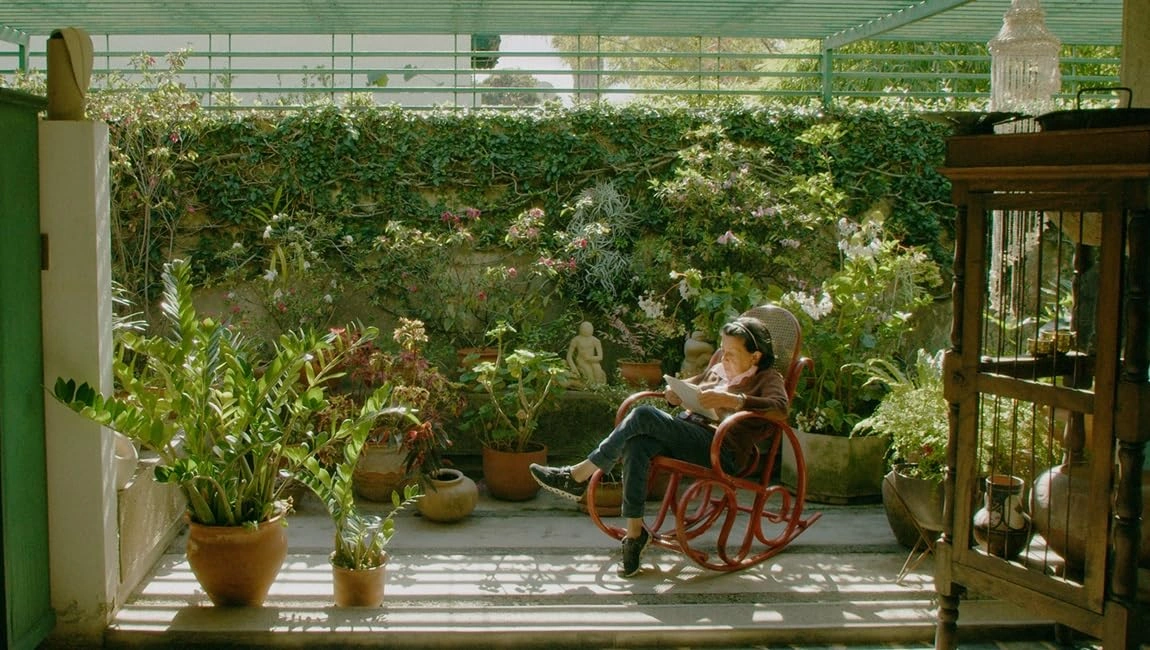
Alvarado avoids converting this disappearance into a suspense sequence. The uncertainty simply remains in the film until Mamama later appears at home, lying on the couch while Ena plays the piano. The missing explanation matters. Dementia enters family life through gaps that cannot always be reconstructed, and the edit reproduces that condition without announcing its cleverness.
The poem becomes Ena’s most intimate act of preservation. She offers lines, waits for recognition, and helps Mamama retrieve portions of a text that once belonged effortlessly to her. It mirrors Ignacio’s collecting, though the emotional stakes differ. A forgotten book can remain dormant on a shelf. A forgotten poem changes the person who carried it.
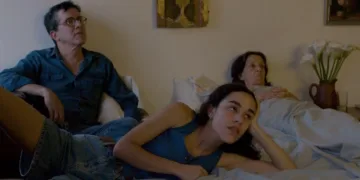
Warmth survives in repetition. Mamama watches Ena at the piano. The family sits before a soap opera. Familiar routines continue after recognition has become unreliable. The natural performances give these moments the texture of domestic observation, with affection expressed through patience rather than declarations.
The film is strongest when it permits love to look like work.
Caracas as a Chosen Memory
Old photographs and postcards introduce Caracas as a city already edited by memory. These images are records, but they are composed records, selected viewpoints that preserve one version of a place while excluding countless others. Alvarado extends this logic through José Ostos’s static cinematography. Apartment buildings, libraries, trees, public architecture, and high-rise facades sit inside carefully balanced frames. Birds and distant traffic continue beyond the family’s concerns.
The camera rarely moves. When it does, such as during Ena and Ignacio’s scooter ride past a brightly painted wall, motion carries an almost illicit charge. The city briefly stops resembling an archive and becomes physical again.
This formal stillness gives the film its contemplative beauty and much of its dramatic weakness. The rare-book search produces leads rather than momentum. Conversations arrive with the visual reserve of interviews. At 67 minutes, the film can feel oddly expansive because scenes accumulate without tightening into confrontation or discovery.
A television-news sequence offers the sharpest expression of this distance. As the family watches, the sound gradually recedes until public reality becomes silent imagery. They live within political crisis while retreating into books, poems, and private ritual. The retreat is protective, cultured, and faintly absurd. History bangs on the window; everyone keeps reading.
Alvarado’s frames do not solve the conflict between preservation and life. Ignacio’s books may never reach readers. Mamama’s poem may not remain intact. The missing novel may exist only through references made by people who can no longer verify them. Caracas endures as photographs, architecture, room tone, and recollection, each form preserving a portion while quietly misplacing the rest.
Lost Chapters had its world premiere at the Marseille International Film Festival in July 2024 and received a limited theatrical release in the United States starting July 24, 2026. The film is currently screening at select independent venues like the IFC Center. The story follows Ena, who returns to Caracas after years abroad to find her grandmother losing her memory and her father obsessively searching for rare Venezuelan books. After discovering a mysterious postcard, she sets out to find a forgotten writer, an effort that parallels her family’s struggle to retain their history.
Full Credits
Title: Lost Chapters
Distributor: Several Futures
Release date: July 10, 2024
Running time: 67 minutes
Director: Lorena Alvarado
Writers: Lorena Alvarado
Producers and Executive Producers: José Ostos, Lorena Alvarado, Tyler Taormina, Emiliana Ammirata
Cast: Ena Alvarado, Ignacio Alvarado, Adela Rodríguez
Director of Photography (Cinematographer): José Ostos, Lorena Alvarado
Editors: Lorena Alvarado
Composer: Various
The Review
Lost Chapters
Lost Chapters treats memory as a fragile public utility, maintained by families after institutions have stopped paying the bill. Lorena Alvarado’s static frames, unfinished literary search, and scenes of Mamama losing familiar names create what might be called archive melancholy: the fear that preservation can continue long after access has vanished. Its restraint sometimes becomes emotional insulation, and the rare-book mystery carries little dramatic pressure. Still, the film’s quiet attention to Caracas, literature, and domestic repetition gives absence a precise shape.
PROS
- Rich literary and cultural themes
- Warm, natural family performances
- Thoughtful static compositions
- Memorable poem and piano scenes
- Strong link between memory and preservation
CONS
- Limited dramatic momentum
- Political realities remain too distant
- Rare-book search feels underdeveloped
- Restraint sometimes creates detachment