

























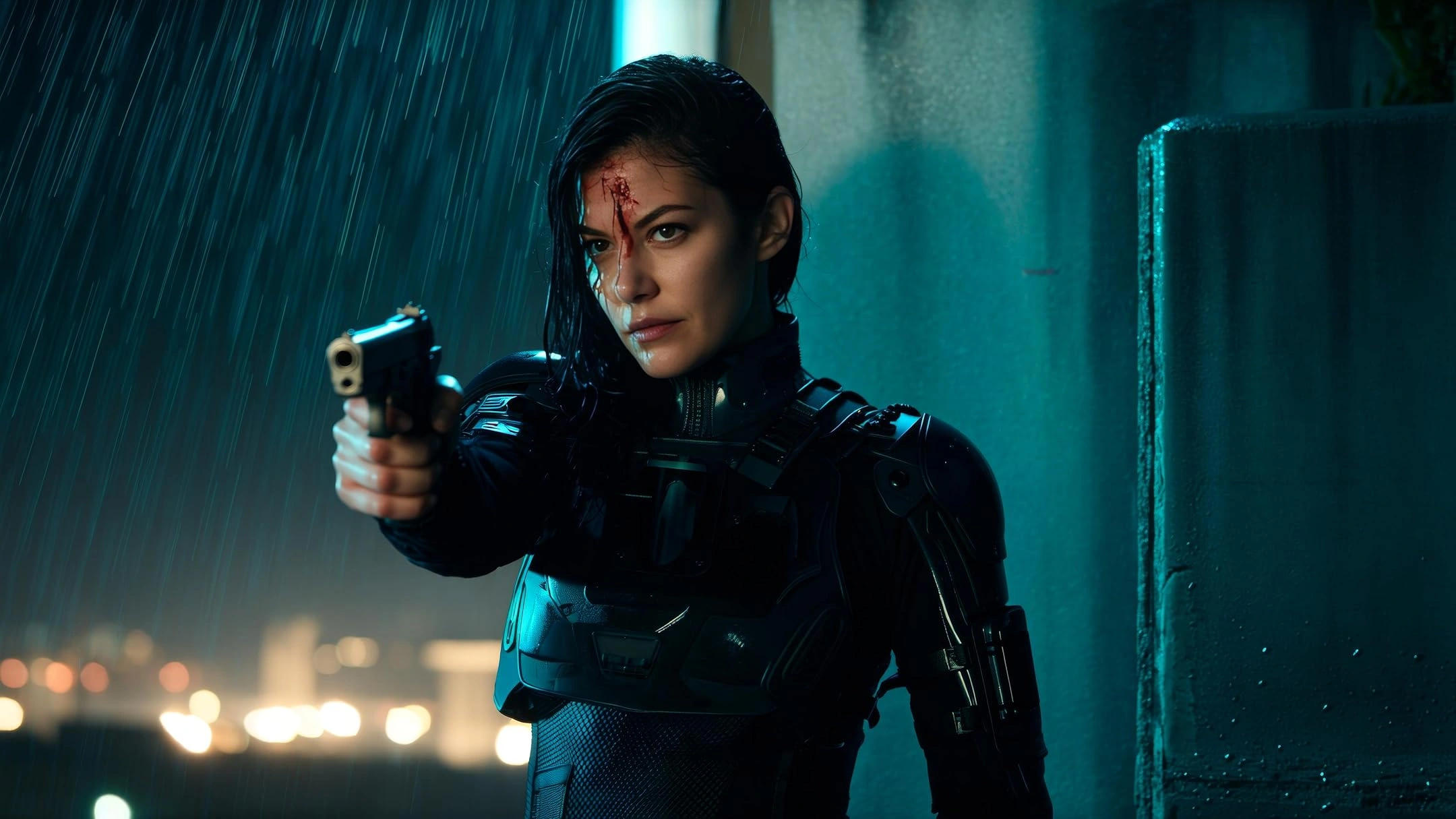

Five seconds is about as long as Kill Code can hold an image before it begins to distrust it. Writer-director Justin Price cuts between cramped interiors, computer-generated cityscapes, flashes of violence, and characters explaining unfamiliar terminology at such speed that individual shots rarely form a coherent sequence. The rhythm resembles a trailer assembled from footage belonging to several different films.
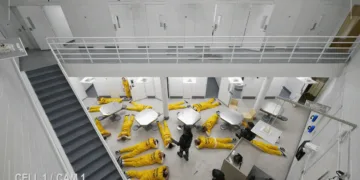
The premise has the raw materials for scrappy cyberpunk entertainment. Following a civil conflict, America has been divided into four quadrants. Nanoscientist Eion Prescott, played by Harvey Keitel, controls Alpire Industries and its ONYX Program, which distributes watches carrying a lethal nano-virus. Wearers must follow orders and kill designated targets to receive the antidote. Eion’s planned “D-Day” would place this system on the wider population.
That idea could support a sharp thriller about privatized punishment and technological obedience. Price keeps adding concepts before the first one has settled. Shadow runners, government conspirators, revolutionary cells, serial-killer DNA, glove-mounted weapons, and something called a trinity spire enter the script with little preparation. The future keeps expanding while the story grows harder to see.
A Map Without Roads
World-building works when places, institutions, and technologies shape what characters can do. Kill Code often treats world-building as a stream of proper nouns. We hear that the country has been devastated and divided, yet scenes set in “New Texas” frequently take place in recognizable streets, suburban homes, and sparsely dressed rooms. There is no clear sense of where the quadrants begin, how Alpire gained authority, or why government officials accept Eion’s program.
The plot suffers from the same missing connections. Elera, played by Franzi Schissler, works inside Alpire while secretly aiding her father Sawyer’s resistance. Kyron has been fitted with an ONYX watch and manipulated by Noel into assassinating Eion. Daxon, whose DNA supposedly powers the nano-virus, appears as a roaming killer. Lukas, Elera’s partner, drifts between exposition and lecherous jokes. Each character belongs to a separate thread, and the screenplay rarely knots those threads together.
A useful example arrives when Elera and Kyron join forces. Their alliance should clarify the conflict by bringing an insider and an exploited prisoner into the same mission. Instead, the film rushes past suspicion, trust, and practical planning so it can move toward another attack. By the time everyone heads for the trinity spire, the climax feels like a destination selected from a menu.
Actors Versus Exposition
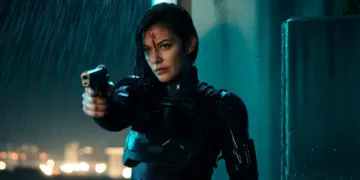
Schissler gives Elera physical determination, especially during the scenes built around her glove-based weapon. The device fires digital projectiles without a conventional gun, a visual idea that could have distinguished her fighting style. The choreography moves at half speed, with performers pausing between strikes and effects arriving without convincing impact. Her supposed cybernetic advantage never translates into fluid movement or tactical intelligence.

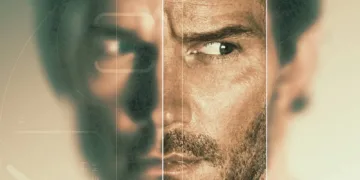
Keitel’s Eion is positioned as a corporate tyrant with control over medicine, prisons, and national security. His motives remain so thin that his scenes become extended delivery systems for plot information. At several points, his eye line and halting cadence make it appear that he is reading his dialogue from nearby cue cards. Menace is difficult to sustain when the villain seems occupied with finding the next sentence.
Frank Grillo approaches Benjamin from an entirely different tonal direction. His crude threat about Eion’s “science experiment” has the aggressive absurdity of a line from a knowingly trashy action comedy. It briefly gives the film a pulse, then exposes how uncertain the surrounding performances are. Tyrese Gibson leans into Lukas’s sleazy humor, while Jacob Artist, Brett Cullen, Sescily Leon Connell, and J.J. Soria are left carrying character names, loyalties, and objectives that the script has barely defined.
The Synthetic Future
The most damaging craft decision is the extensive use of generative AI imagery. These shots are easy to recognize through waxy textures, unstable details, low resolution, and movements that last only a few seconds. Price uses them for establishing views, transitions, and portions of the action, so the film repeatedly abandons the physical spaces where its actors are standing.
Continuity is the basic craft principle being lost here. In a conventional action sequence, editing shows where bodies are positioned, what separates them, and how one movement causes the next. Several confrontations in Kill Code replace that chain with digital fragments. A city appears, a figure moves, an explosion fills the frame, and the film cuts away before the eye can understand scale or geography. Watching it can feel like scrolling through disconnected clips rather than following an event.
The practical work fares better. Cinematographer Filip Vandewal uses colored light to give plain rooms a cyberpunk tint, while production designer David L. Snyder finds industrial corridors and damaged locations that suggest a society operating on salvaged infrastructure. Critter Pierce’s sleek black costumes provide the characters with a readable visual identity. These choices are simple, yet they preserve texture, space, and human presence.
That makes the central irony especially severe. Kill Code tells a story about technology converting people into controllable targets, then uses synthetic imagery that reduces its own actors and environments to disposable visual information. The physical filmmaking occasionally builds a future worth entering. The digital footage keeps deleting it.
Kill Code was released on VOD and digital platforms on July 24, 2026, and is available to rent or purchase on major digital storefronts such as Amazon Prime Video and Apple TV. The film takes place in a dystopian future where a corrupt corporation has seized control of the prison system. Criminals become law enforcers and are forced to participate in a deadly competition using lethal, nano-virus-dispensing watches to win their freedom.
Where to Watch Kill Code (2026) Online





Full Credits
Title: Kill Code
Distributor: Quiver Distribution
Release date: July 24, 2026
Running time: 91 minutes
Director: Justin Price
Writers: Justin Price
Producers and Executive Producers: Justin Price, Latavius Powell, Jeff Bowler, Bret Saxon, Franzi Schissler, Richard Salvatore, Chris Neville
Cast: Harvey Keitel, Tyrese Gibson, Frank Grillo, Franzi Schissler, Jacob Artist, Peter Stormare, Brett Cullen, Nick Loren, J.J. Soria, Brian Kurlander
Director of Photography (Cinematographer): Filip Vandewal
Editors: Ethan Maniquis, Sara Neufeld
Composer: Aldo Shllaku
The Review
Kill Code
Kill Code has enough cyberpunk ingredients to fill several films, yet writer-director Justin Price never gives any of them a stable dramatic foundation. The ONYX watches, divided America, corporate prison system, and resistance movement arrive as disconnected information rather than a functioning world. Practical lighting, industrial locations, and costume design occasionally suggest the grim future the film wants. Then the generative AI footage shatters spatial continuity and turns action into digital debris. A capable cast is left reciting exposition inside a story few of its characters appear to understand.
PROS
- Effective coloured lighting
- Resourceful location choices
- Sleek costume design
- Brief practical action beats
CONS
- Incoherent world-building
- Disconnected plot threads
- Distracting AI imagery
- Underwritten characters
- Weightless action sequences







Thank you for watching the film!