






















![Kingdom Hearts Collection [I-III] Review](https://gazettely.com/wp-content/uploads/2026/10/Kingdom-Hearts-Collection-I-III-1-360x180.webp "Kingdom Hearts Collection [I-III] Review: KHII Holds Steady as Newer Entries Fluctuate 37")




Television spent years telling us that the streaming model would liberate comedy from the restrictions of network scheduling. Adults Season 2 offers a less triumphant interpretation: perhaps somebody should have kept the 22-episode order.
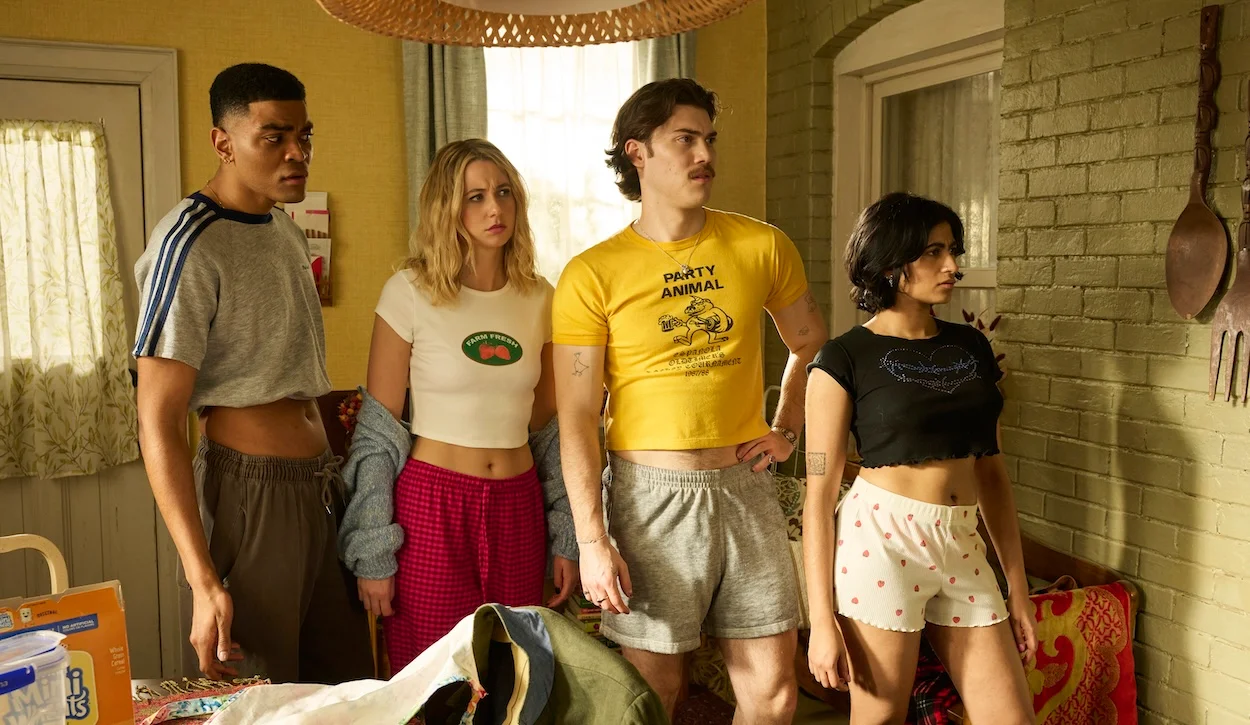
Rebecca Shaw and Ben Kronengold’s FX comedy returns to the Queens house shared by Issa (Amita Rao), Billie (Lucy Freyer), Paul Baker (Jack Innanen), Anton (Owen Thiele), and Samir (Malik Elassal), five twentysomethings trying to construct adulthood from unstable jobs, dubious romantic choices, and the reassuring knowledge that somebody nearby is making an even worse decision.
Season 1 established the arrangement but sometimes confused provocation with characterization. Season 2 is much steadier. The writing moves away from topical premises that seemed designed to become discourse and toward classic sitcom mechanics: incompatible roommates, embarrassing secrets, workplace disasters, relationship confusion, unwanted animals. Apparently the future of Gen Z television involves rediscovering the past. It suits the show beautifully.
Five People, Finally One Ensemble
The major change is less about premise than trust. Shaw and Kronengold now trust these five characters enough to separate them, rearrange them, and place them into pairings that do not need lengthy setup. That confidence immediately helps the performances. Rao gives Issa a manic momentum that can turn a simple problem into an emergency before anyone else has processed the first sentence.
Her work becomes particularly good once Issa begins thinking seriously about motherhood. In “Talia,” her fear of needles leads her to recruit Samir to trick her into receiving IVF injections. The escalating physical confrontations work because Rao keeps Issa’s fear specific rather than playing generic hysteria.
Malik Elassal gets similar mileage from Samir’s habit of thinking himself into disaster. His nervous calculations have their own rhythm. Lucy Freyer, meanwhile, is repeatedly asked to carry humiliation plots, including Billie’s attempt to erase an embarrassing photograph from social media. Freyer understands that cringe comedy collapses if the performer asks for sympathy too early. Billie commits first, realizes the damage later.
Jack Innanen receives one of the season’s smartest pieces of character writing in “The Scrub.” Paul Baker, usually presented as gentle and emotionally open, behaves completely differently around an older group of aggressively fratty male friends. He becomes louder, straighter-coded, and spectacularly stupid. Innanen does not play the second version as a secret identity. Both forms belong to Paul, which turns the episode into a sharp observation about the selves people perform for different social groups.
Then there is Anton. Owen Thiele remains the ensemble’s most precise comic weapon, especially once Raven-Symoné arrives as Anton’s older sister and refuses to validate his preferred image of himself as a competent adult. Anton’s irritation grows through tiny pauses, defensive looks, and increasingly desperate attempts to control the conversation.
The sibling dynamic gives Thiele something better than a collection of punchlines: somebody who knew Anton before he learned how to curate Anton. The house begins to feel like a social ecosystem rather than a sitcom arrangement. They irritate one another, rescue one another, expose one another, then somehow keep sharing a kitchen.
Send in the Raccoon
Episode four, “Raccoon,” is where the season’s renewed confidence becomes unmistakable. The setup is beautifully stupid. Everyone takes acid before watching The Last Airbender. A raccoon then appears inside the house. They have roughly half an hour to remove it before the drugs kick in.
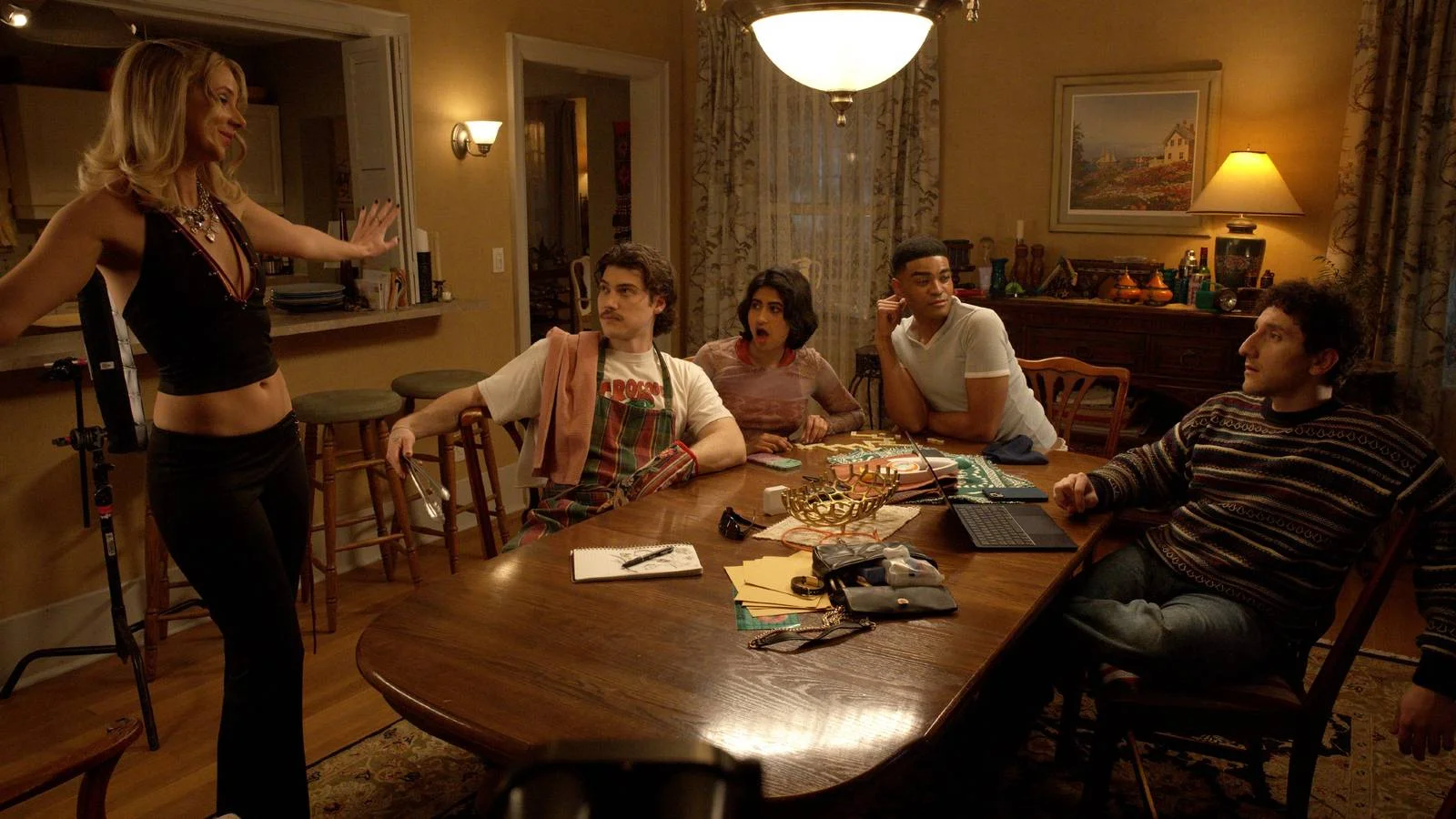
This is old-fashioned sitcom engineering with a contemporary nervous system. One location, one deadline, five incompatible approaches to the same problem. The episode plays close to real time, turning the impending trip into a ticking clock. Every delay matters because the characters know they are rapidly approaching the point where dealing with a wild animal will become less practical.
The smallest joke might be the best one: confusion between a microwave’s cooking timer and its normal timer. It is the kind of banal technological irritation that requires no generational thesis statement. Anyone who has accidentally heated an empty appliance while trying to count down thirty seconds knows the pain.
The episode keeps stacking complications, including further animals, possible sexual arrangements, and consequences that spill into later stories. Its success comes from containment. Instead of sending everyone outward toward separate plots, “Raccoon” traps the cast together and lets their established relationships generate the comedy.
Season 2 occasionally forgets that lesson. Anton’s attempt to normalize use of the c-word within a corporate environment exhausts its premise before the episode is ready to abandon it. A separate storyline in which Samir and Paul cannot find enough private time after becoming roommates feels transparently constructed to deliver them to a sperm donation clinic. The destination has jokes. The route shows the scaffolding.
The stranger moments often fare better. During the premiere’s long take, Issa announces, “It’s season two, Paul Baker. We’re doing a oner.” Later, Raven-Symoné’s entrance receives a sudden studio-audience applause cue, leaving Anton staring around the room and asking what happened. These little ruptures suggest a series increasingly willing to acknowledge television as television. That looseness may be its next useful rebellion.
Romance Without a Lecture
The relationship between Issa, Paul Baker, and Anton gives Season 2 its strongest continuing emotional thread. Season 1 ended with Issa agreeing to marry Paul to help resolve his immigration situation, then backing away. Paul married Anton instead. Afterward, Paul and Anton kissed in front of their friends, with encouragement from the same people now forced to consider what the kiss might actually mean.
A lesser contemporary comedy could turn this into an explanatory exercise. Adults largely refuses. Issa watches for evidence that her boyfriend may be attracted to Anton. Paul and Anton become increasingly conscious of the way they look at one another. Their attraction surfaces through pauses, flirtation, joking, and the awkward effort required to stop flirting once everyone notices.
That approach matters because sexual fluidity here functions as part of character rather than educational programming. Television has spent years congratulating itself for representation while frequently reducing represented people to examples of representation. Paul and Anton are allowed the far greater dignity of being messy.
The same principle shapes the season’s broader treatment of adulthood. Issa gets a job and begins thinking about motherhood. Anton has to confront how his family sees him. Billie faces aging and choices about her future. Samir keeps trying to reason his way toward certainty and repeatedly discovers that certainty has declined the invitation.
Season 2 also answers basic questions the first season left hazy. Families become clearer. Careers matter. Money and housing create pressure. The possibility of eviction turns the house from a convenient sitcom location into something the characters can actually lose. Growing up here means accumulating consequences without suddenly becoming sensible. That feels considerably closer to adulthood than most television speeches about adulthood.
Eight Episodes and a Streaming Problem
The irony of Adults becoming this good is that its format now works against it. Eight episodes can produce an impressively polished season. They can also starve a hangout comedy of the thing it needs most: hanging out. Older ensemble sitcoms such as Friends, Seinfeld, New Girl, Parks and Recreation, and The Office had enough episodes to waste one occasionally. That waste was productive. Secondary pairings could become unexpectedly funny. Running jokes could disappear for six weeks and return. Characters had enough screen time to exist outside the machinery of major arcs.
Streaming has often treated this looseness as inefficiency. Adults demonstrates what gets lost in the cleanup. Paul Baker’s campaign to become president of the local homeowners association arrives in the finale as the kind of idea that could easily support several installments. Here, the campaign has to move quickly because the season is nearly finished. Paul and Anton’s attraction faces the same compression. Their slow burn works precisely because the smallest exchanges matter, yet there are only so many exchanges available across eight half-hours.
“Raccoon” offers the clearest counterargument to the prevailing model. Its pleasure comes from watching five characters occupy one room long enough for familiar behavior to become unpredictable. No mythology is required. No prestige-comedy identity crisis arrives halfway through. Nobody needs to represent an entire generation. They just need another episode. Television once feared running out of stories. Streaming comedy may have developed the opposite problem: it keeps finding characters worth spending time with, then sends everyone home early.
Adults second season premiered on FXX and Hulu on August 27, 2026. The comedy series centers on a codependent group of twenty-something housemates navigating early adulthood and career hurdles together in Queens.
Where to Watch Adults Season 2 Online










Full Credits
Title: Adults
Distributor: FX, FXX, Hulu
Release date: August 27, 2026
Rating: TV-MA
Running time: 22 minutes
Director: Jonathan Krisel
Writers: Ben Kronengold, Rebecca Shaw
Producers and Executive Producers: Ben Kronengold, Rebecca Shaw, Nick Kroll, Stefani Robinson, Sarah Naftalis, Jonathan Krisel, Alicia Van Couvering
Cast: Malik Elassal, Lucy Freyer, Jack Innanen, Amita Rao, Owen Thiele
- Composer: Christopher Bear
The Review
Adults Season 2
Adults Season 2 proves that ensemble comedy still benefits from time, repetition, and characters being allowed to embarrass themselves without every mistake becoming a thesis about their generation. The sharper writing, stronger pairings, and wonderfully controlled chaos of “Raccoon” turn the Queens household into one of television’s most inviting comic spaces. Its eight-episode order now feels less like efficiency than an industry-imposed handicap. Streaming finally has a Gen Z sitcom that knows how to hang out. Naturally, it barely lets us.
PROS
- Excellent ensemble chemistry
- “Raccoon” is a comic standout
- Sharper character writing
- Paul Baker and Anton’s slow-burn tension
- Confident sitcom structure