































Religious horror usually asks what happens when faith becomes fanaticism. Blood Shine is interested in a nastier possibility: what if fanaticism actually gives someone the purpose they were missing? Emily Bennett and Justin Brooks build their folk-horror film around Clara, played by Bennett, an isolated woman in upstate New York who worships light through rituals designed to free people from what she calls the cage of the body.
Brighton West (David Call), meanwhile, has a far less mystical prison. He is a successful horror filmmaker stuck producing another installment of his Craven franchise, unable to finish the script and resentful of the machinery keeping him employed.
His escape to the countryside ends badly. After photographing Clara while she bathes, Brighton is knocked unconscious, taken to her farmhouse, drugged with tea, and eventually chained in the basement. The irony is almost too tidy. A director accustomed to controlling bodies through auditions, cameras, and professional power has suddenly become somebody else’s material.
Two Broken Believers
Brighton is deliberately difficult to pity. During an audition before his trip, he sexually harasses a prospective actress, and David Call gives the scene an ugly casualness. Brighton behaves like someone who stopped noticing the difference between attention and entitlement years ago. His resentment toward the studio may be legitimate, yet the film refuses to let professional frustration wash away personal behavior. Clara sees that rot immediately.
She tells Brighton that he has caused pain and that his lack of close relationships made him suitable for what she intends. Her rituals grow increasingly physical, involving bloodletting, imprisonment, strange drinks, and repeated lectures about escaping darkness through light. Bennett plays these scenes with unnerving restraint. Clara rarely behaves like someone performing insanity for an audience. She has the serene patience of a person explaining something obvious. That makes her considerably scarier.
Her certainty, however, contains its own contradiction. Videotaped sermons from a cult leader played by Larry Fessenden direct much of her behavior. Clara speaks of liberation while following instructions. She recognizes that powerful men have controlled and abused her, yet she recreates the same architecture downstairs, where Brighton eats, sleeps, bleeds, and speaks according to her permission. Call this voluntary captivity, perhaps: the peculiar human talent for choosing the cage once somebody convinces us it has spiritual significance.
I initially thought the parallel between Clara’s cult and Brighton’s studio obligations was too schematic. One serves a prophet, the other serves franchise filmmaking. Then the basement scenes begin eroding that neat comparison. Brighton hates his obligations; Clara loves hers. One experiences control as humiliation, the other as identity. Their shared problem is less obedience than the terror of having no idea who they might become without it.
Where the Light Hurts
Brooks and Bennett give sunlight a menace usually reserved for darkness. Beams enter the farmhouse through carefully placed windows, cutting across dim rooms with almost devotional precision. Clara sees illumination as divine presence, while the camera keeps making it look surgical.
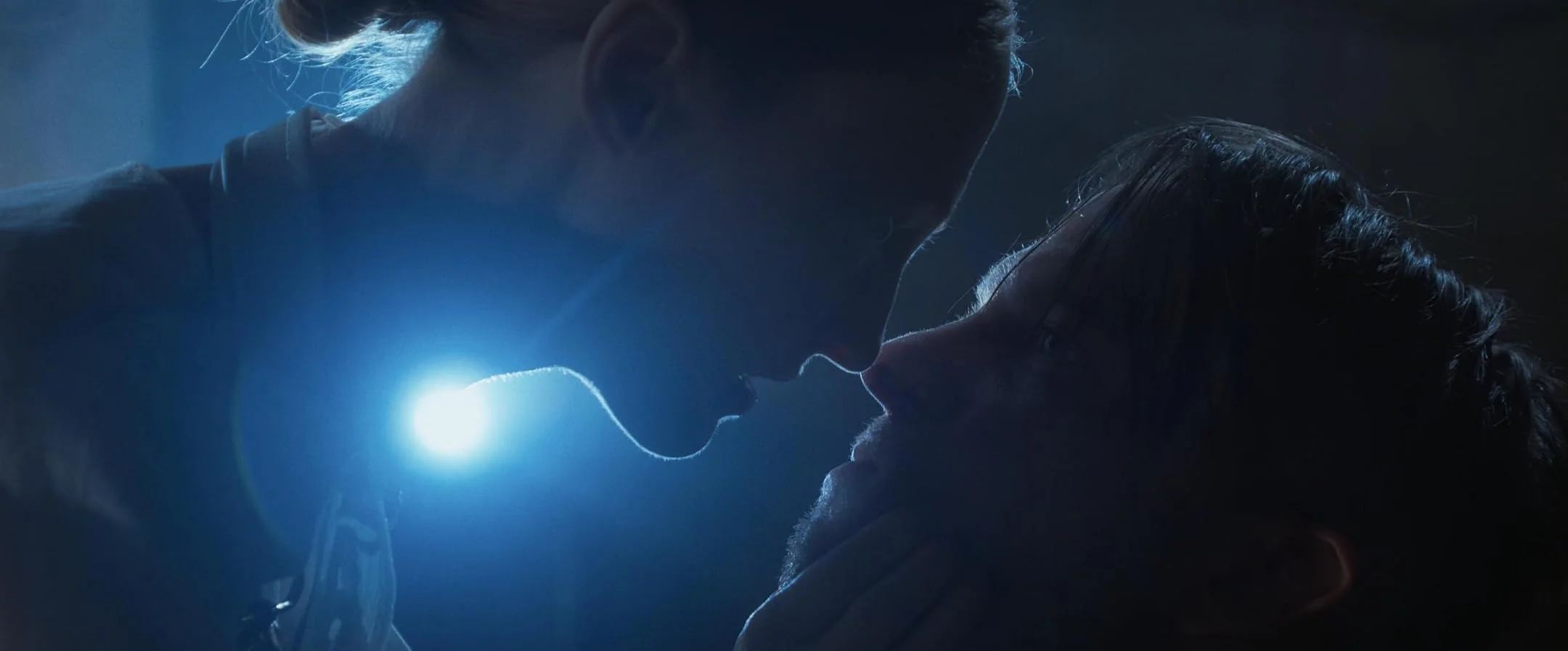
That visual idea becomes especially useful around Brighton. His profession depends on manipulating light to manufacture images. Clara worships roughly the same substance he has spent his career controlling for money. The film never turns this into a speech, thankfully. The connection sits inside the images.
The opening section introduces Keith, an ex-convict whose failed journey leads him toward Clara and a violent encounter. Its dreamlike photography and bloodshed establish the film’s vocabulary before Brighton appears, then the narrative complicates our understanding of what we have watched by tying the material to filmmaking itself. It is clever. It is also longer than it needs to be.
The larger pacing problem arrives once Brighton is chained downstairs. Clara enters. A ritual occurs. Brighton resists. Clara explains another piece of doctrine. The pattern repeats with small variations, and the conceptual claustrophobia gradually becomes literal narrative stagnation. A two-person chamber piece needs every recurrence to change the relationship. Several of these scenes merely confirm what the previous one already established.
The film seems aware of the danger and occasionally finds strange intimacy inside repetition. Clara’s authority in the basement contrasts sharply with her uncertainty elsewhere, while Brighton’s contempt slowly gives way to something harder to categorize. Still, the middle section spends too long circling an idea it had already reached.
The Flesh Refuses to Disappear
For a film obsessed with escaping the body, Blood Shine is very good at reminding us that bodies are stubborn things. The late ritual involving deep wounds, sex, blood, and practical gore finally converts Clara’s theology into physical language. Her talk of transcendence ceases to be abstraction once flesh is opened and desire becomes inseparable from violence.
The sequence is difficult to watch because the brutality carries emotional logic. Clara believes she is approaching revelation. Brighton has reached a point where captivity, fascination, fear, and participation have become disturbingly entangled. Here the film’s ideas stop competing and begin touching each other.
Elsewhere, some remain frustratingly loose. Brighton’s behavior toward actresses hints at a critique of filmmaking as voyeurism and institutionalized male power. Clara’s history suggests abuse repeating itself through adopted systems of domination. Her cult presents surrender as freedom. Brighton’s career presents commercial obedience as success. These threads are present, yet the screenplay occasionally leaves them sitting beside one another rather than forcing them into collision.
Bennett bridges several of those gaps through performance. Watch Clara’s face after moments of certainty, when composure briefly collapses before she restores it. Those tiny failures of conviction say far more about her than another sermon could. The light promises escape. The body keeps bleeding anyway.
Blood Shine arrived in select theaters and on digital platforms via Dark Sky Films on August 21, 2026. Co-directed by Emily Bennett and Justin Brooks, the psychological horror film follows a struggling horror director who retreats to a remote country home to finish a script, only to be taken captive by a religious zealot who subjects him to harrowing, transformative rituals.
Where to Watch Blood Shine (2025) Online






Full Credits
Title: Blood Shine
Distributor: Dark Sky Films
Release date: August 21, 2026
Rating: Not Rated
Running time: 1 hour 30 minutes
Director: Emily Bennett, Justin Brooks
Writers: Emily Bennett, Justin Brooks
Producers and Executive Producers: Emily Bennett, Justin Brooks, Greg Newman, Brett Anker
Cast: Emily Bennett, David Call, Brendan Sexton III, Larry Fessenden, Toby Poser, Kyle Minshew, Maurice Kerry, Michael T. Downey
Director of Photography (Cinematographer): Justin Brooks
Editors: Emily Bennett, Justin Brooks
The Review
Blood Shine
Blood Shine understands that belief becomes most dangerous when it offers an explanation for pain. Clara calls suffering transcendence, Brighton calls exploitation filmmaking, and both have institutions ready to validate the vocabulary. The film is strongest when sunlight, blood, and confinement make that argument physically visible, particularly during its grotesque late ritual. Its middle stretch repeats itself, while several ideas about abuse, authorship, and control remain frustratingly loose. Emily Bennett keeps Clara frighteningly human through all of it (which is rather worse than making her a monster).
PROS
- Emily Bennett’s unsettling performance
- Striking use of sunlight and shadow
- Potent late body-horror sequence
- Strong ideas about control and purpose
CONS
- Repetitive basement section
- Overextended opening misdirection
- Underdeveloped cult mythology
- Thematic threads left disconnected