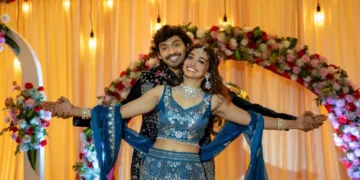





























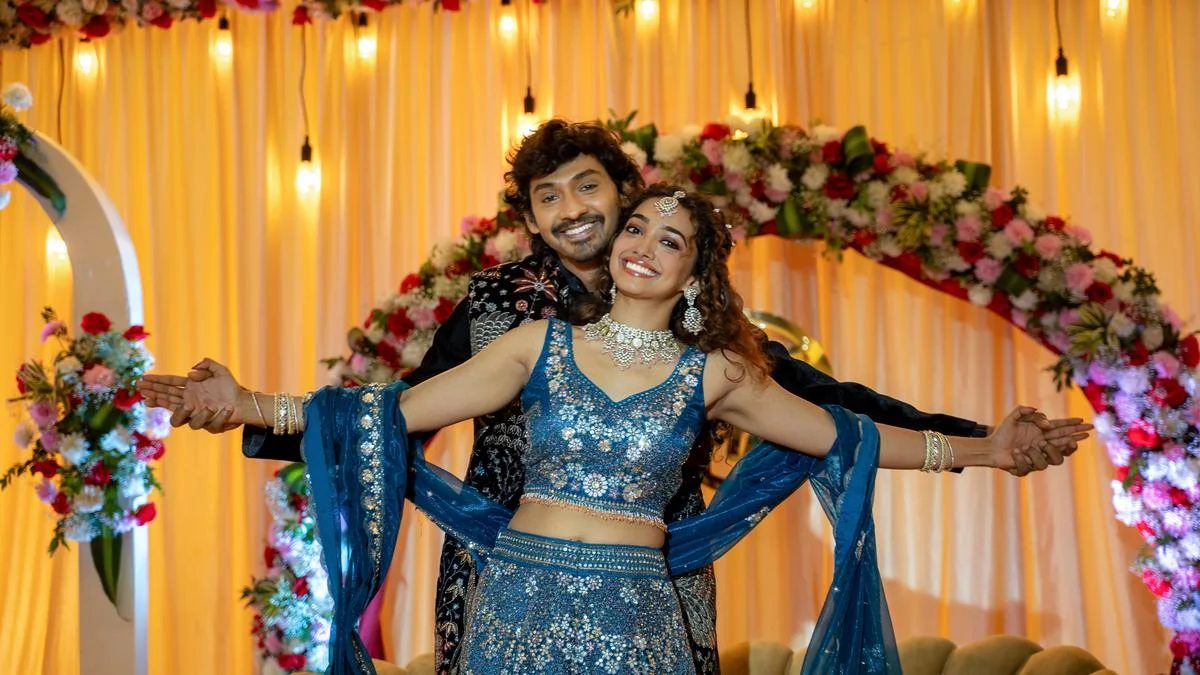

The most revealing moment arrives before the domestic comedy has properly begun. During the wedding, Pavi watches Elan’s parents smiling while her own family fights back tears. The ritual assumes she will leave one household and enter another. She looks at that expectation and simply refuses it.
That decision gives Pyaar Prema Kalyanam its strongest idea. Written and directed by Elan, who also plays the male lead, the film takes a familiar Tamil marriage convention and reverses its direction. Elan, a carefree young man recently returned from Dubai after losing his job, marries Pavi, a social media creator played by Saanve Megghana. Instead of Pavi moving into his family home, Elan becomes the newcomer in hers.
Their romance begins on lighter terms. Pavi, whose online videos challenge misogyny and patriarchal behaviour, initially dismisses Elan as a “walking red flag.” Hearing his version of events changes her opinion, and their relationship develops with the uncomplicated energy of a youthful romantic comedy.
Marriage gives that romance a sharper cultural dimension. Tamil cinema has spent decades turning the daughter-in-law entering an unfamiliar household into drama, melodrama and comedy. Here, the son-in-law gets the initiation.
The House Husband Experiment
Elan’s move into Pavi’s family home works because the screenplay initially treats domestic adjustment as something practical rather than theoretical. He does not know the routines. He misunderstands basic household matters. His confusion between a ration card and an ATM card turns his sheltered adulthood into a joke without needing a speech about masculinity.
Radikaa Sarathkumar, playing Pavi’s mother, is particularly good in these exchanges. Her authority around the house gives Elan someone to bounce against, and his physical awkwardness becomes funnier when everyone else behaves as though the rules should already be obvious to him.
The arrangement also exposes how differently dependence is judged according to gender. Pavi earns enough to support the household while Elan takes on domestic responsibilities. His parents view his unemployment as failure, his in-laws sometimes treat him as another person to manage, and his friends encourage exactly the sort of masculine insecurity that makes cooperation harder.
Kumaravel, playing Pavi’s father, gives the reversal its clearest cultural purpose. He asks Elan to consider what women routinely experience after marriage: leaving familiar surroundings, adapting to another family’s habits and slowly being expected to fit an identity prepared before their arrival. The idea lands because the film connects it to recognizable Indian family structures. Nobody needs to invent an extraordinary social experiment. It merely changes which spouse has to pack a bag.
Where the Reversal Falters
The difficulty is that Pyaar Prema Kalyanam does not apply its own argument evenly. Elan’s discomfort in Pavi’s household receives sympathy, comic attention and eventually emotional growth. When circumstances later place Pavi within Elan’s family environment, her adjustment is treated with much less curiosity. She shares household duties with his sister-in-law, yet the screenplay rarely examines those expectations with the same patience it granted Elan.
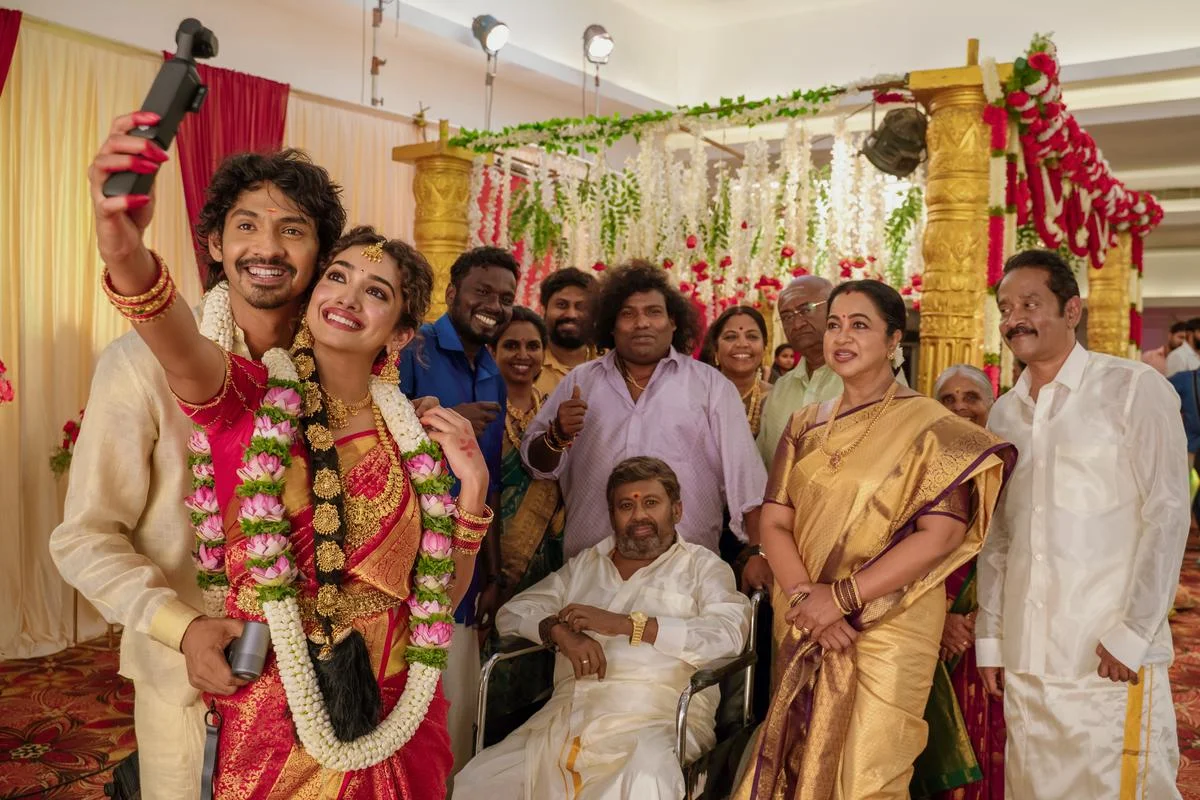
That imbalance matters because Pavi begins as the person with the clearest philosophy. Her social media presence is built around calling out patriarchy, and Megghana plays her with enough conviction that those views feel connected to the character rather than pasted onto her. She knows what she wants from marriage and can explain why.
Yet the narrative increasingly becomes a story about Elan learning responsibility. Pavi, who creates the central challenge, gradually loses dramatic space to the man benefiting from it.
The comedy suffers from a similar contradiction. A scene in which Geetha Kailasam imagines Elan dressed like a conventional newly married daughter-in-law aims for an easy visual gag. It also reveals the limits of the film’s approach. The reversal stops exposing a social convention and briefly turns femininity itself into the joke.
The later stretches lean harder on familiar family melodrama, meddling relatives and explicit speeches. Earlier scenes allow a meal, a chore or an uncomfortable conversation to expose inequality. The final half hour increasingly explains what those scenes had already shown.
Familiar Faces, Youthful Music
Elan’s performance takes time to settle. His repeated startled expression becomes noticeable early, but he improves whenever the character is allowed to appear genuinely lost. His comic physicality suits the house-husband material better than the scenes asking for heavier emotional authority.
Megghana is the steadier presence. Pavi’s confidence during the wedding decision and her refusal to accept marriage as automatic surrender give the film much of its early energy. Her chemistry with Elan keeps the relationship warm enough that their ideological disagreements still feel like marital problems rather than debate-club exercises.
The supporting cast understands the register immediately. Radikaa Sarathkumar can turn a domestic instruction into a comic confrontation, while Kumaravel delivers the screenplay’s social observations without making every exchange sound like a manifesto. Geetha Kailasam is given a far broader mother-in-law figure, which contributes to the television-serial flavour that creeps into the later passages.
Yuvan Shankar Raja’s music fits the youthful romantic tone, and the song sequences allow flashes of visual playfulness beyond the otherwise familiar Tamil Nadu homes. References to older Tamil cinema, including a nod to the celebrated Mudhalvan interview sequence, place the film inside a tradition it is trying to tease apart.
The sharper version of Pyaar Prema Kalyanam appears whenever a husband is asked to perform an adjustment Tamil cinema has long treated as ordinary for wives. The weaker version arrives when the screenplay grows nervous about where that question might lead and reaches back toward the same familiar family conventions it had spent so much time rearranging.
Pyaar Prema Kalyanam premiered directly on Netflix on August 21, 2026, and is available to stream globally in multiple languages including Tamil, Hindi, Telugu, Kannada, and Malayalam. Written and directed by Elan, the Indian romantic comedy-drama mines an unconventional family dynamic and living arrangement for laughs as two young lovers attempt to reconcile their personal ambitions with traditional marital expectations.
Where to Watch Pyaar Prema Kalyanam (2026) Online


Full Credits
Title: Pyaar Prema Kalyanam
Distributor: Netflix, Rise East Entertainment
Release date: August 21, 2026
Rating: TV-14
Running time: 2 hours 6 minutes
Director: Elan
Writers: Elan
Producers and Executive Producers: Sreenidhi Sagar, P. Rupak, Pranav Tej
Cast: Elan, Saanve Meghana, Radhika Sarathkumar, M.S. Bhaskar, Yogi Babu, Geetha Kailasam, Senthil, Elaango Kumaravel
Composer: Yuvan Shankar Raja
The Review
Pyaar Prema Kalyanam
Pyaar Prema Kalyanam finds its sharpest comedy in turning a familiar Tamil marital arrangement inside out, particularly when Elan enters Pavi’s household and discovers how much invisible adjustment marriage can demand. Saanve Megghana gives Pavi’s independence real conviction, while Radikaa Sarathkumar and Kumaravel keep the family comedy lively. Yuvan Shankar Raja’s music suits the film’s youthful warmth. The weaker final stretch retreats into louder melodrama and familiar mother-in-law conflict, softening questions the earlier scenes handled with far greater confidence.
PROS
- Effective gender-role reversal
- Saanve Megghana’s assured Pavi
- Radikaa Sarathkumar’s comic timing
- Stronger early domestic comedy
- Catchy Yuvan Shankar Raja soundtrack
CONS
- Lopsided treatment of Pavi
- Heavy-handed final act
- Familiar family-drama clichés
- Elan’s repetitive expressions
- Uneven social argument







