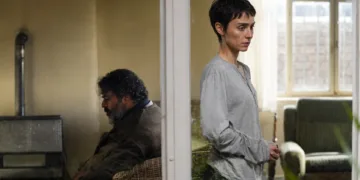





























Rashid’s home is already marked for destruction before he decides to turn it into a prison. Bulldozers claw at the surrounding land, neighbouring buildings have disappeared, and his family has only days left before their own walls come down. Mohsen Gharaei understands the cruelty of that timing. A man terrified of losing his authority responds by locking everyone he loves inside a place that cannot survive.
Falling House, written by Gharaei and Amirmohammad Abdi, begins in quieter territory. Rashid (Farhad Aslani) works as a prison guard outside Tehran, distributing extra food to inmates and helping them with personal problems. His generosity has attracted suspicion from his superiors after a prisoner escapes and a significant bank transfer appears in his financial records.
At home, his wife Zinat (Rima Raminfar) and daughters Ensi (Laleh Marzban) and Janan (Elena Khakbazan) carry troubles of their own. Janan is bullied at school over rumours concerning her father’s job. Ensi has been preparing something far larger: she intends to leave Iran for Turkey and pursue modelling. The family lives together lovingly, yet carefully. Rashid can be affectionate so long as reality arrives in manageable portions.
The Jailer Comes Home
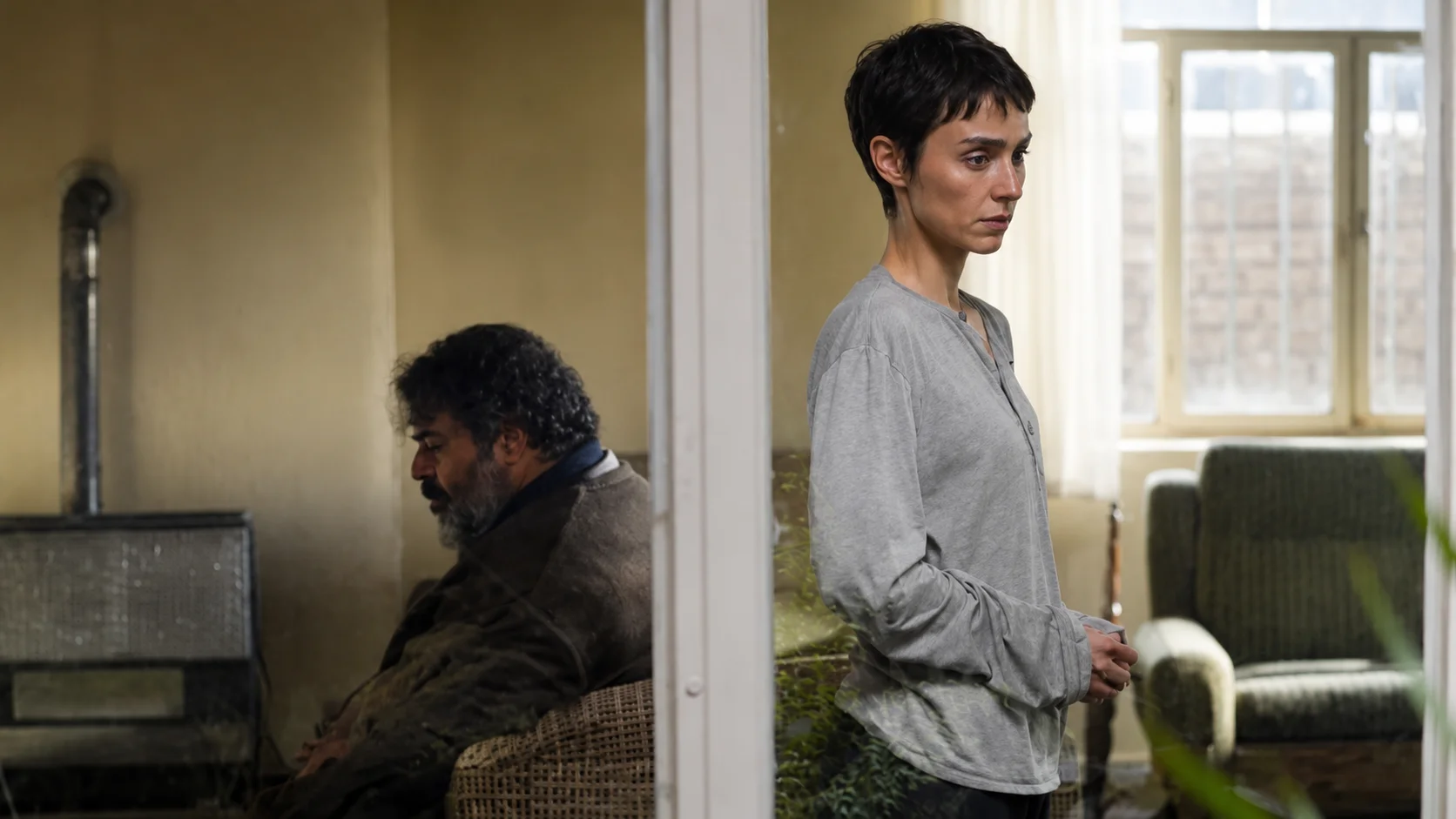
The discovery of Ensi’s plan does something frightening to Rashid because it exposes how fragile his tenderness has always been. Zinat has given Ensi money to pursue the opportunity. Rashid sees the decision as betrayal. His objections to modelling quickly reveal fears surrounding sexuality, reputation, religious propriety, and the prospect of his daughter building a life beyond his supervision. He cannot defeat Ensi’s argument, so he removes argument from the equation. The prison guard begins locking doors.
First Ensi is confined. Zinat and Janan follow. Rashid insists that surrender will restore peace, yet his definition of peace requires everyone else to abandon choice. His lament that he has lost his job and cannot lose his family sounds almost pitiful until one understands what “keeping” a family means to him.
Aslani makes this shift unsettling because Rashid never becomes emotionally simple. The same bulky, almost bewildered man who chuckled with prisoners now stands outside bedroom doors issuing conditions. His cruelty contains wounded pride, financial humiliation, fear and genuine attachment. None excuses what he does. Those contradictions make watching him harder. The tragedy lies in Rashid mistaking proximity for love. If the women remain inside his walls, he believes the family still exists.
Rooms Without Exits
Gharaei hardly hides what the house represents. Rashid guards prisoners professionally, then creates prisoners domestically. The building is structurally condemned while the hierarchy he imposes inside it proves equally rotten.
The imagery can be brutally effective. Locked rooms become cells. Heavy machinery creeps closer outside. The very workers sent to destroy the building unknowingly become the women’s best chance of being discovered. An absurd quality slips through the horror: rescue may arrive because somebody finally wants to knock the walls down. Yet Falling House keeps explaining a metaphor that has already landed.
Once the women are confined, the screenplay cycles through confrontation, refusal, negotiation and renewed anger. At roughly 130 minutes, Rashid’s stubbornness begins to flatten dramatic escalation. The pressure remains painful, though it does not always deepen. A chamber drama needs each return to the same room to reveal something new. Here, some exchanges merely confirm that the door remains locked and Rashid remains immovable.
Ensi’s breast-cancer diagnosis creates a similar problem. Her wish to leave Iran already gives her conflict urgency and personal stakes. The illness places further suffering upon her without receiving enough development to justify the weight assigned to it. She risks becoming someone tragedy happens to when her strongest scenes define her through intention. The film never needed another cage.
What Survives Inside
The performances keep the confined second half alive when the writing begins circling itself. Rima Raminfar gives Zinat years of accumulated accommodation. Her attempts to reason with Rashid carry the weary rhythm of someone who has spent a long marriage learning when to soften a sentence, when to conceal information and when persuasion has ceased to matter. Once confinement destroys those habits, her distress becomes rawer and louder.
Laleh Marzban gives Ensi a different energy. Turkey represents practical escape, a modelling career, and the right to imagine a future Rashid has not approved. Her resistance has particular force because she has already mentally stepped beyond the house before her father locks her back inside it.
Elena Khakbazan’s Janan completes the generational picture. She is young enough to still be shaped by her father’s reputation, yet old enough to witness what his need for respect actually costs the women around him. Her school humiliation follows her home, connecting Rashid’s institutional identity with the private damage his daughters inherit.
Gharaei occasionally lets the women’s shared fear settle into silence, and those quieter stretches hurt far deeper than the screenplay’s loudest declarations. Outside, machines keep approaching. Inside, Rashid keeps insisting that he is trying to save his family. The house has already answered him.
Falling House premiered on September 3, 2026, at the 83rd Venice International Film Festival. The drama explores generational and gender conflict through the story of a prison guard whose family home on the outskirts of Tehran faces imminent demolition.
Where to Watch Falling House (2026) Online
Full Credits
Title: Falling House
Distributor: Paradise City Sales
Release date: September 3, 2026 (Venice International Film Festival)
Running time: 2 hours 4 minutes
Director: Mohsen Gharaei
Writers: Mohsen Gharaei, Amir Mohammad Abdi
Producers and Executive Producers: Milad Khosravi, Mohsen Gharaei, Odessa Rae, Daya Fernández, Amaury Nolasco, Alois Rubenbauer, Jon Kilik
Cast: Laleh Marzban, Rima Raminfar, Farhad Aslani, Elena Khakbazan
Director of Photography (Cinematographer): Farshad Mohammadi
Editors: Evelyn Rack, Emad Khodabakhsh
Composer: Max Richter
The Review
Falling House
Falling House turns a condemned home into a suffocating extension of the prison Rashid carries inside himself. Farhad Aslani gives that transformation terrible weight, shifting from weary kindness to possessive fury without losing the pathetic fear beneath it. Gharaei sometimes presses the metaphor until the walls nearly crack from repetition, and Ensi’s illness feels imposed on a conflict already carrying enough pain. Yet the locked rooms, approaching bulldozers, and three women waiting for freedom create an image that lingers like dust after demolition.
PROS
- Farhad Aslani’s unnerving performance
- Powerful domestic-prison metaphor
- Claustrophobic condemned-house setting
- Strong female ensemble
- Effective demolition countdown
CONS
- Repetitive second half
- Overstated symbolism
- Underdeveloped cancer subplot
- Occasional melodramatic dialogue