
















Brando Benetton seems to have studied the crime thriller as if it were a language exam: corpse in river, damaged veteran, gifted rookie, wealthy family, suspicious butcher, final revelation. He knows the vocabulary. The difficulty is that fluency requires saying something.
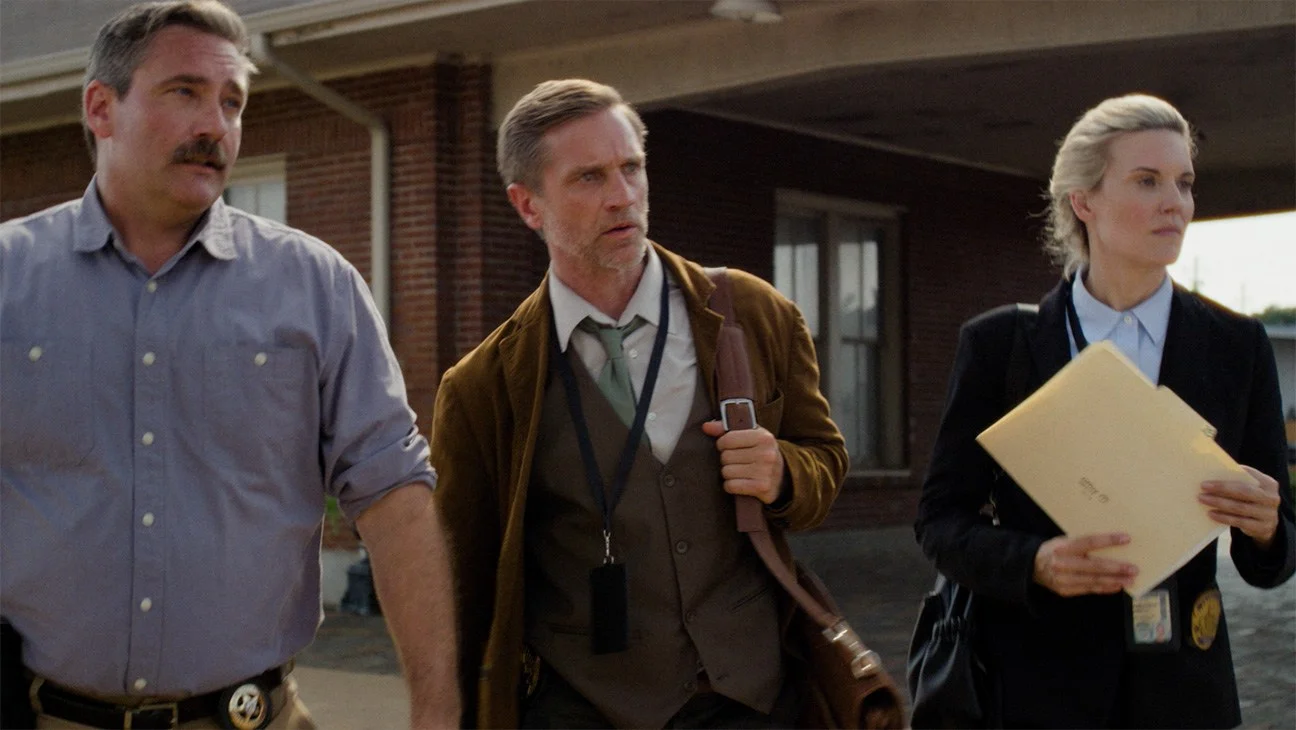
His feature debut, The Girl in the River, sends forensic psychology expert Amelia Pembrock to a small Mississippi town after fourteen-year-old twins Greta and Anna Otto disappear. Greta’s body is recovered from the river, her teeth damaged after death. Anna is still missing. Amelia, played by Maggie Grace, was the top cadet in her class but has avoided field work, so Captain Erica Graysmith pairs her with Alan Kramer, Devon Sawa’s alcoholic investigator who wants to retire and carries a photograph of his dead son.
The setup has genuine pressure. One child is dead, another may still be alive, and the investigators arrive with reasons to distrust both themselves and each other. Benetton keeps reaching for familiar genre shorthand instead of developing those pressures. Alan drinks from a flask because troubled detectives apparently receive one at orientation. Graysmith speaks in declarations about confronting evil. The characters arrive pre-explained.
The Credentialed Genius Problem
Amelia presents the film with an awkward philosophical problem: what does intelligence mean if a story keeps telling us someone is brilliant while showing us ordinary, sometimes reckless decisions? Call it credentialed genius, the narrative habit of treating résumé lines as characterization.
Grace makes Amelia appealing through hesitation and alertness, especially when she first leaves the security of academic training for interviews and crime scenes. Yet her investigation rarely supports the mythology being built around her. Raw chicken found beneath Greta’s fingernails leads her toward Boris, a local butcher with a troubling past. She fixes on him so aggressively that she later enters a suspect’s home illegally, producing one of the film’s few genuinely tense passages while making her judgment look worse, not sharper.
An investigative journalist then provides information that pushes the case closer to the truth. This might have worked if the screenplay treated Amelia as a novice learning how knowledge is distributed across a community. Instead, the film keeps insisting on exceptional aptitude. The gap becomes almost comic.
Sawa has the easier contradiction to play. Alan is exhausted, grieving, frequently drinking, and skeptical of Amelia’s certainty. Watch how Sawa lets his posture sag while his attention remains active during their exchanges. His resistance to the obvious suspect gives the partnership its best friction because it comes from professional instinct rather than another speech about darkness.
Clues Without Mystery
The evidence should make the investigation stranger. Greta’s damaged teeth and the chicken material under her fingernails suggest deliberate manipulation, and Boris looks so conveniently sinister that suspicion should begin turning back on the people constructing the evidence. For a while, Benetton has the foundations of a better puzzle than the film he actually makes.
Then the suspect pool stays small, the interviews stay mechanically informative, and the red herrings behave exactly like red herrings. Boris is framed with such determination that accepting him as the culprit would require forgetting how thrillers work. The eventual solution becomes visible long before Amelia can earn it.
Worse, the decisive break comes when the culprit reveals knowledge they should not possess, a variation on the old “I never told you that” trap. A profiler supposedly beginning a transformative career does not corner evil through behavioral insight; evil essentially forgets which page of the script it is on. There is a dry cosmic justice to that, I suppose, but little detective work.
The final confrontation cannot recover the tension. Its shootout feels physically uncertain, and the characters’ lack of experience does not fully account for how awkwardly the scene moves. The case has spent so long promising psychological chess that ending with pieces falling off the board feels strangely apt.
Mississippi Without Mud
Benetton does show visual competence. The masked figure stopping a van on a bridge and dumping Greta’s body into the water has clean, grim efficiency, while several moving-camera setups suggest a director comfortable arranging space. Yet the Mississippi town rarely acquires the heat, texture, or social density that could have made this investigation belong somewhere specific. It often resembles a television procedural visiting “the South” for one episode.
That functional quality extends to the supporting cast. Tiffany Haddish plays Graysmith with restraint, but lines about fear and real evil leave her performing authority in capital letters. Ralph Macchio fares better as medical examiner Colin because his relaxed presence gives the evidence scenes a human rhythm. He does not need to announce that he has seen terrible things; he simply behaves like someone who has done his job for a while.
The epilogue then treats Amelia as the beginning of an investigative legend. By that point, she has pursued the wrong suspect, crossed a legal line, accepted outside help, and benefited from the culprit’s mistake. Perhaps the film is arguing that institutions manufacture reputations from messy beginnings. I doubt it. Still, that accidental idea is considerably stranger than the mystery Benetton put on the page.
The Girl in the River was released in theaters and on digital platforms on September 4, 2026, by Samuel Goldwyn Films. The crime thriller follows a seasoned investigator and an untested profiler who team up to solve a young girl’s murder and the disappearance of her twin sister.
Where to Watch The Girl in the River (2026) Online






Full Credits
Title: The Girl in the River
Distributor: Samuel Goldwyn Films
Release date: September 4, 2026
Running time: 1 hour 32 minutes
Director: Brando Benetton
Writers: Brando Benetton
Producers and Executive Producers: Hicham Benkirane, Alan B. Bursteen, Dawn Bursteen, Joe Lemmon, Rick Moore, Alessandro Penazzi, Jeff Roschman, Andrew Stevens
Cast: Maggie Grace, Devon Sawa, Tiffany Haddish, Ralph Macchio, Andrew Stevens
The Review
The Girl in the River
The Girl in the River assembles the corpse, the damaged detective, the gifted rookie, the red herring, and the inevitable revelation with the solemn confidence of a film convinced familiarity equals inevitability. It does not. Devon Sawa finds some bruised humanity in Alan Kramer, while Brando Benetton occasionally gives the Mississippi setting a suitably grim texture. Yet Amelia is declared brilliant far more convincingly than she demonstrates brilliance, and the mystery eventually solves itself through a culprit’s convenient mistake. There is craftsmanship here. Personality is harder to locate.
PROS
- Devon Sawa’s weary performance
- Solid chemistry between the leads
- Effective bridge sequence
- Occasional atmospheric touches
CONS
- Highly predictable mystery
- Clichéd dialogue
- Amelia’s profiling feels unearned
- Sluggish investigative stretches
- Weak final confrontation