














![Kingdom Hearts Collection [I-III] Review](https://gazettely.com/wp-content/uploads/2026/10/Kingdom-Hearts-Collection-I-III-1-360x180.webp "Kingdom Hearts Collection [I-III] Review: KHII Holds Steady as Newer Entries Fluctuate 33")








Adolescence is often described as a period of self-discovery, a phrase flattering enough to conceal how much of it actually involves being interpreted by other people. Marine Atlan understands the harsher version. Her teenagers are continually looking at one another, deciding who is desirable, ridiculous, privileged, lonely, confident, pathetic, or worth following. Those judgments can change within minutes. A joke shifts the balance of a group. A glance exposes an attraction. A person who seems socially invincible in one room becomes painfully exposed in another.
The first train ride establishes that economy of attention with remarkable efficiency. Toni watches his best friend James having sex with Angela inside a compartment. Suzanne passes and sees Toni watching. Desire immediately acquires an audience, then that audience acquires one of its own. The arrangement gives Atlan a visual grammar she keeps returning to: everyone possesses a fragment of someone else, and almost everyone mistakes the fragment for the person.
Toni is particularly vulnerable to this mistake because he has become good at producing a public version of himself. Colas Quignard plays him as loud, funny, disruptive and socially agile, the student who can irritate a teacher without losing his audience. His sexuality appears to cause little friction within the group, a welcome refusal to turn gay identity into automatic trauma. The pain sits elsewhere. Toni wants James, and his swagger cannot protect him from the asymmetry of that desire. James moves through the class with the ease of someone who has rarely needed to consider how much social permission he possesses.
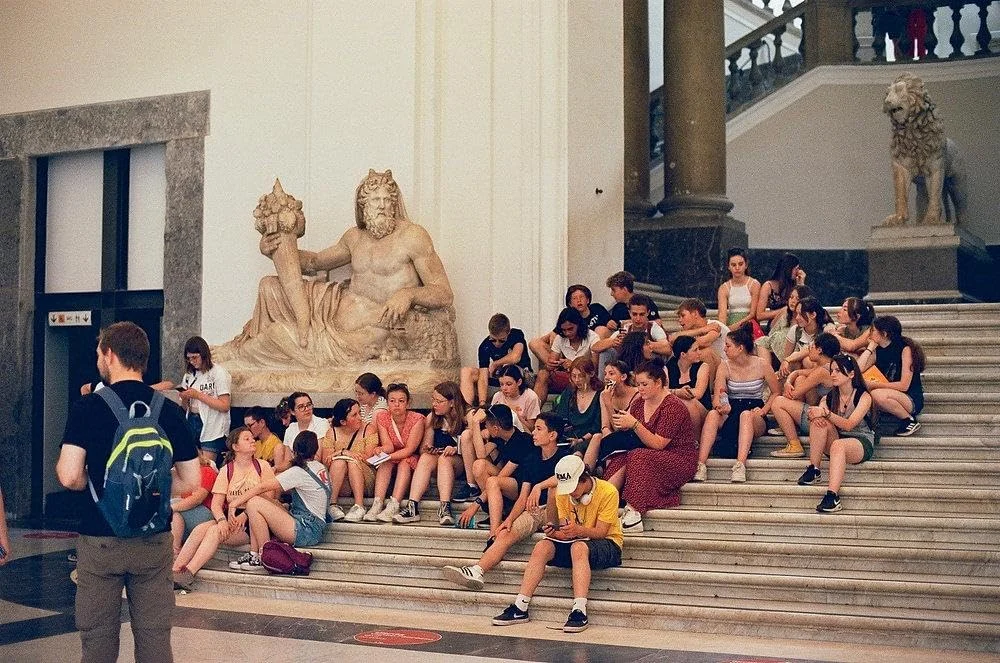
Suzanne occupies another position in this hierarchy. She hangs back, observes, studies and turns the group’s judgments inward. Her brutal description of herself as one of the women who must be undesirable so others can appear desirable captures one of the film’s sharpest insights about adolescence: cruelty does not always require a bully. Social categories can be internalized so completely that a person performs the punishment alone.
Atlan and co-writer Anne Brouillet are especially good at showing how unstable these roles remain. The students split into temporary alliances around drinks, jokes, arguments, flirtations and private conversations. Someone can look sophisticated in one exchange and absurdly young in the next. The effect is neither sentimental nor cynical. Teenagers here are capable of tenderness, vanity, political thought, casual selfishness and startling self-awareness, sometimes within the same conversation.
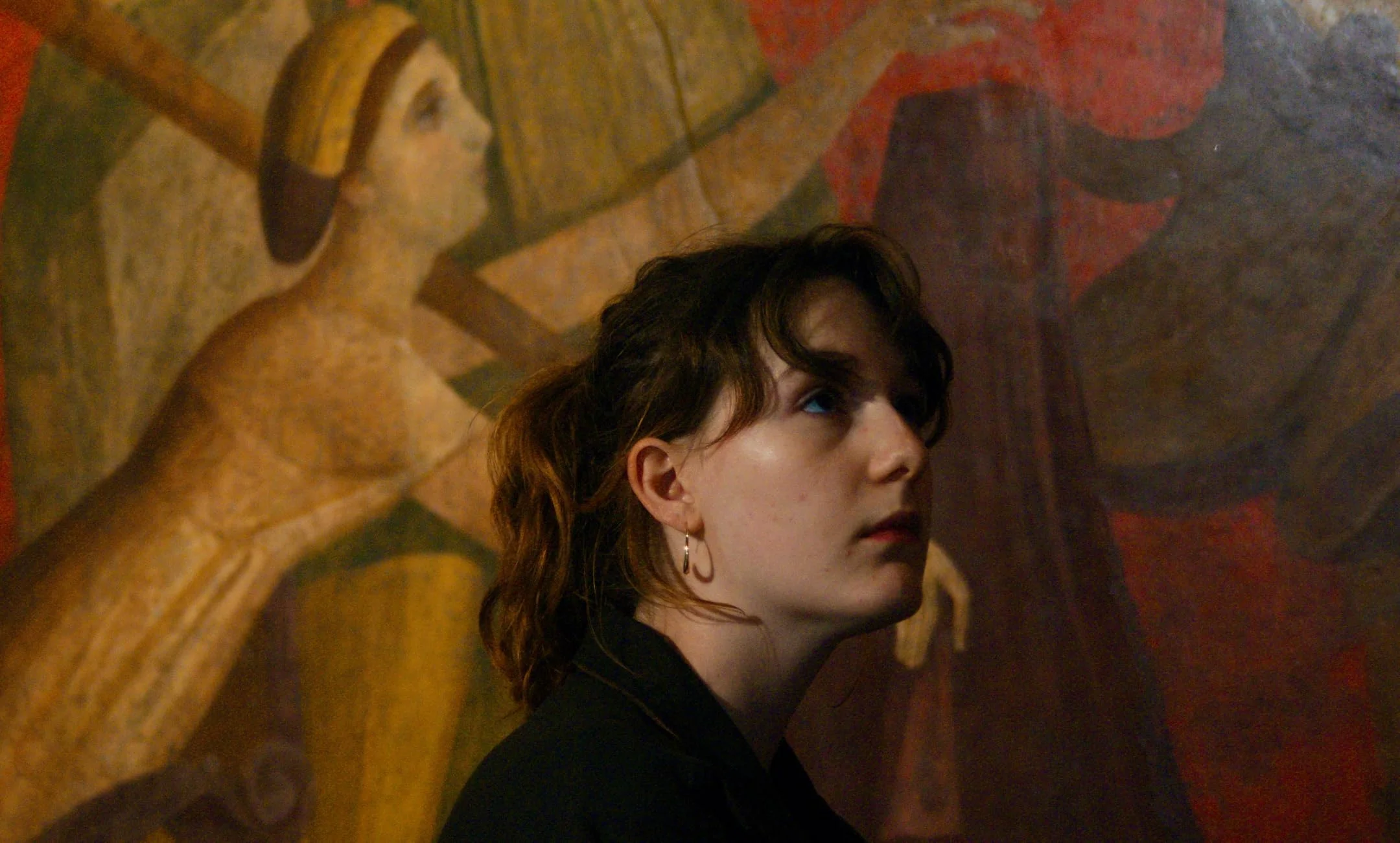
That instability gives the class trip to Pompeii its real purpose. The obvious symbolism is sitting in plain sight: young people full of volatile emotions visiting a city destroyed by a volcano. Atlan is smarter when she leaves that comparison alone. The stronger connection lies in the act of reconstruction. Pompeii asks visitors to look at fragments and imagine complete lives from them. Toni is doing precisely that with his own family.
He has inherited a story about his Neapolitan grandmother, a servant who supposedly fell in love with an aristocrat. Their romance was defeated by class expectations and finally by the 1980 earthquake that killed him. Toni clings to the story because it gives his family history grandeur. The affair turns poverty into romance, displacement into tragedy, and absence into destiny. It transforms social inequality into the setting for an impossible love story.
The trip threatens that interpretation. As Toni moves closer to the place where the story supposedly happened, the fantasy begins to lose its protective surface. Class difference looks less romantic when detached from inherited storytelling. The film’s dinner-table argument about meritocracy sharpens the point.
Some students repeat comfortable assumptions about effort and success; others answer from lives that have taught them how unevenly opportunity is distributed. Toni’s private mythology and the group’s political argument belong to the same world. Both ask what happens when people explain inequality through stories that make it easier to live with.
Madame Mercier occupies an especially poignant place inside this structure. Antonia Buresi plays her as tired without making exhaustion her entire personality. She still wants the students to care about art, geology, Roman life and the bodies preserved at Pompeii, even when their attention keeps drifting toward messages, hookups, jokes and college decisions. Her problem is not that the students are shallow. They are standing inside a time scale they have barely learned to perceive.
That distance between historical knowledge and immediate experience gives the college acceptances particular force. The students are walking among preserved evidence of interrupted lives while receiving news about the futures they expect to have. Some celebrate. Some are disappointed. Some have no clear path. Later, when they dance together, the scene carries the strange contradiction of a group celebrating at the precise moment its shared life is beginning to disappear.
Atlan’s cinematography, shared with Pierre Mazoyer, gives these tensions room to exist without constantly announcing them. The camera moves loosely through groups, catching reactions at the edges rather than isolating every emotional beat for emphasis. Sunlight, train windows, the Italian coast and the neon of the night bus produce an atmosphere of movement that suits characters who do not yet understand how temporary their current arrangements are. The beauty matters because it never freezes them into picturesque youth. They are always shifting inside the frame.
The film’s long running time depends on that patience. What initially resembles looseness gradually reveals itself as preparation. Atlan spends enough time with casual banter, small humiliations and temporary alliances that changes in behavior begin to register before anyone explains them. Toni’s movement from noisy confidence toward silence is especially painful because Quignard has first established the physical rhythm of someone accustomed to taking up space. When that rhythm contracts, the absence becomes visible.
The late tragedy draws its power from everything the film has established about incomplete perception. No single character possesses the whole picture. Mercier knows her students institutionally, friends know one another socially, lovers know each other selectively, and families pass down histories already shaped by need. Knowledge arrives in pieces.
The students are surrounded by ways of describing themselves: dating profiles, academic placements, relationships and future plans. Yet description does not guarantee recognition. Mercier’s devastating task near the end brings that failure into view. Buresi’s posture and expression begin carrying the knowledge before the students receive it. The scene does not assign simple blame because blame would be too comforting. It exposes a group forced to confront the distance between the person they thought they knew and the life that had remained outside their sight.
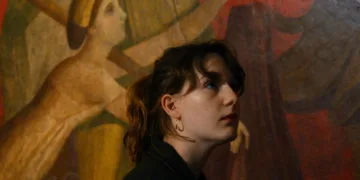
The title’s connection to Wilhelm Jensen’s Gradiva, with its fixation on an imagined woman reconstructed from an artifact, quietly fits this concern. Atlan’s teenagers keep creating versions of one another from whatever evidence is available. Some versions are flattering, some cruel, some romantic, some disastrously incomplete.
The film refuses the fantasy that perfect attention could have prevented every wound. Its demand is smaller and harder: treat partial knowledge as partial. The loud student may be frightened; the aloof girl may be watching because participation feels impossible; the privileged boy may not understand the ease others see in him; a family legend may conceal the class structure that produced it. Pompeii preserves bodies at the instant history overtook them, while Atlan’s teenagers remain in motion, arguing, flirting and making plans, unaware that this trip will look entirely different once it belongs to memory.
La Gradiva had its world premiere at the 79th Cannes Film Festival on May 16, 2026, where it won the Critics’ Week Grand Prize. The coming-of-age drama follows a French high school class traveling to Pompeii, where adolescent desires awaken against an eternal landscape of ancient ruins.
Where to Watch La Gradiva (2026) Online
Full Credits
Title: La Gradiva
Distributor: Tandem, mk2 Films, 1-2 Special
Release date: May 16, 2026 (Cannes Film Festival) / October 21, 2026 (France)
Running time: 2 hours 25 minutes (145 minutes)
Director: Marine Atlan
Writers: Marine Atlan, Anne Brouillet
Producers and Executive Producers: Inès Daïen Dasi, Angelo Barbagallo
Cast: Colas Quignard, Antonia Buresi, Suzanne Gerin, Mitia Capellier-Audat
Editors: Guillaume Lillo
The Review
La Gradiva
La Gradiva turns a school trip into an unusually perceptive study of how people construct one another from fragments. Marine Atlan's patient ensemble direction, Colas Quignard's gradual physical retreat as Toni, and the film's use of Pompeii as a place of reconstruction give its tragedy extraordinary weight. Its looseness requires patience, yet that accumulated observation is precisely what makes the later rupture hurt. Few coming-of-age films grant teenagers this much contradiction without reducing them to lessons.
PROS
- Remarkably natural ensemble performances
- Toni's arc develops through precise behavioral change
- Pompeii imagery serves character and social meaning
- Sharp treatment of class, desire, and partial perception
- Patient camerawork rewards attention
CONS
- The lengthy runtime demands patience
- Early looseness can initially feel diffuse