




























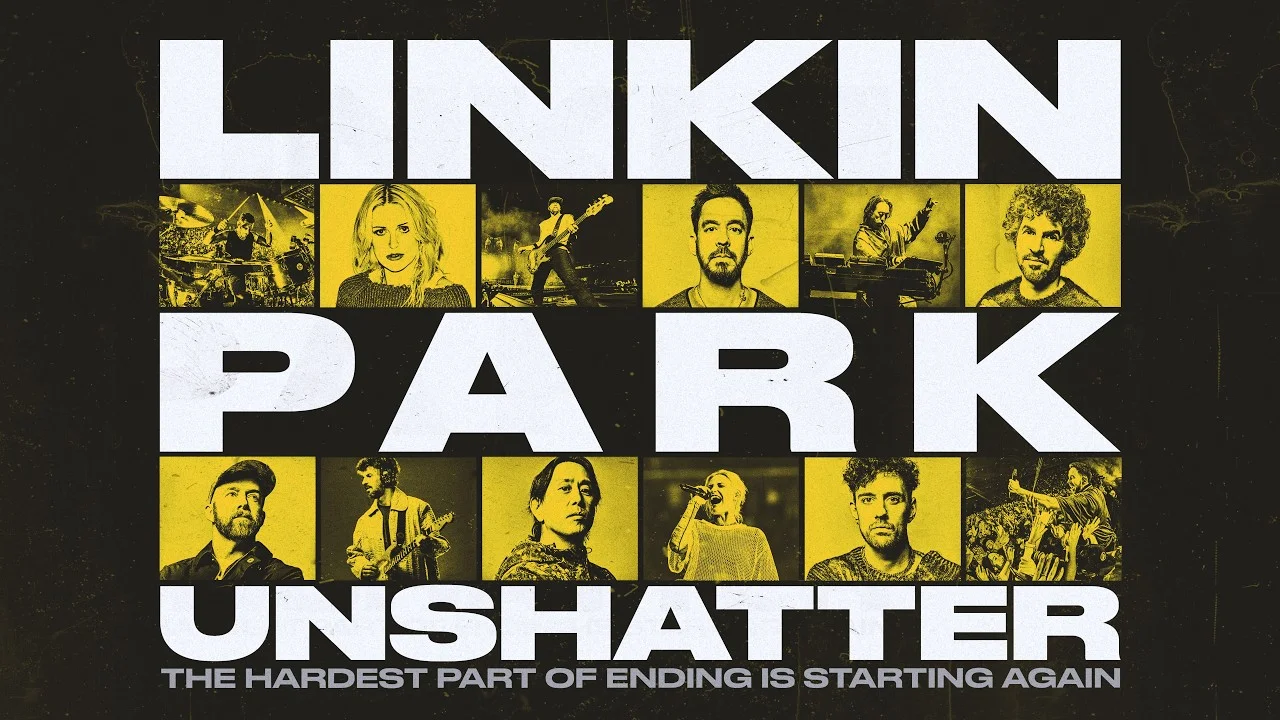

Keeping the Linkin Park name becomes a difficult question in the studio discussions captured by Unshatter. After Chester Bennington’s death by suicide in 2017, the surviving musicians have to decide what that name can still describe. It carries friendships and shared work, alongside the memories listeners have attached to a voice they will never hear live again. Continuing under it means entering a relationship whose expectations extend far beyond the rehearsal room. The discussions make that responsibility tangible without assuming that attachment to the past must dictate the musicians’ future.
The responses within the band complicate any easy equation between reunion and recovery. Rob Bourdon’s decision against returning hurts his former bandmates; Brad Delson’s initial reluctance produces complicated feelings for Mike Shinoda. These admissions matter because they allow the wish to resume and the wish to step away to occupy the same emotional history. A triumphant comeback narrative can make participation look like the natural reward for surviving grief. Here, the hesitation interrupts that logic. The people who shared a loss do not emerge from it wanting precisely the same things, and the group’s return cannot stand as a measure of everyone’s healing.
Footage of Shinoda, Joe Hahn, and Dave Farrell making music in Shinoda’s studio gives the eventual reunion a less predetermined origin. Their meetings offer companionship and creative activity before the future of Linkin Park has acquired a settled shape.
The documentary locates a reason to continue in the work itself: people gather, play, and discover that something remains possible between them. When vocalist Emily Armstrong and drummer Colin Brittain enter the account of the band’s 2024 return and From Zero era, they join a process already marked by uncertainty. The studio material makes that uncertainty credible through activity rather than retrospective declarations of destiny.
Armstrong’s arrival brings the question of continuity into the songs. The members discuss her singing Bennington’s parts in the existing catalogue, a task that carries a peculiar demand. Familiar music invites recognition, while a new singer needs room to establish her own presence.
The interviews expressing confidence in Armstrong explain why the musicians want her there, but their approval cannot resolve the listener’s relationship with those songs. Unshatter has to demonstrate what the changed group can do together. Its concert footage becomes essential to that argument, giving musical substance to decisions that could otherwise remain enclosed within the band’s testimony.
The cut from Armstrong recording “Heavy Is the Crown” in the studio to her screaming it before roughly 55,000 people in São Paulo is the film’s most persuasive connection between those private decisions and their public consequences. The transition lets the same performer and song bridge radically different scales.

Creative possibility becomes a shared event at Allianz Parque, and the stadium supplies an answer that the studio cannot provide on its own. There is exhilaration in that expansion, though the edit also makes visible how a comeback acquires its apparent inevitability. What began as an experiment can look destined for this reception once the two moments sit beside each other.
“Bleed It Out” places a different pressure on Armstrong’s membership. Following discussion of her approach to Bennington’s material, the performance tests the new lineup against an established song rather than a track created for this incarnation. The distinction matters.
New material can announce a fresh identity; the catalogue brings older attachments into the room. By moving from discussion to performance, the film allows continuity to be heard as something the musicians enact together. The song remains available for use in the present, even as the absence of its former singer changes what hearing it can mean.
Onstage cameras and drone views give the São Paulo sequences both proximity and scale. The musicians’ activity is situated within an enormous gathering, making the audience’s participation part of the film’s account of renewed connection. Interspersing these sequences with interviews and studio footage keeps the spectacle attached to the choices that produced it.
The stadium is emotionally persuasive evidence that this version of Linkin Park can sustain a relationship with listeners. Its persuasive force still has a limit: an enthusiastic crowd at a reunion concert cannot settle every disagreement surrounding the reunion. The film’s exhilaration is real, but applause offers a narrower answer than universal acceptance.
That distinction becomes especially significant in a documentary shaped from inside the band. Hahn’s involvement brings access to difficult conversations, including doubts about the name and hurt over members who were unwilling or hesitant to return. These disclosures give the film genuine intimacy. Its treatment of disagreement becomes less searching, however, when the concern originates outside the group. The backlash surrounding Armstrong’s reported past ties to Scientology goes unaddressed. The omission leaves a substantial part of the public dispute beyond the film’s inquiry, even as it examines the emotional difficulty of introducing a new vocalist.
This selectivity changes the account of what acceptance entails. Viewers receive detailed access to grief, creative compatibility, and the responsibility of singing familiar songs, but cannot assess the band’s response to that separate controversy through the documentary. No speculation about the reason for its absence is needed to recognize the gap. Unshatter earns trust through particular admissions, then asks that trust to carry it across an issue it does not examine. Its closeness to the musicians produces valuable understanding while restricting the range of questions they are shown answering.
The closing archival footage of Shinoda and Bennington together onstage returns the film to a relationship that the successful reunion cannot recreate. After the studio experiments and the São Paulo performances, this older material introduces a different kind of presence: an interaction preserved because it belongs to a finished period of their lives. Bennington remains visible as someone making music with his bandmate, rather than existing solely as the loss around which others must organize themselves. The archive gives the new performances a history while retaining something they cannot absorb, the particular experience of these two musicians sharing a stage.
Linkin Park: Unshatter arrives in theaters worldwide today, September 30, 2026. The documentary chronicling the legendary rock band’s major reunion, studio recording sessions, and return to the global stage following a seven-year hiatus is available in select cinemas.
Where to Watch Linkin Park: Unshatter (2026) Online
Full Credits
Title: Linkin Park: Unshatter
Distributor: Trafalgar Releasing
Release date: September 30, 2026
Running time: 1 hour 47 minutes (107 minutes)
Director: Joe Hahn
Writers: Igor Kovalik
Producers and Executive Producers: WL Boyd, Joe Hahn, Igor Kovalik, Ryan DeMarti, Trish Evangelista, Bill Silva
Cast: Emily Armstrong, Mike Shinoda, Brad Delson, Dave “Phoenix” Farrell, Joseph Hahn, Colin Brittain, Alex Feder
Director of Photography (Cinematographer): Adam Evans, Kenneth Wales
Editors: Igor Kovalik, Erich Wiemer
Composer: Linkin Park, Alec Puro
The Review
Linkin Park: Unshatter
Unshatter earns its emotion through the uneasy work of rebuilding: studio gatherings, hesitation, and performances that let Armstrong establish her place. Its treatment of grief allows different responses to coexist without making reunion a test of loyalty. The São Paulo footage gives the return musical conviction, though crowd enthusiasm cannot answer every public objection. Leaving Armstrong’s reported Scientology ties unexamined limits an otherwise revealing account of how a band renegotiates its identity.
PROS
- Candid accounts of grief and disagreement within the band.
- Studio-to-stage editing gives the comeback concrete musical force.
- Catalogue performances demonstrate Armstrong’s place in the lineup.
- Closing archive preserves Bennington’s relationship with Shinoda.
CONS
- Omits the controversy surrounding Armstrong’s reported Scientology ties.
- Concert enthusiasm offers a narrow measure of public acceptance.





And why is her Religion important – Is she participating in Human sacrifices?
Has she been arrested by the FBI/Police for being a Scientologist?
Was she elected to public office ?
Are you one of these closet haters who pretend to like the band while bad mouthing them in secret ?