





Seamus McGarvey’s camera catches Derek Jarman before history has finished deciding what to do with him. He jokes about the BBC’s appetite for nudity, discusses the prospect of Edward II looking suspiciously mainstream, directs actors without ceremony, and moves through Bray Studios with the relaxed authority of somebody who has no interest in performing importance for the lens. Theo Rollason’s Queer Edward II gains much of its force from leaving that informality intact.
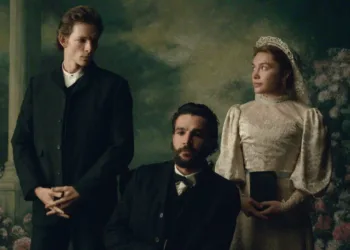
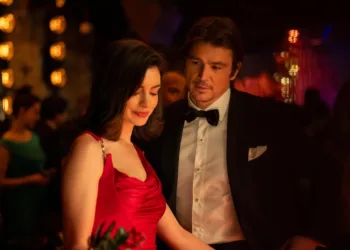
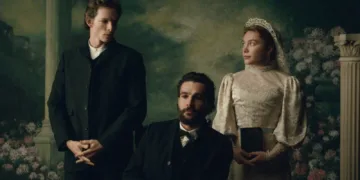
McGarvey, decades away from becoming the cinematographer behind films such as Atonement, had been given remarkable freedom to record Jarman’s 1991 adaptation of Christopher Marlowe’s play. Steven Waddington plays Edward, Andrew Tiernan is Gaveston, and Tilda Swinton appears as Queen Isabella. Around them, Jarman folds contemporary queer protest into a medieval tragedy already built around political power and forbidden desire.
Rollason understands that the surviving material becomes richer when treated as evidence rather than relic. Jarman is already living with HIV. Britain is still governed by laws and political attitudes that make queer visibility dangerous. The documentary keeps these facts close without coating every frame in retrospective solemnity. There is life everywhere. That matters.
Cinema Held Together With Loose Change
The filmmaking material is often wonderfully mundane. Crew members drag scenery through the studio. Extras argue about expenses. Producers search for money and occasionally reach into their own pockets. A pack of beagles threatens temporary disorder. Composer Simon Fisher Turner tests the acoustic possibilities of scaffolding poles and fools around with samples connected to Cliff Richard, who happens to be recording nearby.
These details give the production a physical geography. Bray Studios stops being an abstract birthplace of art and becomes a collection of rooms where money, bodies, cables, costumes and tempers must somehow occupy the same square footage.
Rollason and editor Nicole Halova are particularly good at preserving the textures inside McGarvey’s footage. The young cinematographer watches rather than interrogates. His lens often remains close enough to register the tired expression of somebody solving another production problem, yet loose enough to catch activity happening behind them. It produces something close to documentary chiaroscuro without literal shadows: glamour and drudgery sharing the frame.
Tilda Swinton appears amid Sandy Powell’s costuming, while Annie Lennox’s performance of “Ev’ry Time We Say Goodbye” briefly changes the film’s temperature. The bustle drops away and performance takes command. Rollason lets the moment breathe.
A few backstage conversations receive less disciplined treatment. Some repeat their point after the tension has already evaporated, and viewers unfamiliar with Jarman’s collaborators may struggle when important figures pass without clear identification. Intimacy occasionally becomes opacity.
OutRage! Crosses the Hallway
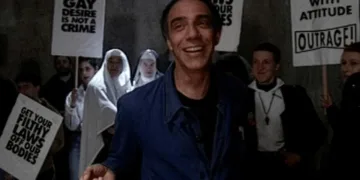
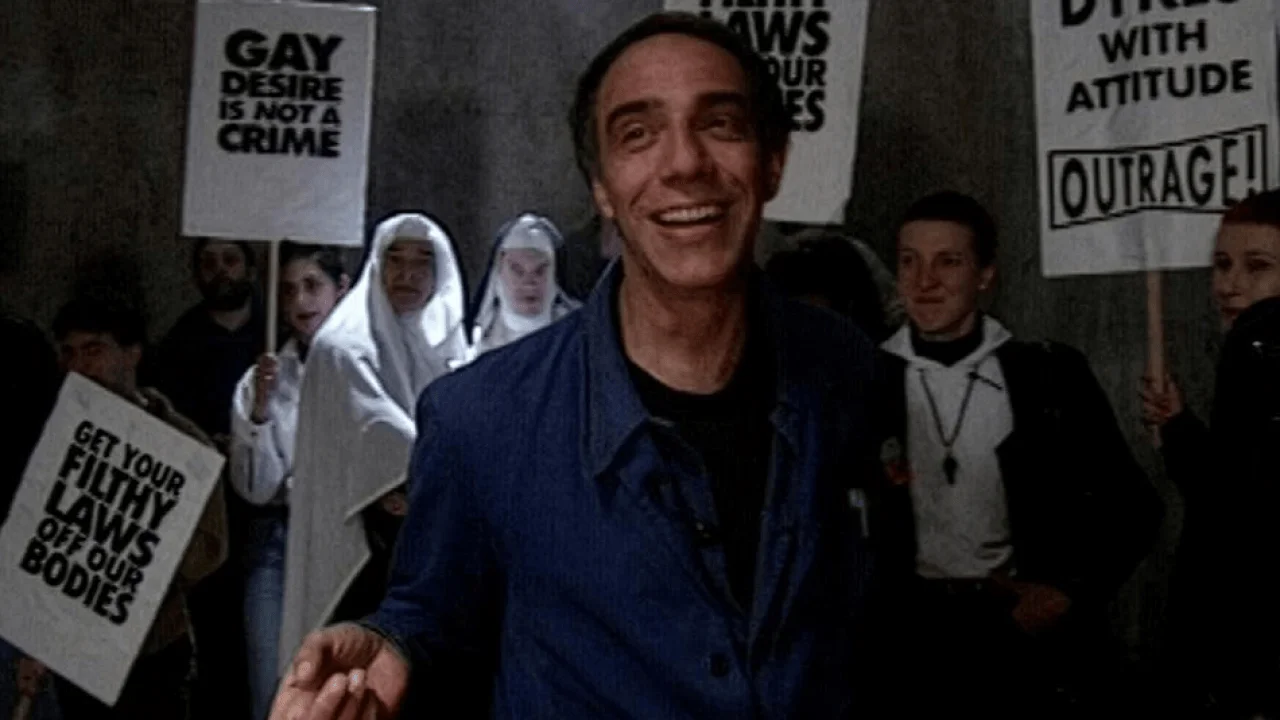
The documentary’s moral center arrives through what initially looks like farce. Members of OutRage!, brought onto Edward II as protesters, discover that Cliff Richard is working in a neighboring studio. They decide to confront him and pressure him into publicly addressing long-standing speculation about his sexuality. The intervention generates tabloid interest, possible legal consequences and a fresh problem for a production already balancing every pound.
McGarvey’s footage catches production manager Sarah Swords handling journalists on the telephone while everyone works out how serious the threat might become. The framing turns bureaucratic panic into suspense. No sinister score is required. A ringing phone will do.
The episode is valuable precisely because Rollason refuses to clean up its ethics. The activists are fighting a Britain where gay men face discriminatory law and institutional hostility. Their anger has material causes. The attempted outing still carries an ugliness that time has made easier to see. Political righteousness does not automatically produce righteous tactics. Then Jarman is told what happened.
His response reveals the film’s most interesting moral composition. He does not abandon the activists to protect his production. He recognizes the trouble they have created and remains aligned with the struggle that brought them there. The contradiction stays unresolved, which is where it belongs.
Cinema loves moral lighting schemes with obvious sources. Villain in darkness, hero in light. Real political life rarely grants the gaffer such convenient instructions.
History Keeps Returning the Same Props
Rollason widens the film through television appearances, news footage and images of street protest. Jarman speaks openly about homosexuality, criminalization and living with HIV. Jonathan Ross interviews him with the peculiar mixture of bluntness and curiosity characteristic of the period. Jeremy Paxman appears in archival reporting from a Britain where openly gay public figures remain conspicuous enough to become news in themselves.
The editorial structure continually places Edward II beside the political world feeding it. Jarman recruits activists for the film because the modern struggle belongs inside his treatment of Marlowe. Protest scenes therefore occupy two realities at once: staged resistance inside the production and actual resistance beyond the studio walls.
Rollason resists turning Jarman’s illness into the documentary’s dominant visual key. We see him taking medication. We hear him discuss uncertainty about how long he might live. Yet the camera repeatedly returns to work: directing, laughing, arguing, planning. That choice protects him from the flattening effect of sainthood.
The most revealing portrait comes from accumulation. A filmmaker supports activists who create problems for his film. A politically furious artist cracks jokes. A dying man keeps organizing tomorrow’s shoot. Through those contradictions, Queer Edward II preserves something biography often loses when it places its subject safely behind glass. Jarman never looks safely contained here. Neither does the history around him.
Queer Edward II premiered out of competition at the 83rd Venice International Film Festival on September 4, 2026. The documentary chronicles filmmaker Derek Jarman during the turbulent 1991 production of his radical historical feature Edward II amidst intense political and homophobic backlashes.
Full Credits
Title: Queer Edward II
Distributor: Lightborn Films, March 13th, John Gore Studios
Release date: September 4, 2026 (Venice International Film Festival)
Running time: 1 hour 37 minutes
Director: Theo Rollason
Writers: Theo Rollason
Producers and Executive Producers: Sandy Powell, Tilda Swinton, Christine Vachon, Russell Tovey
Cast: Derek Jarman, Andrew Tiernan, Tilda Swinton, Peter Tatchell, Jonathan Ross, Ian McKellen, Steven Waddington, Nigel Terry
Director of Photography (Cinematographer): Seamus McGarvey
Editors: Theo Rollason, Nicole Hálová
Composer: Simon Fisher Turner
The Review
Queer Edward II
Queer Edward II finds its sharpest argument in the collision between McGarvey’s restless set footage and the political pressure surrounding Jarman’s production. Theo Rollason lets money problems, tabloid panic, OutRage!’s reckless intervention, and Jarman’s own mortality occupy the same frame without flattening their moral differences. Some workplace passages linger past their dramatic usefulness, and newcomers may wish certain collaborators were identified more clearly. Yet Jarman emerges with unusual immediacy: amused, stubborn, politically committed, and fully aware that making Edward II carried consequences beyond cinema.
PROS
- Remarkable unseen McGarvey footage
- Jarman captured with rare intimacy
- Strong integration of queer political history
- Cliff Richard episode carries real ethical tension
- Excellent archival editing
CONS
- Several conversations overstay their purpose
- Some collaborators lack clear identification
- Certain historical threads receive limited development