



























Mr. Mui’s problem is simple enough to build an entire film around: he has spent his life perfecting a bowl of phở, and none of the adults in his family seem interested in inheriting it. His son would rather paint. His son-in-law comes from a rival restaurant family and remains outside the circle of trust. His grandson Sa Sung has the nose and palate for the work, but he is eight years old and has a mother who would quite reasonably prefer that nobody plan his career before he finishes primary school.
That conflict gives Scent of Pho its strongest dramatic spine. Writer-director Minh Beta understands that Mr. Mui’s obsession is rooted in fear rather than simple stubbornness. When the owner of a competing phở restaurant suffers a fatal stroke, succession stops feeling theoretical. Mr. Mui suddenly sees his own absence waiting for him at the end of the counter.
Xuân Hinh plays that anxiety loudly, sometimes very loudly, but the performance works because Mr. Mui is written as a man whose authority has gone mostly unquestioned for decades. His restaurant has become a local institution. His recipe has become family mythology. He therefore treats resistance as if everyone else has misunderstood a perfectly obvious truth. The problem is that everyone understands him perfectly.
Inheritance Becomes a Hostage Situation
The screenplay is strongest when Mr. Mui and his daughter-in-law Trinh are arguing about Sa Sung. She sees a child. He sees the next custodian of a tradition. Neither position requires much embellishment, and Thu Trang gives their confrontations the restraint the film desperately needs.
Watch the difference in their performances during these clashes. Xuân Hinh leans into theatrical gestures, raised volume, and wounded pride. Trang stays grounded, which turns Trinh into an effective counterweight. She never needs to become the villain standing between grandfather and grandson because her objection already makes sense: loving a family tradition does not give one generation ownership over the next.
Minh Beta complicates this good material almost compulsively. Mr. Mui decides that if his existing family will not provide a suitable successor, perhaps he can manufacture one, so he marries the much younger Ms. Kieu in hopes of producing another heir. From there, the film keeps adding comic schemes, family confrontations, melodramatic reversals, and eventually a kidnapping-for-ransom plot. There is a point where escalation stops raising the stakes and starts obscuring them. Scent of Pho crosses it several times.
The kidnapping material is especially revealing because the original conflict needs no external villain. Mr. Mui already created the family crisis himself. Bringing in increasingly extreme plot machinery gives the second half movement, but it also distracts from the far sharper question sitting inside the restaurant: can tradition survive if preservation requires coercion?
Comedy at Full Volume
The film’s tonal strategy is similarly crowded. Scenes can move from slapstick to screaming matches to tears with almost no transition, sometimes accompanied by music that announces an emotional shift before the performances have fully arrived there.
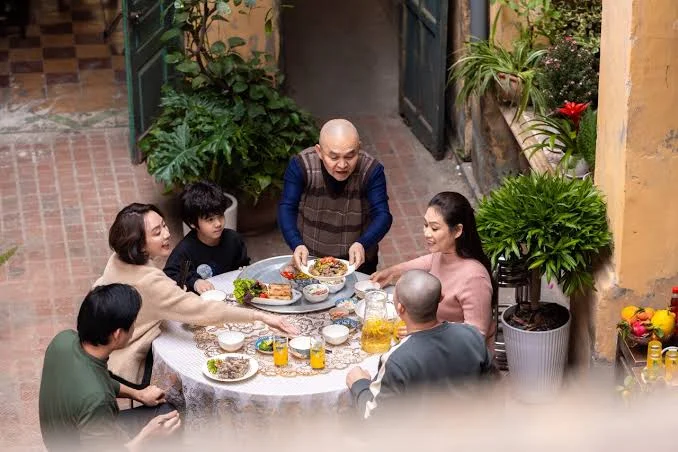
Some of this comes from a comic tradition that embraces theatrical exaggeration. Xuân Hinh, a veteran stage performer, is clearly comfortable working at that scale. His mannerisms and bursts of outrage can be very funny because Mr. Mui is already a character who believes every disagreement deserves the emotional weight of a constitutional crisis.
Thanh Hương’s Ms. Kieu pushes the same approach much further. Her storyline is designed around absurdity, but the fast-forward music-video sequence attached to the marriage subplot keeps extending a joke whose point arrived several beats earlier.
Sa Sung is charming enough to justify why the family circles around him, though the young performer’s line delivery can sound rehearsed rather than spontaneous. It matters less when he is reacting to the adults, where his presence itself provides the joke: a household full of grown people has turned an eight-year-old’s future employment into open warfare.
That comic excess will be the film’s biggest dividing line. Viewers comfortable with this performance style may find the energy infectious. Others may spend several scenes waiting for everyone to use indoor voices.
The Bowl Is the Best Storyteller
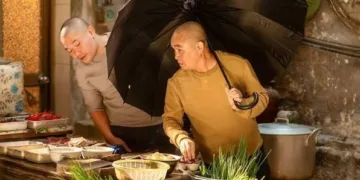
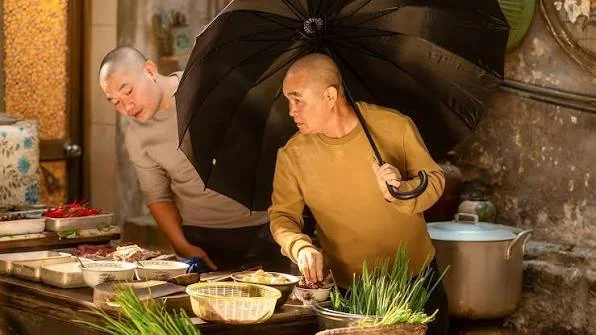
Dominic Pereira’s cinematography gives the film a clarity its screenplay often lacks. The phở sequences follow ingredients through preparation, cooking, plating, serving, and eating with patient attention to texture and color. Steam catches the light. Broth glows. Herbs and meat are framed with enough care to make the restaurant feel tangible rather than decorative.
Those images also explain Mr. Mui better than some of the dialogue does. The recipe represents decades of repetition, memory, and labor. Every carefully prepared bowl shows why he cannot treat the business as something that can simply close or be sold.
The locations in Nam Dinh and Hanoi’s Old Quarter carry similar weight. Minh Beta occasionally leans so heavily into Vietnamese food, architecture, folk culture, and Đạo Mẫu imagery that scenes can resemble tourism promotion, but the cultural specificity remains one of the film’s strongest assets.
The music tries to solve the same generational problem as the story. “Scent of Memories” draws from Northern folk traditions, while “Rap Pho” combines xẩm singing with rap. That fusion is far cleaner than Mr. Mui’s approach to succession. Tradition survives here because somebody allows it to change form. If only the screenplay trusted that idea as much as the soundtrack does.
Scent of Pho premiered in theaters in February 2026 and became available for streaming on platforms such as Amazon Prime Video. The family comedy-drama follows a devoted pho master whose decision to name his young grandson as the sole successor to the family business triggers fierce rivalries.
Where to Watch Scent of Pho (2026) Online

Full Credits
Title: Scent of Pho
Distributor: 3388 Films, Beta Productions
Release date: February 17, 2026
Rating: 13+
Running time: 1 hour 51 minutes
Director: Minh Beta
Producers and Executive Producers: Minh Beta, Alex Morsanutto
Cast: Xuan Hinh, Thu Trang, Bao Nam, Thanh Thanh Hien, Cuong Ca
The Review
Scent of Pho
Scent of Pho works best when its family feud stays tied to Mr. Mui’s fear that his recipe will die with him. Xuân Hinh and Thu Trang give that conflict real force, while Dominic Pereira’s food photography makes every bowl feel worth fighting over. The screenplay is far less disciplined, piling exaggerated comedy, melodrama, a young-wife subplot, and even kidnapping onto a sturdy generational story. Some tonal pivots land; others feel like the script changing channels. Still, its cultural specificity and affection for its characters carry it through the clutter.
PROS
- Mouth-watering food cinematography
- Strong Xuân Hinh and Thu Trang dynamic
- Rich Northern Vietnamese setting
- Effective generational conflict
- Energetic audiovisual presentation
CONS
- Overstuffed screenplay
- Abrupt tonal shifts
- Excessive comic performances
- Contrived late plot twists
- Uneven child performance