












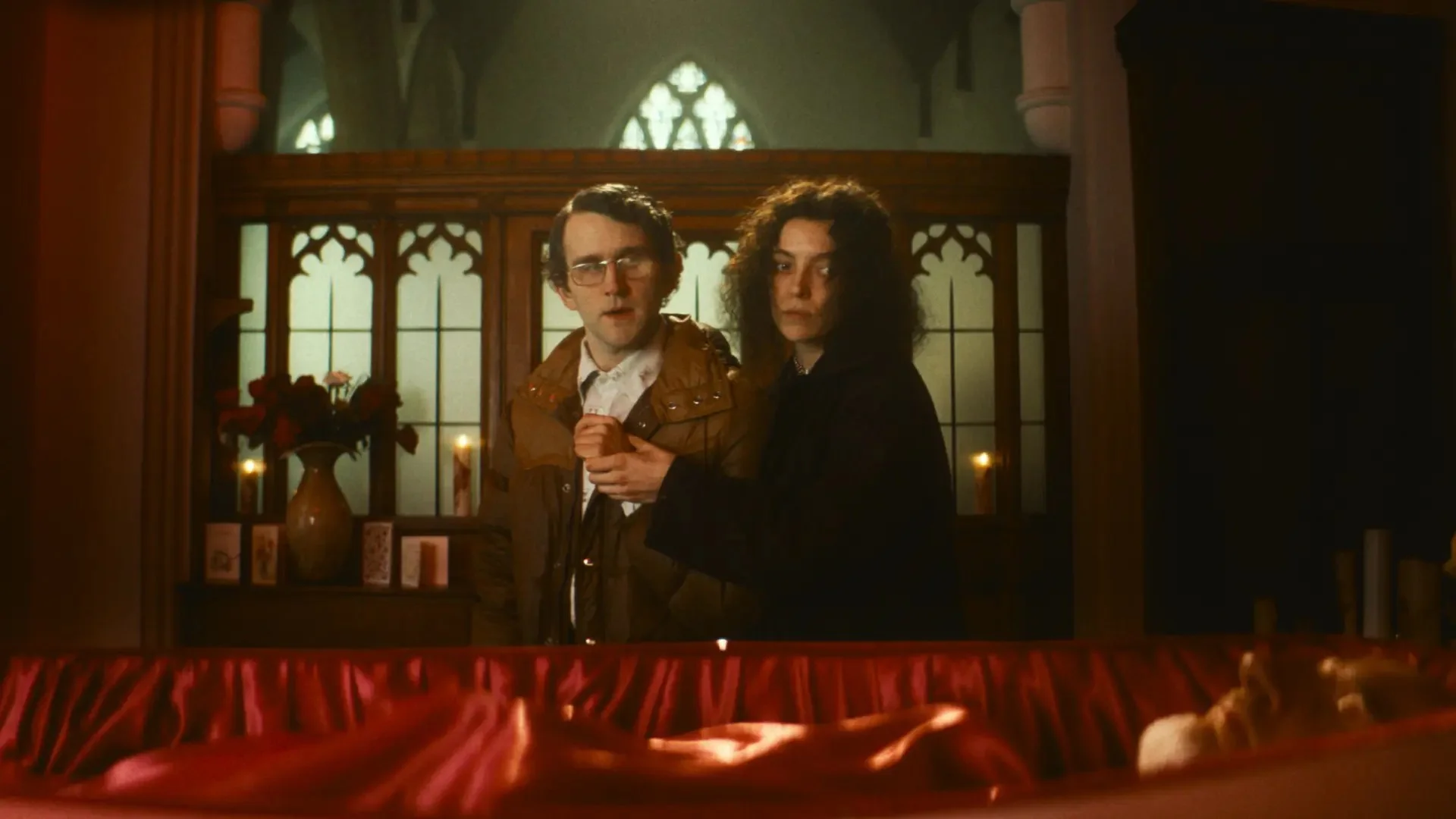

Bernie’s saddest idea is also the one that finally makes him interesting to someone: he is willing to die if it means he can stop being invisible. He has spent ten years making sandwiches on a factory line, brings in a cake his colleagues barely acknowledge, and visits a mother whose dementia is erasing the person who remembers him best. So when a classified ad promises the chance to become exceptional, death starts looking strangely like proof of life.
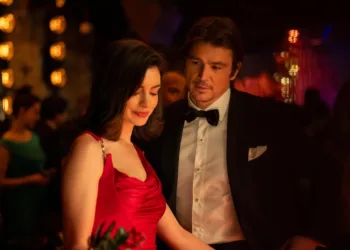
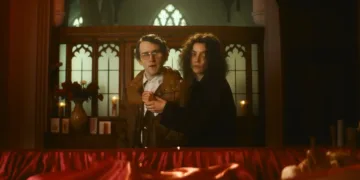
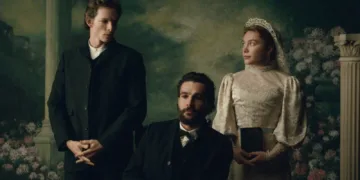
The person offering that proof is Araminta, a reclusive taxidermist whose ambition is to preserve a human body. Stuffed could have played this setup purely for grotesque comedy, and there are certainly moments when its dead animals, formaldehyde plans, and gothic theatricality invite a nervous laugh. What gives Theo Rhys’s film its emotional pull is the way Harry Melling and Jodie Comer refuse to treat Bernie and Araminta as jokes. Their connection becomes sincere long before either character knows what to do with that sincerity.
Melling understands that Bernie’s willingness to be stuffed has to feel emotionally reasonable to Bernie, even while the rest of us can see how horrifying the proposition is. His sadness is built from tiny humiliations rather than grand tragedy. The untouched work anniversary cake matters. His collection of obituaries belonging to other Bernies matters. His mother failing to recognize him matters most of all. Each detail pushes him toward the same fear: if nobody sees you while you are alive, what evidence remains once you are gone?
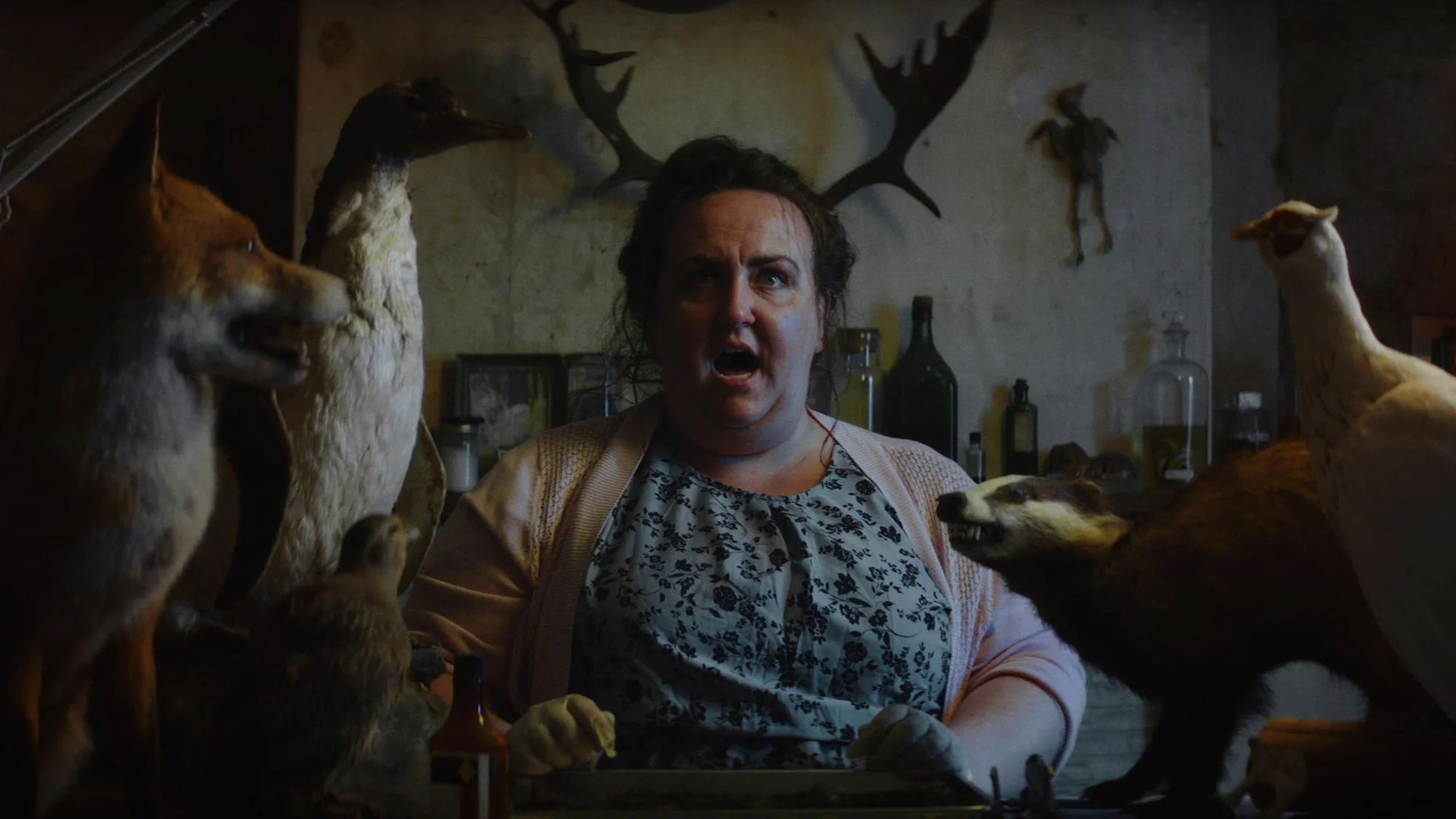
That is where Araminta becomes dangerous and comforting at the same time. She looks at Bernie with an intensity nobody else gives him. She studies his face, imagines preserving it, and treats his ordinary body as something worthy of permanent attention. The irony is cruel and strangely tender. Bernie has to agree to become an object before somebody finally treats him as significant.
Comer gives Araminta a different kind of isolation. She is guarded and severe, comfortable with dead things because dead things cannot complicate the arrangement. Her taxidermy is built around control: preserve the body, stop decay, hold something in a fixed state. Bernie disrupts that logic simply by remaining alive long enough for her to care about him. The plan that initially brings them together becomes harder to complete once he stops being a specimen and becomes a person she might miss.
At first they appear almost mathematically suited to each other. Bernie wants permanence. Araminta wants something to preserve. He supplies the body she needs, and she offers the recognition he craves. Then affection ruins the neatness of the transaction. The unsettling question underneath their romance is how much of this connection is healing and how much is two complementary obsessions finding an unusually intimate arrangement.
The musical format gives that shift room to breathe. Joss Holden-Rea’s songs are less interested in producing a string of catchy showstoppers than in letting these withdrawn people say things they would struggle to speak aloud. The nursing-home number about being remembered establishes the film’s preoccupation before Bernie can properly articulate it himself. Later songs give his fear of disappearing a direct voice, while Araminta’s musical moments expose the tension between fulfilling the ambition that has defined her and recognizing its emotional cost.
That sincerity is important. A winking score could have turned the whole film into a joke about taxidermy and lonely weirdos. Instead, the music treats their desires with almost alarming seriousness, and Melling and Comer commit to that tone completely.
The problem is that the film keeps returning to a similar expressive mode. Many numbers are solos or duets staged in confined spaces, with little visual movement separating one emotional confession from the next. Once the audience understands what Bernie wants and what Araminta fears, some later passages repeat those feelings rather than changing them. At 117 minutes, the story begins to feel stretched around a conflict that has already become clear.
That weakness is amplified by the chamber-piece scale. The sandwich factory, Araminta’s home, and a handful of other locations create an intentionally sealed world, but the intimacy eventually works against the pacing. The film does not need a bigger cast or louder set pieces. It needs greater variation in how its central tension develops.
Beck Rainford’s production design gives that confinement an expressive purpose. The manual factory work, old televisions and computers, muddy industrial landscapes, and uncertain period make the entire setting feel slightly preserved already. Araminta’s collection simply makes the metaphor literal. Wyatt Garfield’s cinematography gradually allows more light into the film as Bernie and Araminta grow closer, giving their emotional movement a visual counterpart without announcing it.
That change captures what Stuffed does best. These two people begin by believing permanence is something you achieve through objects. Bernie wants to leave physical evidence that he existed. Araminta wants to defeat disappearance by holding bodies in a fixed state. Their relationship suggests a quieter possibility: being remembered may depend less on preservation than on becoming important to somebody while you are still alive.
Stuffed never fully escapes the limits of its premise. Its middle stretches too long, several songs occupy similar dramatic territory, and the film occasionally seems enchanted by its own strangeness. Yet that strangeness is not what stayed with me. Bernie agreeing to die because he wants someone to notice him is funny until it suddenly is not. Araminta wanting to preserve him forever sounds romantic until affection makes the idea unbearable.
That is the feeling the film understands best: loneliness can make almost any form of attention feel like salvation. Stuffed takes that thought somewhere absurd, bloody, and unexpectedly sad, then lets two beautifully committed performances make it feel human.
Stuffed premiered on September 10, 2026, as the opening film of the Discovery program at the Toronto International Film Festival. The musical body horror romance follows a man afraid of being forgotten who volunteers his body to a taxidermist, leading to an unexpected romance.
Where to Watch Stuffed (2026) Online
Full Credits
Title: Stuffed
Distributor: Agile Films, Fresh Fish Films, BFI, Ffilm Cymru Wales
Release date: September 10, 2026 (TIFF)
Rating: Not Rated
Running time: 1 hour 57 minutes (117 minutes)
Director: Theo Rhys
Writers: Theo Rhys, Joss Holden-Rea
Producers and Executive Producers: Sam Ritzenberg, Dimitra Tsingou, Myles Payne, Hayley Williams, Danny Roberts, H.S. Naji, Jackie Langelier
Cast: Jodie Comer, Harry Melling
Director of Photography (Cinematographer): Wyatt Garfield
Editors: Chris Dickens, Gareth C. Scales
Composer: Joss Holden-Rea
The Review
Stuffed
Stuffed stretches its intimate story too far, and several musical passages repeat feelings the film has already made clear. Yet Jodie Comer and Harry Melling keep its strangest ideas emotionally grounded. Their relationship transforms a grotesque bargain about death and preservation into something tender, sad, and surprisingly human. The taxidermy gets your attention, but Bernie’s desperate need to be remembered gives the film its real sting.
PROS
- Comer and Melling fully commit
- Strong emotional logic beneath the macabre premise
- Musical numbers reveal character interiority
- Expressive production design and cinematography
CONS
- 117-minute runtime feels stretched
- Several songs occupy similar dramatic territory
- Limited staging weakens musical variety