


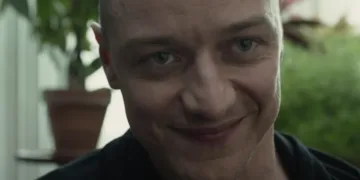












Wes takes a job filming a pilot for a house-flipping show. His host is strange, but strange hosts are hardly a reason to abandon a shoot. That premise gives Josef, Mark Duplass’s serial killer, something he usually has to manufacture: another person with a professional reason to keep the camera running. The episode finds a particularly ugly possibility inside an ordinary television assignment. Production has its own demands, and Josef knows how to take advantage of them.
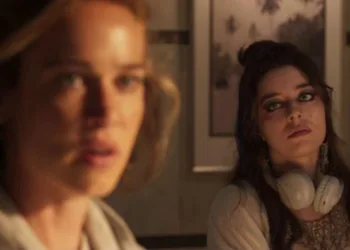
Ava’s job making a salacious documentary offers a variation. Here, an uncomfortable subject is part of the attraction. Her assignment helps explain why she might stay with someone whose behavior should send her away. These setups give The Creep Tapes Season 2 its sharpest use of found footage. A camera can belong in almost any room if somebody has been paid to point it there.
Across six short episodes, creators Mark Duplass and Patrick Brice keep returning to tapes from Josef’s collection, changing the people and circumstances around him. Viewers know the masked killer called Peachfuzz is likely to survive each encounter. That certainty places pressure on the guest characters: can they alter his routine enough to surprise him? It also places pressure on the series. Once a killer has a dependable method and an apparently endless supply of victims, another tape needs a reason to exist beyond adding to the pile.
The season answers most confidently by making Josef share his act. In the opening episode, David Dastmalchian plays a copycat who calls himself “Joseph.” His imitation puts Josef in the unfamiliar position of watching someone else perform a version of him.
Duplass’s appeal has always depended on the gap between the persona Josef presents and the threat underneath it; Dastmalchian makes that performance visible by reproducing it badly enough to irritate its owner. The joke has a television-sized bite, too. A character built to sustain a series comes face to face with his own repeatability.
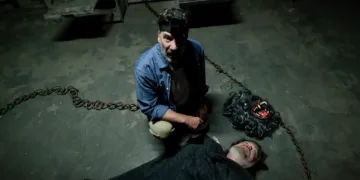
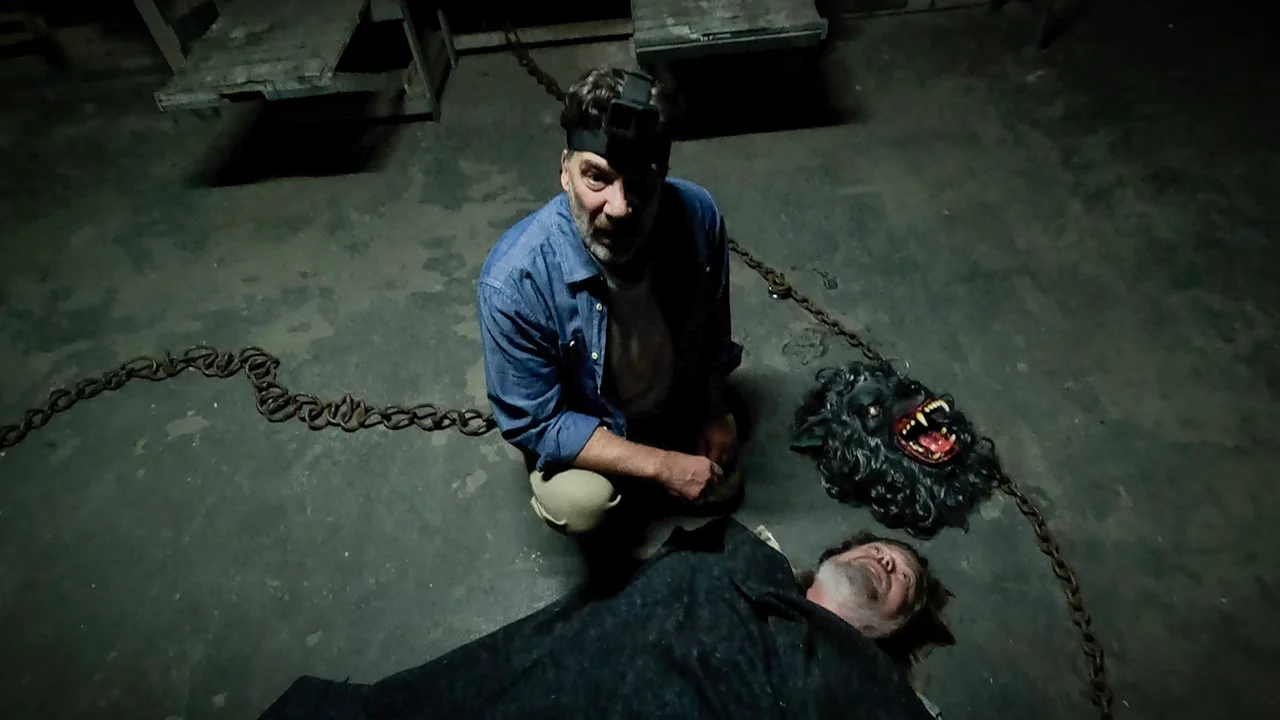
Robert Longstreet gives the Saw-inspired episode a different kind of resistance. His captive wakes chained in a dilapidated room and struggles with the puzzles Josef has prepared. The pleasure of the setup lies in Josef’s mounting frustration.
He has arranged an elaborate ordeal, yet the person trapped inside it fails to behave like the participant he imagined. Duplass is funny when Josef’s confidence slips into impatience, and Longstreet’s response keeps the joke attached to the imbalance of power. Josef can control the room. He cannot guarantee a satisfying performance from the man inside it.
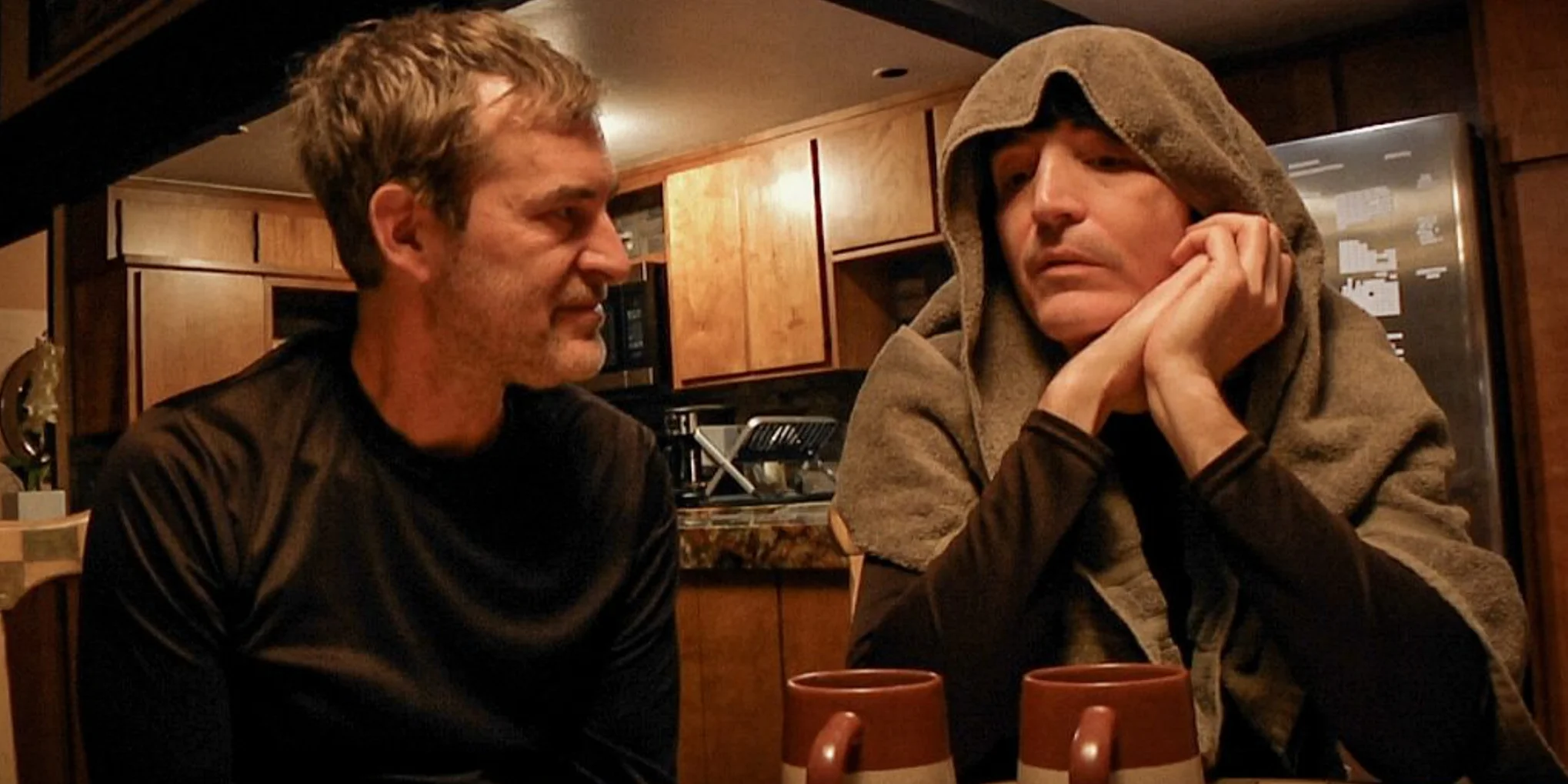
Those encounters give Duplass room to move between menace and childish annoyance without asking the audience to forget what Josef does. A confrontation involving law enforcement similarly tests his ability to improvise when his plan meets people he cannot simply cast as victims. The danger comes from seeing how quickly he can change his manner to suit the situation. The comedy comes from recognizing that, to Josef, every interruption is also an affront to his direction.
The approach has limits. Ava’s documentary and Nick’s Christmas Eve emergency therapy session provide distinct situations, but their escalation is less convincing than the copycat or puzzle-room encounters. At roughly twenty minutes apiece, these tapes have little space to establish a new person, complicate Josef’s scheme, and make the consequences register.
When his behavior grows especially outlandish, the brief format can move past the moment at which someone ought to challenge it. The season is entertaining in those episodes, though its appetite for another bizarre scenario sometimes weakens the unease that gave the original Creep films their intimacy.
Katie Aselton’s Angela changes the balance again in the finale. She has a personal connection to Josef, and her volatile presence gives him someone who can unsettle him without entering one of his carefully arranged games as a stranger. Aselton meets Duplass’s theatrical energy rather than merely reacting to it. Their encounter offers glimpses of his history, but its greater value is immediate: Josef has to deal with a person who brings expectations of her own.
The Creep Tapes expands upon the cult-classic found footage horror films, streaming on Shudder and AMC+. The anthology series exposes the twisted video archives of a charismatic serial killer who ropes unsuspecting victims into his lethal games.
Where to Watch The Creep Tapes Season 2 Online










Full Credits
Title: The Creep Tapes
Distributor: Shudder, AMC+
Release date: November 15, 2024 (Season 1) / November 14, 2025 (Season 2) / September 15, 2026 (Season 3)
Rating: TV-MA
Running time: 21–27 minutes per episode
Director: Patrick Brice
Writers: Patrick Brice, Mark Duplass
Producers and Executive Producers: Mark Duplass, Patrick Brice, Jay Duplass, Mel Eslyn
Cast: Mark Duplass, Mike Luciano, David Nordstrom, Josh Fadem, Josh Ruben, Scott Pitts, Krisha Fairchild, John Craven
Director of Photography (Cinematographer): Patrick Brice
Editors: Christopher Donlon, Pat Smith
The Review
The Creep Tapes Season 2
The Creep Tapes Season 2 finds fresh reasons to keep Josef’s camera running. A house-flipping pilot, a copycat killer, and a captive who cannot follow the script give Mark Duplass room to be frightening and absurdly irritated. The shorter tapes sometimes rush past the point where Josef’s behavior should meet resistance, but the strongest episodes let other performers disrupt his control.
PROS
- Inventive reasons for the footage to exist
- Dastmalchian and Longstreet challenge Josef’s act
- Aselton gives the finale a different balance of power
CONS
- Some encounters escalate too quickly
- Ava and Nick’s episodes are less convincing