




















Simon has found a remarkably efficient way to confuse motion with progress. He flies across borders, collects footage, attends festivals, and speaks about his next documentary with the vocabulary of someone who has already solved problems he has barely begun to confront. Alex Mallis and Travis Wood build The Travel Companion around that contradiction, turning the precarious economy of independent filmmaking into a comedy about dependency disguised as ambition.
Simon, played by Tristan Turner, is still circulating his thesis short while supposedly developing an experimental documentary about geography, cultural division, and human connection. His childhood friend and roommate Bruce, played by Anthony Oberbeck, works for an airline and has named Simon his annual “travel companion,” granting him free standby flights. Simon treats the arrangement like infrastructure.
Then Bruce begins dating Beatrice, played by Naomi Asa, another filmmaker whose career has begun moving with considerably greater purpose. What threatens Simon is therefore larger than romance. Bruce may choose Beatrice as his companion, while Beatrice herself embodies the professional momentum Simon keeps pretending he possesses.
Talking the Film Into Existence
The opening festival Q&A establishes the social ecosystem with surgical accuracy. Filmmakers answer inflated questions with equally inflated declarations, crew members are pulled into discussions that have little to do with their work, and Simon waits patiently for his chance to explain himself. The theater needs to clear before he gets it. It is a cruelly appropriate introduction. Simon wants desperately to speak, yet his greatest problem is that speaking has become his substitute for making.
Asked about his next project, he reaches for phrases concerning geography, cultural barriers, the past and future, then struggles to decide if the footage already captured during his travels belongs to the documentary or amounts to scouting. Later, he tells a festival programmer that the project is nearing completion and already receiving encouraging responses. Her premiere requirements expose the fiction immediately, forcing him to retreat from claims nobody required him to make.
Mallis, Wood, and co-writer Weston Auburn understand a particular economy of artistic insecurity: everyone must appear busy because admitting uncertainty feels professionally dangerous. Projects are “developing,” ideas are “marinating,” and unfinished work acquires impressive theoretical architecture long before it develops an actual shape. Simon has mastered this language.
His day job shooting promotional videos for New York taxis makes the discrepancy sharper. He performs creativity for wages while treating his personal filmmaking as a grander activity whose completion can remain indefinitely deferred.
Turner prevents the character from collapsing into a simple satire of narcissism. Simon’s lies rarely carry the confidence of manipulation. Watch how quickly his certainty dissolves whenever somebody asks a practical question. His ego functions like emergency scaffolding.
Two Dudes Chillin’
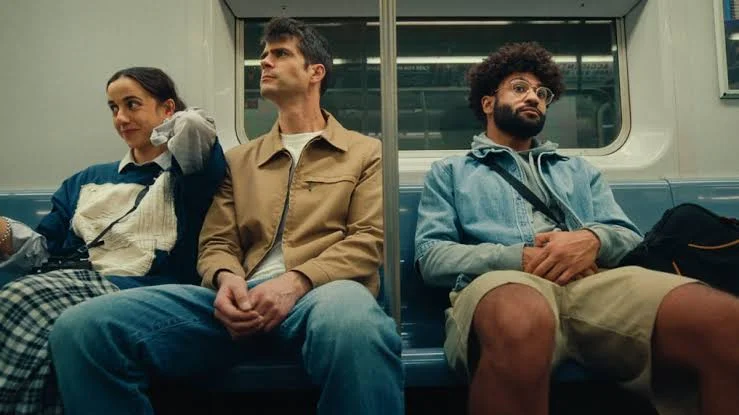
Bruce and Simon have known each other since childhood, and Turner and Oberbeck give that history a physical ease the screenplay never needs to announce. They exercise together, sit outside their building, exchange insults, and share rooms with the casual entitlement of people who stopped thinking about personal boundaries years ago.
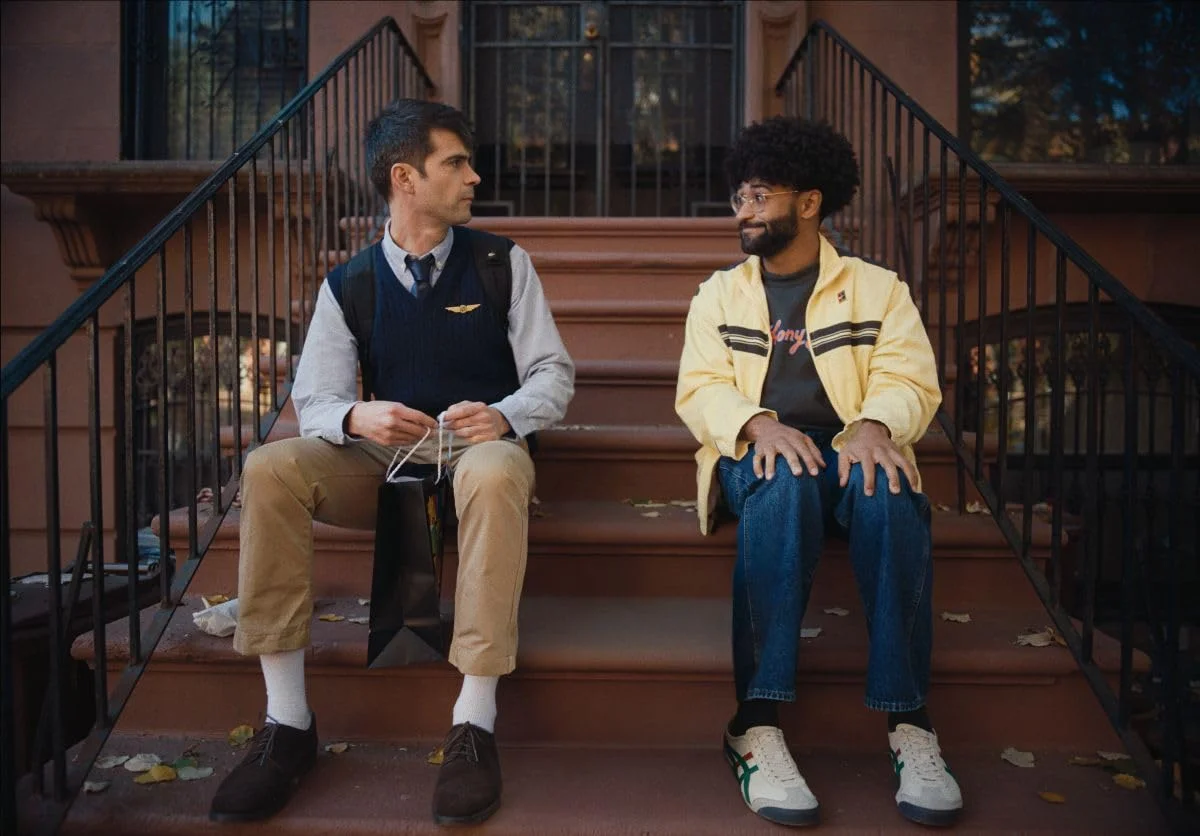
One absurdly revealing moment involves Simon’s portable zip-up steam room. Bruce suggests moving the “schvitz” into Simon’s bedroom. Simon instead installs it in their shared space because being alone would prevent him from talking to Bruce. Funny, yes. Also diagnostic.
The arrival of Beatrice exposes how much Simon has mistaken access for intimacy. He keeps asking Bruce about his travel privileges, then begins interfering in the relationship while framing his anxiety around logistics. Free flights become something he believes friendship has permanently guaranteed him.
Beatrice intensifies the crisis because she is professionally functional in ways Simon is not. She has commercial directing work and seeks financing for a feature. Her presence therefore unsettles two arrangements simultaneously: Simon’s access to Bruce and his preferred understanding of himself.
Naomi Asa wisely refuses to play Beatrice as an invading girlfriend manufactured to split two men apart. The screenplay grants Bruce similar autonomy once scenes begin following him without Simon present. That small structural shift matters. Simon has unconsciously organized the people around him as supporting characters, while the film quietly withdraws that privilege.
Oberbeck’s performance makes Bruce’s growing irritation persuasive because it arrives incrementally. Years of affection remain visible inside his frustration. Friendship here does not collapse because somebody suddenly changes. It strains because one person finally does.
Departures Without Arrival
Jason Chiu’s cinematography turns airports into the film’s clearest expression of Simon’s predicament. LaGuardia’s fluorescent interiors, aircraft windows, New York streets, and borrowed public spaces produce an unusual visual richness for such a small production. The footage captured in uncontrolled locations rarely looks stolen. It belongs to a movie about people trying to create inside spaces never designed to accommodate them. The repeated travel imagery carries a neat irony. Simon can reach another country with less effort than he can reach the next stage of his own work.
That tension connects the filmmaking satire to something wider about creative labor. Festival recognition offers prestige without security. Commercial jobs pay while draining enthusiasm. Peers become friends, collaborators, competitors, and unwanted evidence that somebody else has managed to move forward.
The central conflict grows easier to predict once Bruce and Beatrice become serious. Simon’s possessiveness, interference, and eventual reckoning travel along a familiar dramatic route. The specificity surrounding that route keeps it alive: the airport terminals, awkward professional conversations, taxi shoots, festival rituals, and Simon’s endless verbal architecture around an absent film.
When losing his travel arrangement finally removes his preferred escape hatch, movement can no longer masquerade as development. For someone obsessed with getting somewhere else, staying put becomes the first meaningful creative decision he makes.
The Travel Companion premiered at the Tribeca Festival on June 5, 2025, before receiving a theatrical release through Oscilloscope Laboratories on April 10, 2026. The comedy-drama follows a struggling documentary filmmaker whose free standby flight privileges, secured through his airline employee roommate, become threatened when his friend starts a new romance.
Full Credits
Title: The Travel Companion
Distributor: Oscilloscope Laboratories
Release date: June 5, 2025 (Tribeca Festival), April 10, 2026 (United States theatrical)
Running time: 1 hour 31 minutes
Director: Travis Wood, Alex Mallis
Writers: Weston Auburn, Alex Mallis, Travis Wood
Producers and Executive Producers: Alex Mallis, Travis Wood, Weston Auburn, Neil Champagne, Veronica Diaferia, Sara Eolin, Nate Eggers, Charlie Hoxie, Kuye Youngblood, Zachary Collinger, Jourdan Daleo, Gill Holland, Nathan Mardis
Cast: Tristan Turner, Anthony Oberbeck, Naomi Asa, Anil Joseph, Dara Messinger, Raheem Roher, Peter Davis, Peter Fairman
Director of Photography (Cinematographer): Jason Chiu
Editors: Bryan Chang
Composer: Eliot Krimsky
The Review
The Travel Companion
The Travel Companion turns the precarious economy of independent filmmaking into a study of entitlement, artistic paralysis, and friendships sustained long past their natural expiration date. Simon’s fixation on free flights is funny because it exposes something uglier: movement has become his preferred substitute for progress. Tristan Turner makes that self-deception painfully believable, while Anthony Oberbeck and Naomi Asa prevent Bruce and Beatrice from becoming accessories to Simon’s crisis. The romantic triangle follows a familiar course, yet the film’s precise social observation and Jason Chiu’s airport imagery give its modest story unusual bite.
PROS
- Tristan Turner’s painfully precise performance
- Sharp satire of indie film culture
- Strong Turner and Oberbeck chemistry
- Jason Chiu’s polished cinematography
- Thoughtful treatment of creative stagnation
CONS
- Predictable central conflict
- Simon can test audience patience
- Familiar jealousy-driven narrative shape