






























Before anyone sits down to talk, Alexis Lloyd gives us the most revealing material in Group: The Schopenhauer Effect: people walking through Manhattan while their private thoughts chatter over the images. Their bodies move through public space with reasonable composure; their minds are busy rehearsing fears, judgments, obligations, resentments. Civilization, apparently, is the art of looking normal while twelve conversations happen inside your skull.
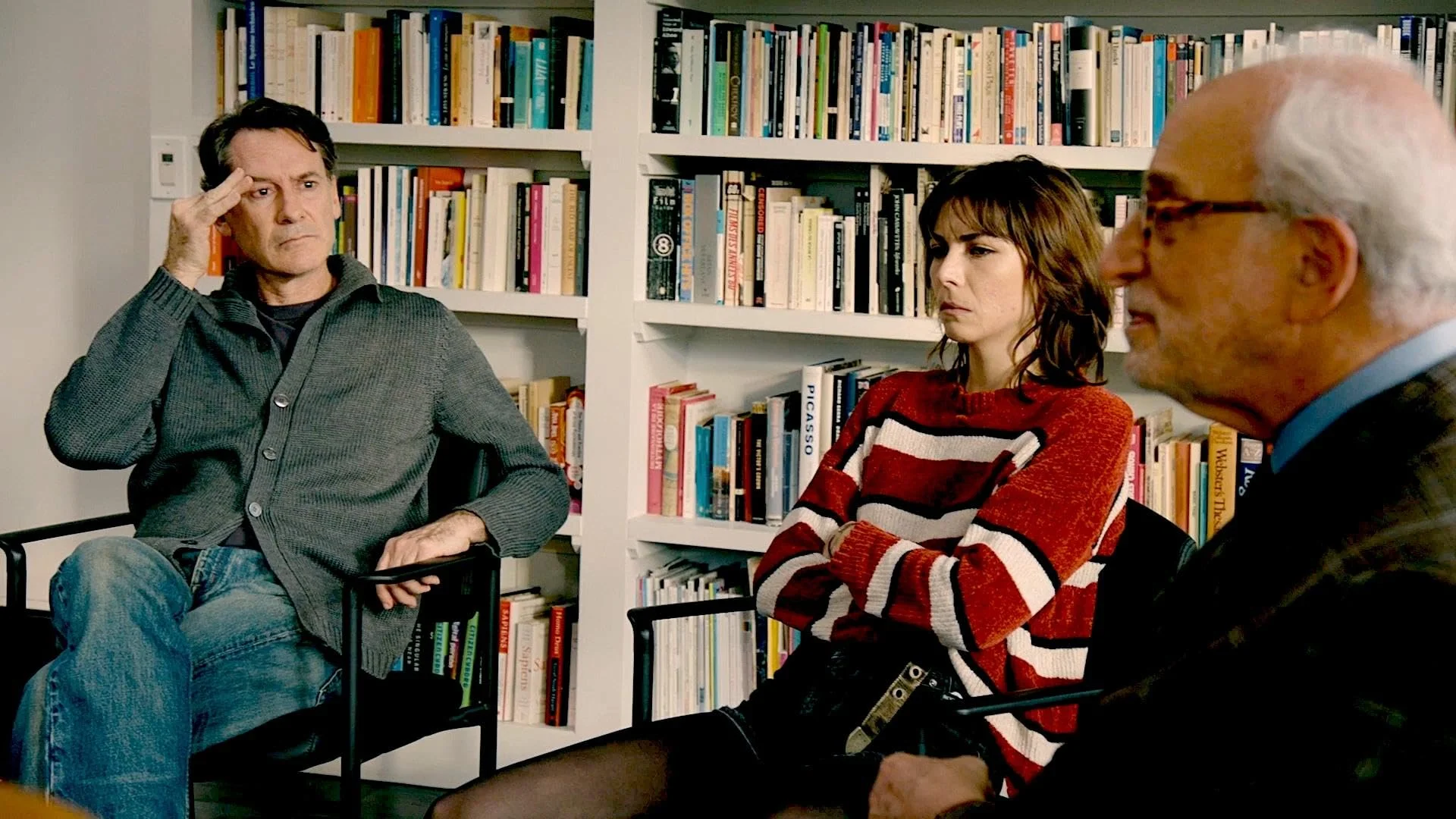
The contrast becomes important once everyone reaches Dr. Ezra Hertzfelt’s group-therapy room. Pam, Manny, Rebecca, Frank, Tilda, Stuart, and Karina are returning to an in-person session after meeting through Zoom during COVID, yet their supposed return to physical intimacy immediately produces another barrier. Thomas Sadoski’s Alexis arrives as a documentary filmmaker invited to observe them. Nobody particularly wants him there.
When the group challenges his presence, Alexis claims that he needs therapy himself. The maneuver is revealing because the film’s central question appears almost accidentally inside it: can someone observe another person without changing what they observe? Alexis wants access while presenting himself as vulnerable. The patients want privacy while sitting in a circle designed around disclosure. Everybody has a role. Everybody also resents being reduced to one.
Controlled Instability
Lloyd builds the film through an unusual mixture of planned situations and improvisation. The actors know their characters and certain dramatic circumstances, yet they do not always know precisely how another participant will respond. Elliot Zeisel complicates this further because he is an actual psychoanalyst playing the group’s therapist. You can feel the difference.
Zeisel rarely approaches a conversation like an actor waiting for his cue. He listens, allows uncomfortable pauses to remain uncomfortable, then asks questions that redirect the emotional current without announcing themselves as plot machinery. When someone becomes defensive, he does not rush to interpret the defensiveness for the audience. He lets another member respond.
That uncertainty gives scenes such as Tilda’s awkward admission of attraction their strange electricity. The embarrassment does not come from a grand confession written toward applause. It emerges through hesitation, reaction, and the awareness that seven other people now have to decide what to do with information they did not request.
Luke Geissbuhler’s camera makes those decisions visible. Close-ups frequently remain on the listener rather than the speaker, which is exactly right for this material. Therapy depends on language, yet group therapy also depends on the terrifying knowledge that several faces are processing your language at once.
Some dramatic scaffolding remains visible. Manny’s feelings for Pam occasionally possess the clean contours of a storyline waiting for its next escalation, and Alexis functions rather transparently as Lloyd’s surrogate inside the room. The film becomes less persuasive whenever interpersonal friction starts behaving like screenwriting. Then somebody reacts in a way that seems impossible to have diagrammed, and the illusion repairs itself.
The Therapist Becomes Mortal
The second session changes the emotional architecture when Ezra makes a startling personal announcement. Revealing its substance would remove much of the sequence’s force, because its significance lies partly in watching the group understand that the person they have assigned stability to possesses a life outside their needs. This produces something close to emotional mutiny.
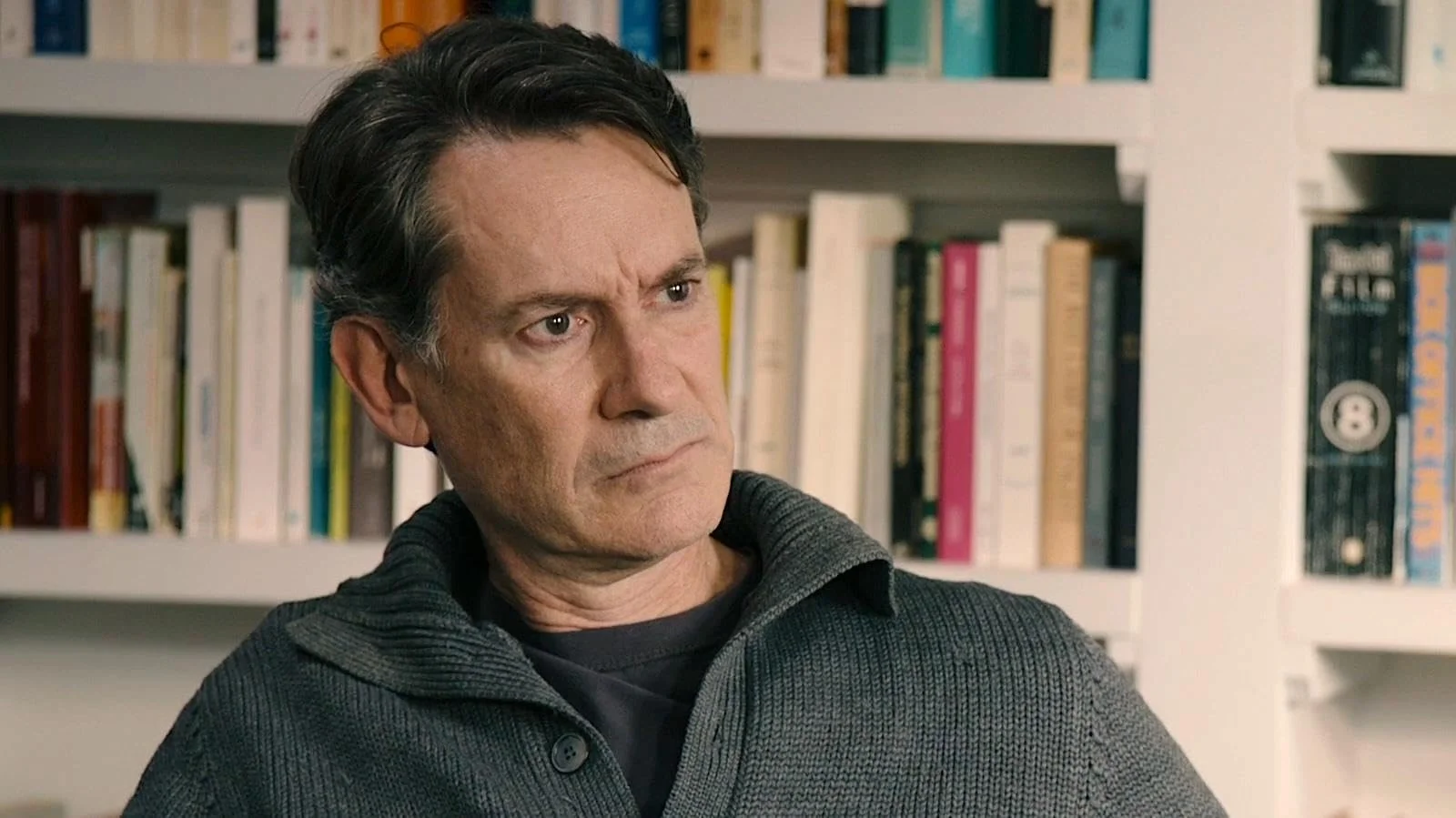
Anger, fear, accusation, grief, and dependency begin colliding. The therapist who usually interprets the room becomes an object within it. The group suddenly has to confront an uncomfortable proposition: relationships formed in therapy may be professional in structure and deeply personal in experience. That contradiction becomes one of Lloyd’s sharpest ideas.
Pam’s declaration to Manny that the baby is not his works through a similar collision between private feeling and public exposure. Manny’s attachment to Pam already exists inside a communal space, so her response cannot remain between two people. Every member becomes a witness, and witnessing carries its own quiet form of participation.
Schopenhauer would probably have found the room exhausting, which may be the point. Eight people seeking relief from themselves keep discovering that other people are part of the problem. They are also, inconveniently, part of the cure.
Authenticity Is Still a Performance
Knowing that these are performers does not destroy the film’s credibility. It makes the idea of credibility stranger. Tilda’s confession is acted. Manny and Pam’s tension emerges from constructed characters. Ezra’s announcement belongs to a dramatic framework. Yet the pauses, defensive gestures, interruptions, and shifts in attention frequently possess the disorder of experiences happening before they have acquired meaning.
Lloyd refuses the usual escape hatch of flashbacks explaining why everyone behaves this way. We learn people through how they speak, what they avoid, whom they interrupt, and what happens to their faces when somebody else says something painful. Character becomes relational rather than biographical.
There is an ethical discomfort embedded in Alexis’s camera, too. He enters a space dependent on trust because he wants to document it, then becomes part of the process he hoped to record. Observation becomes contamination. Call it the authenticity trap: the moment someone asks you to behave naturally, natural behavior becomes impossible.
Yet group therapy already contains a version of that paradox. Patients are asked to speak sincerely while knowing they are being evaluated, interpreted, remembered, and emotionally answered by others. Performance does not necessarily make sincerity false. Sometimes performance is the route through which sincerity becomes visible. The film keeps the camera close while the distinction deteriorates. Someone speaks. Someone else flinches. Ezra waits. For a room devoted to explanation, the waiting often says the most.
Group: The Schopenhauer Effect premiered in theaters on March 13, 2026, distributed by Abramorama. The hybrid drama blends improvised fiction and real psychotherapy when a filmmaker joins a Manhattan group therapy session to research a television project.
Full Credits
Title: Group: The Schopenhauer Effect
Distributor: Abramorama
Release date: March 13, 2026
Running time: 1 hour 59 minutes
Director: Alexis Lloyd
Writers: Alexis Lloyd
Producers and Executive Producers: Alexis Lloyd, Alex Spatt, Jack Lechner, Molly Conners, Ronald Guttman, Doug Schwalbe, Dr. Elliot Zeisel, Thomas Sadoski
Cast: Thomas Sadoski, Dr. Elliot Zeisel, Cara Ronzetti, Ezra Barnes, Teresa Avia Lim, Gabriela Kohen, Elisha Lawson, Bernardo Cubria, Lucy Walters
Director of Photography (Cinematographer): Luke Geissbuhler
Editors: Alexis Lloyd
The Review
Group: The Schopenhauer Effect
Group: The Schopenhauer Effect turns the therapy room into a curious laboratory where performance and sincerity keep contaminating each other. Alexis Lloyd’s semi-improvised method occasionally exposes its scaffolding, particularly around Manny and Pam, yet the uncertainty of each exchange gives the film its nervous pulse. Elliot Zeisel’s real therapeutic instincts complicate the fiction beautifully, while Luke Geissbuhler’s close-ups turn listening itself into drama. The central paradox lingers: people may be performing versions of themselves, but perhaps that is what people do everywhere.
PROS
- Remarkably natural improvisation
- Zeisel’s precise interventions
- Intimate close-up photography
- Strong ensemble chemistry
- Fascinating fiction-reality tension
CONS
- Some conflicts feel engineered
- Alexis is an obvious filmmaker surrogate
- Single-room format demands patience