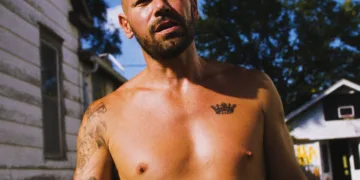


















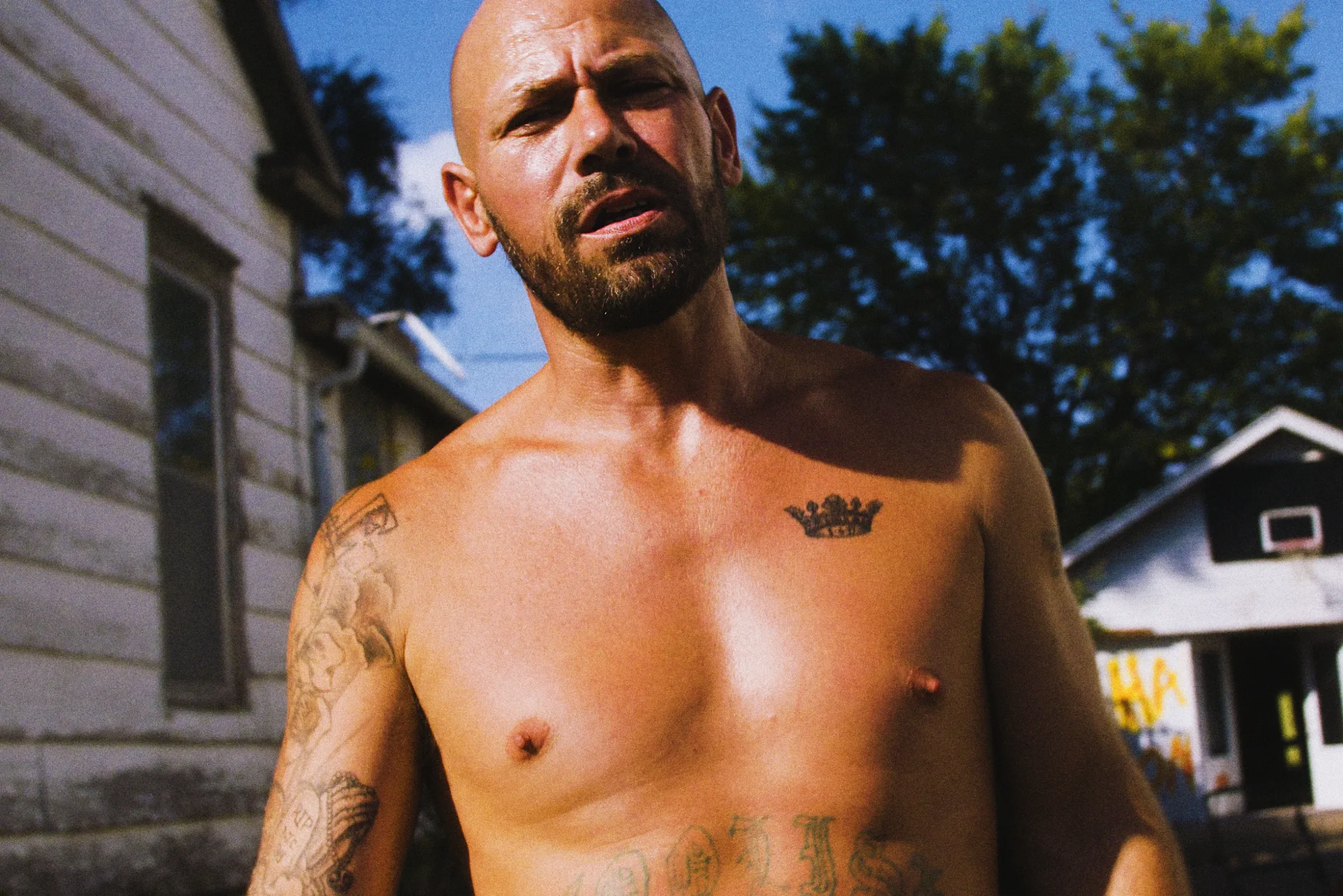

Ryan wants to make a movie about fatherhood, and for a while Robert Greene lets him believe that is exactly what is happening. He has the charisma for it. A carpenter, former fighter, father of six and enthusiastic dispenser of motivational slogans, Ryan approaches the camera with the confidence of someone who has already decided what his story means. The smarter move in Too Much Sugar is that Greene gradually stops treating that confidence as narrative authority.
Greene met Ryan through their sons’ basketball games in Moberly, Missouri, where Ryan’s habit of loudly coaching from the bleachers initially made him difficult company. Friendship followed, then collaboration. Ryan’s pitch is sincere enough: he wants to make a film about two fathers who grew up without dads and are trying to do better with their own children. That premise contains the version of himself he prefers, the flawed man whose mistakes nevertheless produced six children he clearly loves.
The documentary could easily have settled into that shape. Ryan is a natural subject because he fills space quickly, physically and conversationally. He coaches his children, trains his sons in boxing, talks constantly about improvement and treats family life as another arena in which persistence should eventually win. His line about making bad decisions that turn into great kids is funny because it compresses accountability and self-forgiveness into the same sentence. Greene’s structure starts applying pressure the moment everyone else receives a camera.
Ryan is not the only person invited to imagine a movie. His children, his partner Amanda, his mother Candy and his best friend Michael “AccRite” Midgyett are encouraged to develop projects of their own. Candy gravitates toward horror. Tray imagines a wrestling film. Wayde wants action and performance. Amanda has her own domestic idea. Greene moves among these miniature productions, documentary observation and staged sequences without always announcing the border between them.
The device matters because authorship becomes a form of testimony. Ryan can describe himself as a devoted father, but Gavin can question the entire production by asking if giving his dad a film simply validates him. Gavin did not learn Ryan was his father until he was 14. Other children respond to him differently, some joining the filmmaking experiment with enthusiasm, others revealing a quieter sense that their own lives might not be important enough to deserve a movie. That difference in perspective does most of the film’s real dramatic work.
Greene does not need to expose Ryan as a fraud because the documentary is stronger when Ryan remains recognizable as several things at once. He appears genuinely invested in his children. He can also be domineering, self-absorbed and volatile.
His tough-love persona has practical expressions in training and coaching, yet his children have accumulated memories that do not fit cleanly inside the heroic fatherhood story he wants to shoot. Ryan even looks strangely stiff when asked to play himself in scripted material, a nice little reminder that being the main character in your own life does not guarantee screen presence once somebody calls action.
Amanda sharpens that contradiction. She has remained beside Ryan for years and welcomed his children into her home, giving her unusual authority to measure both his generosity and the damage surrounding it. Her account includes his infidelity, neglect and temper. She begins closer to the edge of Greene’s film, then steadily acquires greater narrative weight as Ryan’s preferred account of family life becomes harder to sustain. Greene does not dramatically announce that the film has changed protagonists. He simply keeps allowing other people’s experiences to accumulate until Ryan can no longer occupy the center without resistance.
The collaborative filmmaking takes on heavier stakes through AccRite. Like Ryan, he has spent time incarcerated. Unlike Ryan, his central burden in the film is the death of his 16-year-old son DeQiran in a shooting. AccRite proposes Rewind, a film built around an impossible correction: imagining a timeline in which he saves his son and gets to watch him grow older.
Greene has explored reenactment and performance as emotional tools in earlier work including Procession, Bisbee ’17 and Kate Plays Christine. Here the idea becomes especially clear because Rewind does not pretend cinema can repair what happened. It gives AccRite a temporary structure for approaching something reality has left permanently unresolved. His grief does not disappear once the scene ends, which saves the sequence from becoming therapeutic spectacle with tidy credits attached.
The film’s looser passages reveal the cost of Greene’s approach. By granting so many people authorship, he accepts a degree of sprawl. Some of the participant-made films tell us less than the unscripted stretches around them, and the documentary can feel as though it is circling several possible centers rather than driving toward one. Democracy is admirable. It remains a difficult editing strategy.
Yet that looseness is tied directly to what the film is trying to discover. A cleaner structure would probably require choosing one version of this family and making the others subordinate. Greene instead builds a movie where competing accounts stay alive beside each other. Ryan can love his children and still have failed them. Amanda can remain loyal without endorsing every part of the relationship. Gavin can distrust the project while participating in the story it produces. AccRite can use fiction to approach grief without turning fiction into a cure.
Ryan begins with the kind of idea filmmakers usually like: a clear subject, a simple emotional hook and a protagonist ready to explain himself. Greene gradually replaces that neat arrangement with something less convenient. The family keeps revising the film faster than Ryan can define it, and the scenes that linger longest are the ones no personal script can quite contain.
Too Much Sugar had its world premiere at the 83rd Venice International Film Festival on September 3, 2026. The documentary film follows a formerly incarcerated amateur MMA fighter and father in Missouri as he collaborates with the filmmakers to process his life and family struggles through cinema.
Full Credits
Title: Too Much Sugar
Distributor: Cinetic Media / Festival Release
Release date: September 3, 2026 (Venice International Film Festival)
Running time: Not publicly specified
Director: Robert Greene
Producers and Executive Producers: Bennett Elliott, Robert Kolodny
Cast: Ryan Holliger, Michael Midgyett, Amanda Sanner, Gavin Jones, Wayde Holliger, Bonnie Holliger, Hank Holliger, Tray Martin
Director of Photography (Cinematographer): Robert Kolodny
Editors: Robert Greene
Composer: Wilkie Davis Greene
The Review
Too Much Sugar
Too Much Sugar works because Robert Greene refuses to let Ryan’s preferred version of fatherhood control the film built around him. The collaborative structure occasionally loosens the documentary’s grip, and some participant-made films reveal less than the unscripted material surrounding them. Still, that sprawl has a purpose: every new perspective complicates Ryan’s self-portrait until the family becomes the real author of the story. Greene finds something richer than redemption here, a portrait of people revising one another in real time.
PROS
- Strong structural reversal around Ryan’s self-image
- Excellent use of competing family perspectives
- AccRite’s Rewind gives the formal conceit emotional weight
- Amanda becomes a vital counterbalance
- Collaborative filmmaking produces genuine character insight
CONS
- The loose structure occasionally drifts
- Some films-within-the-film are less revealing than the candid material
- Multiple narrative centers weaken momentum in places