






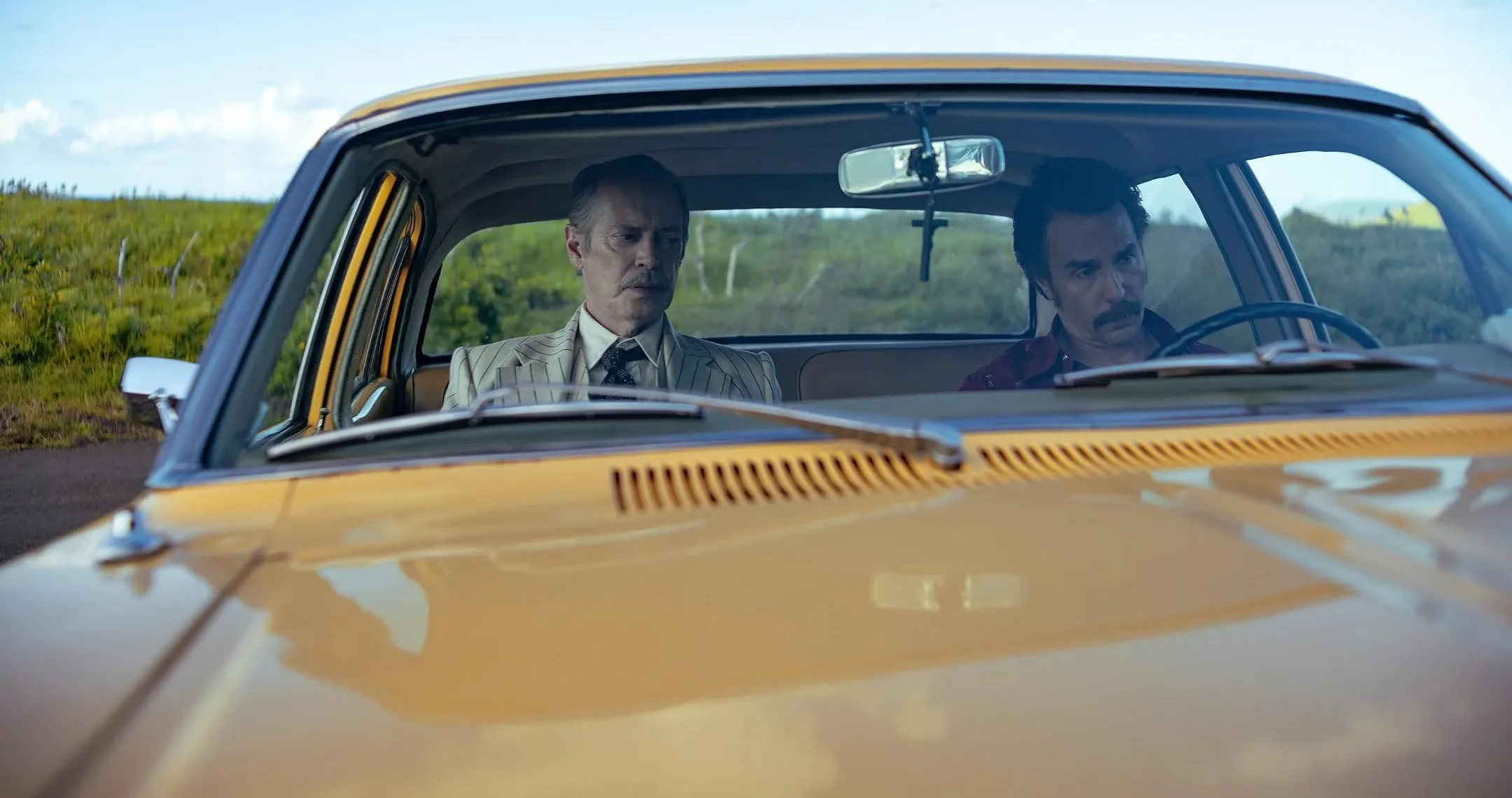

Martin McDonagh has made another film about two men waiting for death, yet Wild Horse Nine changes the emotional equation by giving one of them decades of political violence to remember and very little time left to remember it correctly.
The year is 1973. CIA operatives Chris Carlisle and Lee Chesterfield are stationed in Chile while Salvador Allende’s government moves toward the military coup that will arrive in September. Chris, played by John Malkovich, has spent decades participating in American interventions abroad. He recalls Guatemala, Congo and Cuba with the brisk efficiency of someone reading old expense reports. The implication that he also handled the rifle connected to John F. Kennedy’s assassination gives his résumé an especially poisonous final entry.
Chris is also dying. Cancer is spreading through his body while dementia begins removing pieces of his mind. He wants to visit Easter Island, or Rapa Nui, with Lee before either condition leaves him unable to choose what happens next. That sounds almost sentimental until McDonagh reveals the arrangement Chris has already made. He asked Lee to kill him there.
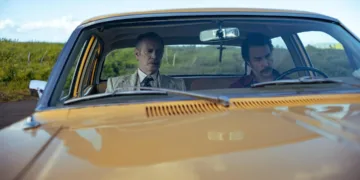
Sam Rockwell plays Lee as partner, protégé, caretaker and reluctant executioner. Their supervisor MJ, played by Steve Buscemi, has another concern entirely. Chris is recording material for a memoir, and an intelligence agency built on secrets cannot afford to let an increasingly forgetful operative decide which secrets belong in a book.
The resulting setup has the recognizable bones of In Bruges: two killers, a beautiful foreign location, a distant superior and a friendship being slowly converted into a death sentence. McDonagh knows exactly how familiar those ingredients are. The interesting question is what happens when the man awaiting death has already survived long enough to become part of history.
The In Bruges Blueprint, Rewired
The resemblance to McDonagh’s earlier work is impossible to miss. Lee and Chris occupy neighboring rooms, kill time through sightseeing and conversation, receive increasingly threatening instructions from above and gradually learn that each man arrived with information the other lacks.
Sometimes that familiarity works against the film. MJ can feel like a cousin of Ralph Fiennes’ Harry Waters in In Bruges, another furious boss who treats friendship as an operational inconvenience. Several later reversals arrive with the tidy mechanical satisfaction of pieces McDonagh has fitted together before.
Chris’s condition changes the rhythm, though. His dementia means he has been leaving notes for himself. “Remember that you’re dying” is one. “Don’t trust Lee” is another. A simple screenwriting device becomes an unusually effective source of tension because Chris cannot fully remember the reasoning behind his own warnings.
McDonagh also understands how funny the situation can be without treating Chris as harmless. At the Santiago airport, he meets Chilean students Monica and Alicia and casually tells them that the CIA came to destabilize their country. Lee is horrified. Chris treats the disclosure like weather chat.
The same instinct drives a wonderfully ridiculous speech linking healthy democracies, gay populations and good cheese. Malkovich delivers it with such calm conviction that the joke comes from Chris’s internal logic rather than a simple shock line. His arguments over the terms Rapa Nui and moai work differently. Here McDonagh exposes a man irritated that the world has started changing its vocabulary without asking his permission.
Lee usually responds with silence, a glare or one exhausted question. Rockwell has always been good with McDonagh’s dialogue, but his strongest work here happens between lines. Watch how his expressions change once Chris’s request for assisted death stops feeling theoretical. The irritated colleague gradually disappears. The friend remains. That shift is what separates this pairing from In Bruges. Lee has not been ordered to dispose of some troublesome coworker he barely understands. He is being asked to kill the man who taught him how to survive.
A Career Written in Blood and Forgetfulness
Malkovich gives the film its deepest register. The obvious comparison is Burn After Reading, where he also played a CIA employee attempting to write a memoir. Chris could hardly be further from Osborne Cox. The eruptions are mostly gone. Malkovich lowers his voice, lets thoughts trail away and turns Chris’s familiar irritation into the behavior of a man frustrated by a mind that no longer obeys him.
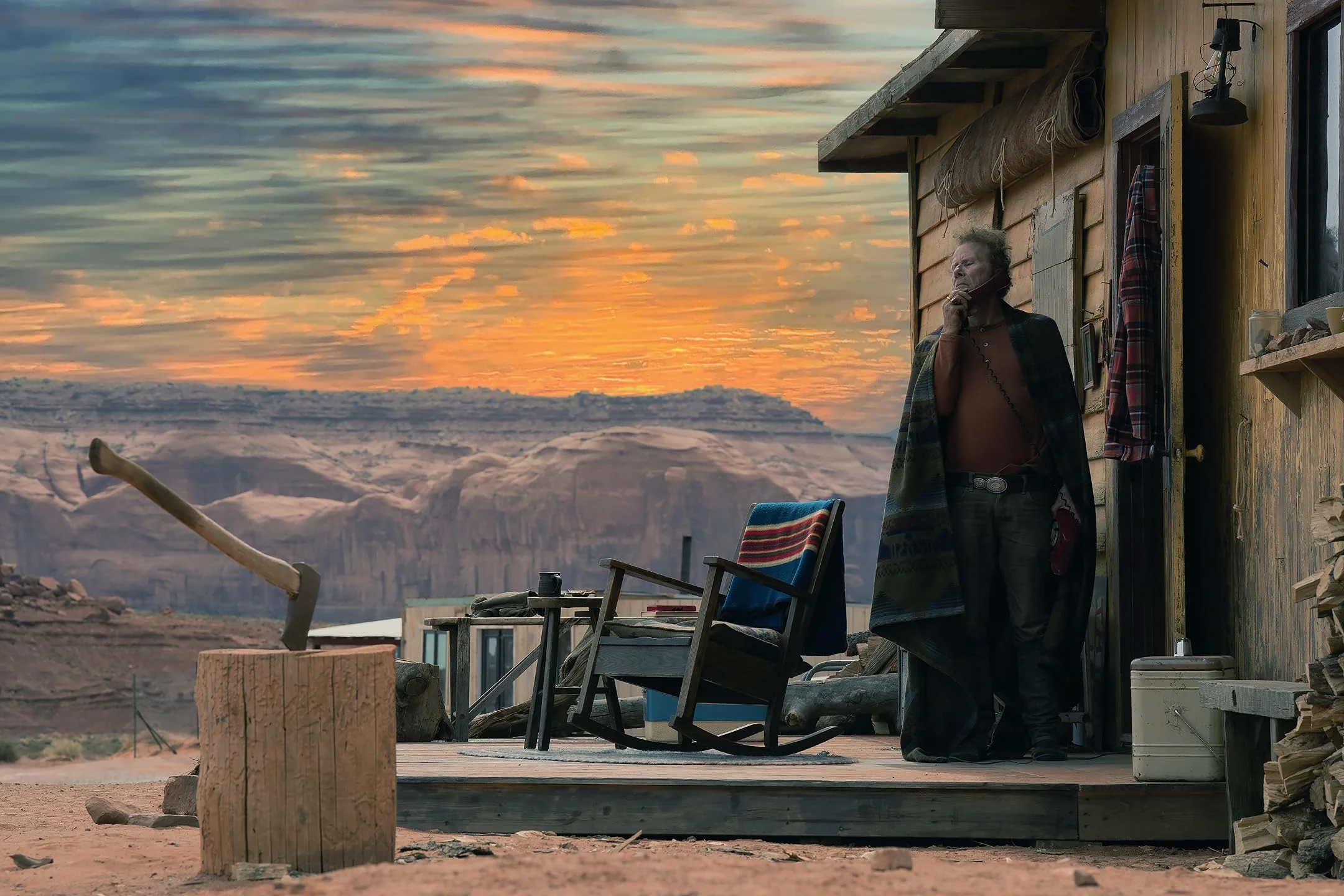
His dictaphone scenes are especially good. Chris begins cataloguing operations that altered countries, then drifts into tangents, private memories and strange observations. The technique lets McDonagh shrink geopolitical history to the scale of one damaged brain. Coups that changed millions of lives have become fragments competing for space with forgotten names and thoughts about dinosaurs.
Chris becomes gentler around the island’s horses. McDonagh does not overexplain the connection. The camera simply lets Malkovich’s body language change. His shoulders loosen. His voice quiets. For once, Chris approaches another living creature without trying to control, manipulate or assess it.
A phone call to his estranged brother, played by Tom Waits, exposes another crack. Their argument turns toward JFK. His brother sees the assassination as the point when America lost something essential. Chris cuts through the nostalgia by suggesting the country had always been rotten. The difference is that people can see it now.
That exchange matters because the film never allows illness to become absolution. Chris can be funny, frightened and deeply sad while remaining responsible for terrible things. Mortality gives him perspective. It does not give him innocence.
Rockwell carries the other half of that idea. His early deadpan slowly gathers grief, especially once MJ’s demands begin colliding with Chris’s own request. Lee is trapped between two forms of obedience, one institutional and one intimate, and Rockwell makes the distinction visible before the screenplay spells it out.
The Island Watches Them Die
Ben Davis shoots Rapa Nui with remarkable restraint. The landscape could easily become travel-poster decoration, especially with aerial footage of the coastline and Harry Belafonte’s “Island in the Sun” floating across the soundtrack. Instead, the scale keeps reducing Chris and Lee.
The moai are particularly effective. McDonagh does not turn them into mystical symbols with flashing neon arrows. They simply stand there while two representatives of American covert power chatter, lie and deteriorate beneath them. The composition does the work.
The wild horses extend that visual idea into western territory. Chris begins to resemble an aging gunslinger who has finally ridden somewhere his reputation means nothing. His frontier was never Monument Valley, though his brother fittingly lives there. It was Guatemala, Cuba, Congo and every other place where political violence could be described as an assignment.
That is where the film’s faint connection to The Searchers becomes useful. Chris has spent his life moving through conflict and reaches old age with no real home waiting for him. He has Lee, a handful of memories and an institutional history that would prefer to erase him before he can write any of it down.
Carter Burwell’s score gives these stretches their emotional temperature. The melodies are gentle where McDonagh’s dialogue is abrasive. When Chris wanders under morphine or sits near the horses, Burwell creates enough stillness for sadness to enter without forcing it.
McDonagh’s direction remains comparatively plain beside the painterly gloom of The Banshees of Inisherin. He tends to place the camera where Malkovich and Rockwell can control the scene and lets the words establish rhythm. That simplicity occasionally makes the film visually modest, yet on Rapa Nui it also keeps the scenery from overwhelming the people who came there to disappear.
The Joke Behind the Empire
The Chile setting gives Chris’s personal reckoning political weight. His career turns American intervention into a grotesque sequence of professional achievements. Guatemala went one way. The Bay of Pigs went another. Chile is simply the next file.
McDonagh’s satire becomes sharpest when this machinery is reduced to ordinary incompetence. Chris discusses coups while flirting with students. MJ handles geopolitical secrets with the temperament of an annoyed middle manager. Lee spends part of a historic political crisis worrying about his partner and receiving absurd telephone updates from his wife Marge.
Parker Posey only gets a small amount of screen time, yet she turns Marge’s phone calls into perfectly calibrated comic interruptions. Asked about their children, she responds with near-total indifference. Steve Buscemi brings similar precision to MJ, whose irritation keeps rising as Chris becomes harder to contain.
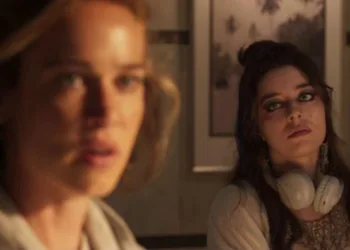
The women are also where the screenplay feels thinnest. Alicia gets limited space, and Marge mostly functions through jokes and plot information. Mariana Di Girolamo fares better as Monica, especially once her initial disgust with Chris gives way to wary recognition that the obnoxious American tourist is dying.
Her presence keeps Chile from becoming scenery for an American moral crisis. Chris can speak casually about destabilizing democracy because political interference has become routine to him. Monica hears those same words as a threat to the country she actually has to live in.
That difference gives Wild Horse Nine its sharpest political joke. The men who once helped reshape nations are now tired, sick, suspicious of one another and arguing on an island about language and cheese. History eventually reduces power to people, and people can look remarkably small beside the damage they leave behind.
Wild Horse Nine premiered at the 83rd Venice International Film Festival on September 3, 2026, ahead of its wide theatrical release by Searchlight Pictures. The black comedy action thriller follows two CIA agents dispatched to Easter Island just before the 1973 Chilean coup, where their routine assignment escalates into a dangerous series of complications.
Where to Watch Wild Horse Nine (2026) Online
Full Credits
Title: Wild Horse Nine
Distributor: Searchlight Pictures
Release date: September 3, 2026 (Venice Film Festival), November 6, 2026 (United States)
Running time: 1 hour 58 minutes
Director: Martin McDonagh
Writers: Martin McDonagh
Producers and Executive Producers: Graham Broadbent, Pete Czernin, Martin McDonagh, Anita Overland
Cast: John Malkovich, Sam Rockwell, Steve Buscemi, Mariana di Girolamo, Ailín Salas, Tom Waits, Parker Posey
Director of Photography (Cinematographer): Ben Davis
Editors: Mikkel E. G. Nielsen
Composer: Carter Burwell
The Review
Wild Horse Nine
Wild Horse Nine returns to Martin McDonagh’s familiar territory of damaged men, mordant jokes and friendship under lethal pressure, yet John Malkovich gives that framework fresh emotional weight. His quietly devastating performance turns Chris’s failing memory, terminal illness and blood-soaked CIA history into a reckoning the film wisely refuses to treat as redemption. Sam Rockwell matches him with beautifully restrained grief, while Rapa Nui and Carter Burwell’s score give their final days an elegiac calm. The structure occasionally feels borrowed from McDonagh’s earlier work, and its women deserve richer material, but the emotional precision lands.
PROS
- Superb John Malkovich performance
- Excellent Malkovich-Rockwell chemistry
- Sharp political satire
- Beautiful Rapa Nui photography
- Tender Carter Burwell score
CONS
- Familiar McDonagh structure
- Underdeveloped female characters
- Some predictable reversals