




























Derek Hough’s correction to Briar Nolet gives Dancing with the Stars: The Next Pro an unusually useful account of expertise. Too much travel across the floor, he explains, costs her rotation and hip action. A movement that might register as vaguely unsatisfactory acquires a cause.
The viewer receives something to look for, and the dancer receives something to change. In a competition offering a professional position on Dancing with the Stars, this exchange makes teaching itself part of the attraction. The pleasure lies in watching knowledge pass between bodies.
That clarity becomes harder to sustain when Tristen Sanders performs his jive. His speed, expressive gestures, and gymnastic flourishes generate excitement, while Shirley Ballas questions how much jive the solo actually contains. Derek’s disagreement with her makes the judging interesting.
Their competing responses expose a genuine problem of selection: a dancer can command attention while leaving the requirements of a particular style insufficiently fulfilled. Television presence and ballroom proficiency occupy the same floor, with no guarantee that they will move together. The programme gives both standards persuasive advocates.
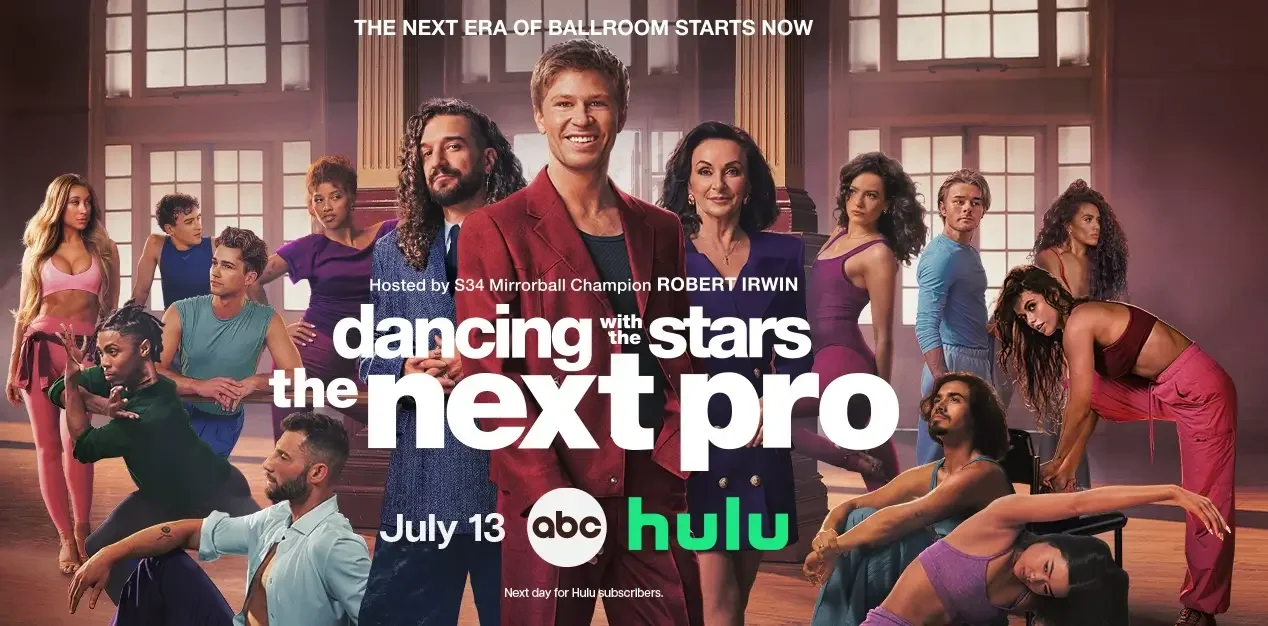
Twelve experienced dancers live and train together under a rotating guest mentor, with Shirley and Mark Ballas providing the permanent judging presence and Robert Irwin hosting. Across the first three episodes, the competition considers technique, storytelling, and group work.
This is a promising way to examine a profession whose visible product can conceal its varied demands. The eventual winner must perform, choreograph, communicate, and help a celebrity acquire confidence. A room full of accomplished dancers makes those distinctions worth watching. Their existing skill permits the programme to ask what kind of professional each might become.
The small studio changes how that work reaches the audience. Without the flagship’s live crowd, performances lose some of the communal excitement that can make a successful routine feel like an event. Audible breathing and occasional exclamations give the dancing a less immaculate surface.
Yet the quieter environment also leaves instruction unusually exposed. Derek’s explanation can hold attention without competing against the machinery of celebration. The production gains intimacy, though its performances sometimes feel stranded between the closeness of a rehearsal and the spectacle their delivery seems to anticipate.
Selena Hamilton gives the pursuit of visibility a specific cultural purpose. She speaks about limited Black and Latino representation in ballroom and her wish to offer younger dancers someone to recognize. Her confident samba with Natalie Jolley, beginning with Selena’s somersault, gives that ambition a physical presence.
The series allows her to articulate what entering this profession would mean before a celebrity partner supplies the dominant story. Her statement cannot establish the demographics of an entire field, but it makes her own stake in the competition clear. Becoming recognizable has value beyond securing another week’s survival.
The storytelling episode extends that attention into private experience. Allen Genkin’s dance with Adele Zaikman draws on his relationship with his late mother, allowing the dancer’s own history to shape the performance. The tribute is moving without requiring grief to certify his suitability for the job.
Under Brandon Armstrong’s mentorship, the episode gives emotional expression room within the audition, and Irwin’s encouragement offers Allen support at a vulnerable point. There is something generous in this reversal of emphasis: the person ordinarily employed to help somebody else communicate receives space to express an attachment of his own.

Supporting somebody else proves a less comfortably resolved subject when Benji Castro and Nina Mayster struggle to collaborate. The programme shows Benji telling the house that he feels unheard, followed by a conciliatory gesture the next day. Nina later tells the judges that he had not expressed his frustration.
Placing these accounts within the same episode invites the audience to assess the discrepancy. The judges’ criticism of Nina’s approach, coupled with their emphasis on supporting a partner, supplies a relevant professional standard. Listening matters in a job that requires adjusting choreography to another person’s abilities and needs.
Benji’s elimination then leaves the relationship between that standard and the outcome inadequately explained. Expressing dissatisfaction does not prove that he handled the partnership successfully, and edited footage cannot settle everything that happened between them. Departures are divided by gender, so Nina’s survival does not mean she and Benji were direct alternatives for one place.
Still, the episode has chosen to emphasize an ignored concern and criticism of the person apparently ignoring it. The decision arrives without sufficiently connecting those observations to Benji’s departure. Its weakness is the gap between the professional conduct the programme teaches viewers to value and the selection it asks them to accept.
That gap matters because collaboration among professionals remains an incomplete demonstration of teaching. Benji and Nina’s difficulty reveals something relevant about communication; it cannot reproduce the task of guiding a novice through unfamiliar movement. Derek’s patient diagnosis of Briar’s problem offers a clearer glimpse of that work. The contestants are being assessed for a role whose essential responsibilities extend beyond the performances available for judgment. The series earns interest by exposing several kinds of ability, then needs greater precision about what each challenge establishes.
Britt Stewart’s group-work episode supplies another useful pressure. With only hours to learn their routines, the dancers must absorb choreography and coordinate their execution. The paso doble group’s stronger choreography loses security through timing problems, while the tango group achieves greater tidiness with less ambitious material. Individual distinction becomes inseparable from the capacity to maintain a shared performance.
Natalie’s collision with Stephani Sosa interrupts that assessment altogether. Unable to continue, Natalie leaves the competition, despite having already demonstrated confidence and accomplishment in her samba. The accident establishes neither negligence nor a failure of professional readiness. It removes the opportunity to keep demonstrating readiness at all. A contest organized around weekly availability has little space in which an injured dancer can recover and remain a candidate.
Dancing with the Stars: The Next Pro premiered on Disney+ and ABC on October 19, 2026. Executive produced by Conrad Green and Deena Katz, the reality competition spin-off follows a group of aspiring professional ballroom dancers as they compete for a spot on the main show’s cast.
Where to Watch Dancing with the Stars: The Next Pro Online



Full Credits
Title: Dancing with the Stars: The Next Pro
Distributor: Disney+, ABC
Release date: October 19, 2026
Rating: TV-PG
Running time: 45–60 minutes per episode
Director: Phil Heyes, Alan Carter
Producers and Executive Producers: Conrad Green, Deena Katz, Ashley Edens
Cast: Alfonso Ribeiro, Julianne Hough, Derek Hough, Carrie Ann Inaba, Bruno Tonioli, Artem Chigvintsev, Britt Stewart, Emma Slater
The Review
Dancing with the Stars: The Next Pro
Dancing with the Stars: The Next Pro gives professional dancers space to become subjects of their own television. Its first three episodes offer illuminating instruction, expressive performances, and personal stories with emotional weight. The competition is less assured about connecting its judgments to its eliminations, particularly when supporting a partner becomes an explicit criterion. This is absorbing television about the demands of a profession, with an audition process that still needs to explain how those demands determine who stays.
PROS
- Specific coaching makes technique accessible.
- Dancers’ ambitions and histories receive meaningful attention.
- Contrasting judging perspectives expose useful artistic tensions.
CONS
- Benji’s elimination is inadequately connected to the feedback shown.
- The quiet studio sometimes diminishes performance excitement.
- Peer collaboration offers limited evidence of teaching novices.