




























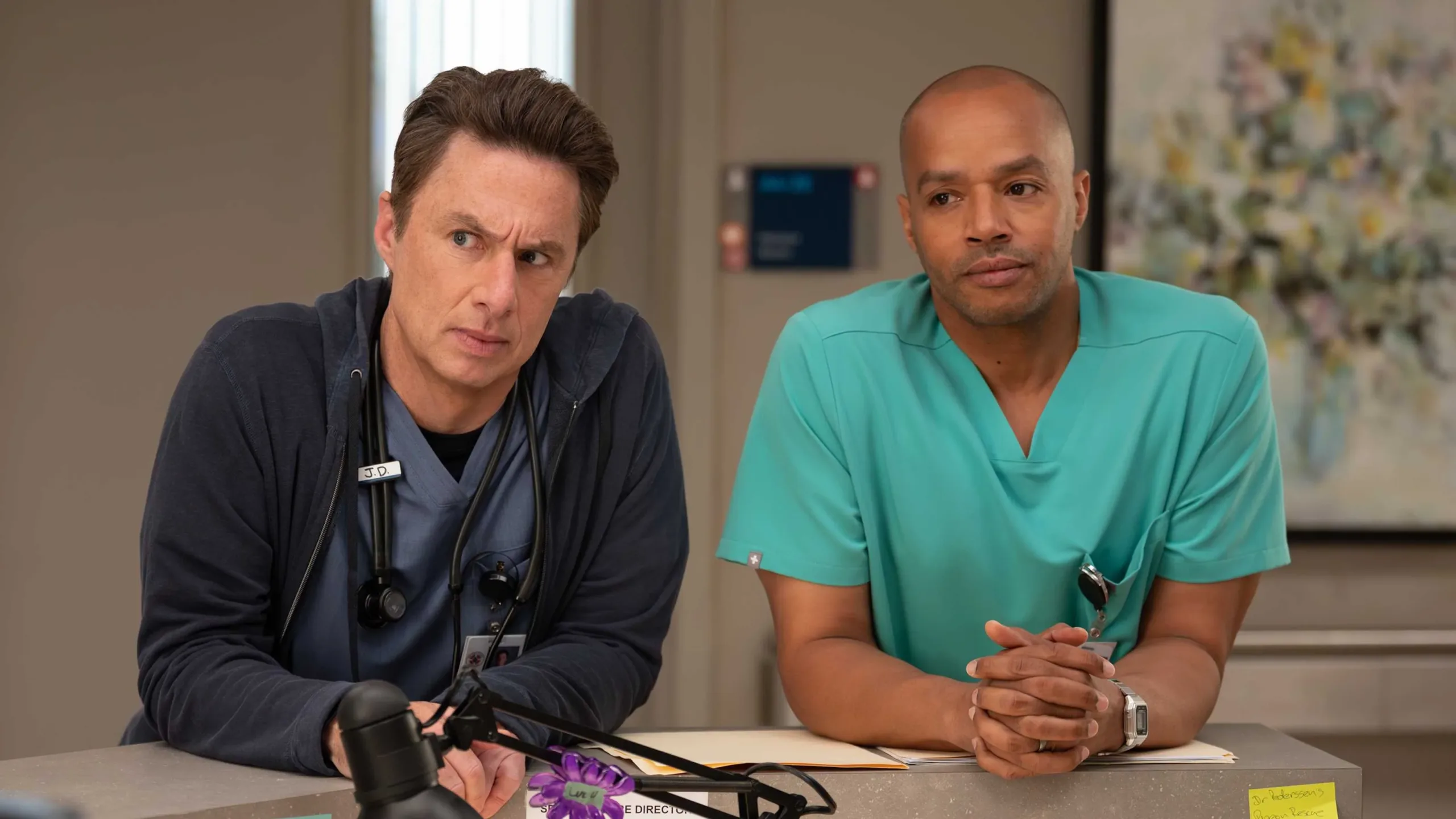
J.D.’s promotion to Chief of Medicine gives the Scrubs revival an awkward obligation: its beloved protagonist now represents the institution. His concern for Dr. Cox is easy to share, but concern cannot settle every question about how he uses his position. When new Chief Resident Grant Summers challenges him over possible insurance fraud, the younger doctor interrupts the reassuring logic of a reunion. We know why J.D. wants to help. Grant asks what that help permits him to do. Across this second season’s two-episode premiere, the conflict gives the returning cast something substantial to negotiate.
Cox, meanwhile, encounters the hospital from a position his former authority cannot protect. His autoimmune disease, following the kidney failure established last season, makes him dependent on doctors he once trained. The first episode explores his discomfort with being a patient; the second presents a $35,000 medical bill and a rejected insurance appeal. Scrubs places professional knowledge beside administrative powerlessness. Cox understands medicine and still cannot make the machinery of payment cooperate. His history with Sacred Heart offers emotional security, while the bill demonstrates how little that history counts elsewhere.
Using Cox for this story makes the institutional criticism immediate. Viewers already have reasons to care about him, and J.D., Turk, and Elliot bring years of attachment into his treatment. The reversal gives the revival a productive use for its accumulated history: people who once needed guidance can now provide care. It also establishes the limits of the premiere’s perspective. The insurance system becomes visible through its treatment of a cherished doctor, with his colleagues gathered around him. That is a powerful route into the problem, though it leaves the experience of patients without those relationships largely outside this particular story.
The aging jokes work on a smaller scale. J.D.’s back cramps during sex with Charlie and Turk’s refusal to wear glasses during surgery acknowledge bodies that have changed faster than their owners’ self-images. Turk’s resistance is especially pointed because it reaches into his professional life.
The joke lets vanity intrude on a place where competence matters. J.D.’s relationship with Charlie, played by Rachel Bilson, supplies a lighter expression of the same discrepancy between appetite and physical capacity. These moments make the actors’ return feel connected to elapsed time, though Cox’s dependence gives that time a weight the bodily gags cannot carry alone.
The comic form remains accommodating enough to hold both registers. Power Ranger doctors and multiple versions of J.D. preserve the fantasy sequences’ permission to behave absurdly. Elsewhere, J.D.’s enthusiasm about being alive sits beside Elliot having to tell a family that someone has died.
The juxtaposition works because the hospital contains both experiences at once. A doctor’s good day does not suspend another person’s loss. That proximity keeps the silliness from making Sacred Heart feel insulated from its purpose, and it allows the Cox storyline to remain serious without requiring the entire programme to adopt his mood.
The harder production question concerns who gets enough attention to become indispensable. Ava Bunn’s promotion to series regular gives Samantha “Sam” Tosh a clearer place in the ensemble than the other returning interns. Her uncertainty about choosing a specialty can feel like an efficient bundle of youthful anxieties, but her relationship with Elliot offers a specific reason to keep watching. Sam reminds the older doctor that she still has time to change her own life. The exchange allows advice to travel upward through the hierarchy. Sarah Chalke’s Elliot receives a possibility from the person she is supposed to guide, rather than simply demonstrating how much experience she possesses.
Sam’s romance with Asher is less persuasive. The previous season developed his feelings for Amara, so the new pairing arrives with insufficient preparation for the change. Their efforts to sidestep HR supply workplace comedy, but the romantic arrangement moves faster than the emotional reasoning behind it.
This matters particularly for characters still establishing identities beyond their place in a revived ensemble. Familiar viewers can supply years of association for J.D.’s romantic behaviour. Sam and Asher have much less accumulated history to draw upon, making the missing connective tissue conspicuous.
Other younger doctors receive promising functions in smaller doses. Blake’s refusal of J.D.’s mentorship gives him a choice that does not flatter the returning star. Grant, whom J.D. subsequently takes under his wing, can question his new mentor’s judgment. Dashana’s interactions with Turk are more restricted, frequently making his age the point of her presence.
The difference concerns what each character is allowed to change. Grant can complicate a decision; Dashana too often helps define someone else’s stage of life. Expressions such as “Temu docs” announce contemporary language, but the more useful generational encounters occur when younger staff challenge a senior doctor’s assumptions.
A ten-episode season makes these allocations consequential. Two episodes must accommodate Cox’s care, J.D.’s leadership and romance, Sam’s specialty decision and relationship, and Grant’s arrival. The compressed Asher–Sam transition exposes the cost of that workload.
Yet the episode count alone does not explain every weakness. Concentrating on Cox’s treatment and the Elliot–Sam relationship gives the premiere coherent threads, and a longer run would not automatically make every intern better defined. The immediate issue is selection: introducing another useful doctor adds possibilities while also competing with characters the revival has already asked viewers to invest in.
Keeping much of the action inside Sacred Heart assists that concentration, though it narrows the evidence of lives lived between the original series and this return. J.D.’s romance and Turk’s efforts with Carla provide some access to life beyond professional duties, but family and social experience remain comparatively limited.
The hospital efficiently reunites everyone; it also encourages younger characters to be understood through their relationships with senior colleagues. Repeated P.F. Chang’s references find their way into this crowded space with rather less difficulty. No sponsorship arrangement needs to be assumed to notice that the restaurant’s name receives conspicuous repetition.
Blake’s refusal of mentorship leaves a useful possibility for the episodes ahead. He can belong to Sacred Heart without accepting the particular relationship J.D. offers him. The premiere does not spend enough time with Blake to develop that independence fully, but the refusal creates a direction that the younger cohort needs: choices whose consequences remain theirs, including consequences that the familiar doctors cannot absorb into their own stories.
Scrubs Season 2 premiered on ABC on September 30, 2026, with next-day streaming on Hulu. The sophomore season of the acclaimed comedy revival follows J.D., Turk, and Elliot as they navigate new medical challenges, updated hospital dynamics, and enduring bonds at Sacred Heart.
Where to Watch Scrubs Season 2 Online





Full Credits
Title: Scrubs Season 2
Distributor: ABC, Hulu
Release date: September 30, 2026
Rating: TV-PG
Running time: 21–22 minutes per episode
Writers: Bill Lawrence
Producers and Executive Producers: Bill Lawrence, Zach Braff, Donald Faison, Sarah Chalke, Aseem Batra, Randall Winston
Cast: Zach Braff, Sarah Chalke, Donald Faison, John C. McGinley, Ken Jenkins, Neil Flynn, Judy Reyes
Composer: Jan Stevens
The Review
Scrubs Season 2
Cox’s illness gives Scrubs Season 2’s two-episode premiere an emotional purpose, turning familiar relationships into questions about care, authority, and institutional responsibility. The absurd comedy still works beside medical vulnerability. Its proposed generational handover is less assured: Sam’s exchanges with Elliot and Grant’s ethical objections have substance, while rushed romance and uneven attention restrict other newcomers. Returning stars remain an asset, but their successors need choices that carry consequences of their own.
PROS
- Cox’s care gives established relationships new stakes.
- Insurance obstacles sharpen the hospital’s social criticism.
- Fantasy comedy coexists effectively with grief.
- Sam and Grant challenge senior doctors’ assumptions.
CONS
- Asher and Sam’s romance lacks preparation.
- Younger doctors receive uneven dramatic attention.
- Limited life outside Sacred Heart narrows characterization.