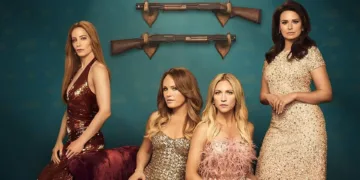























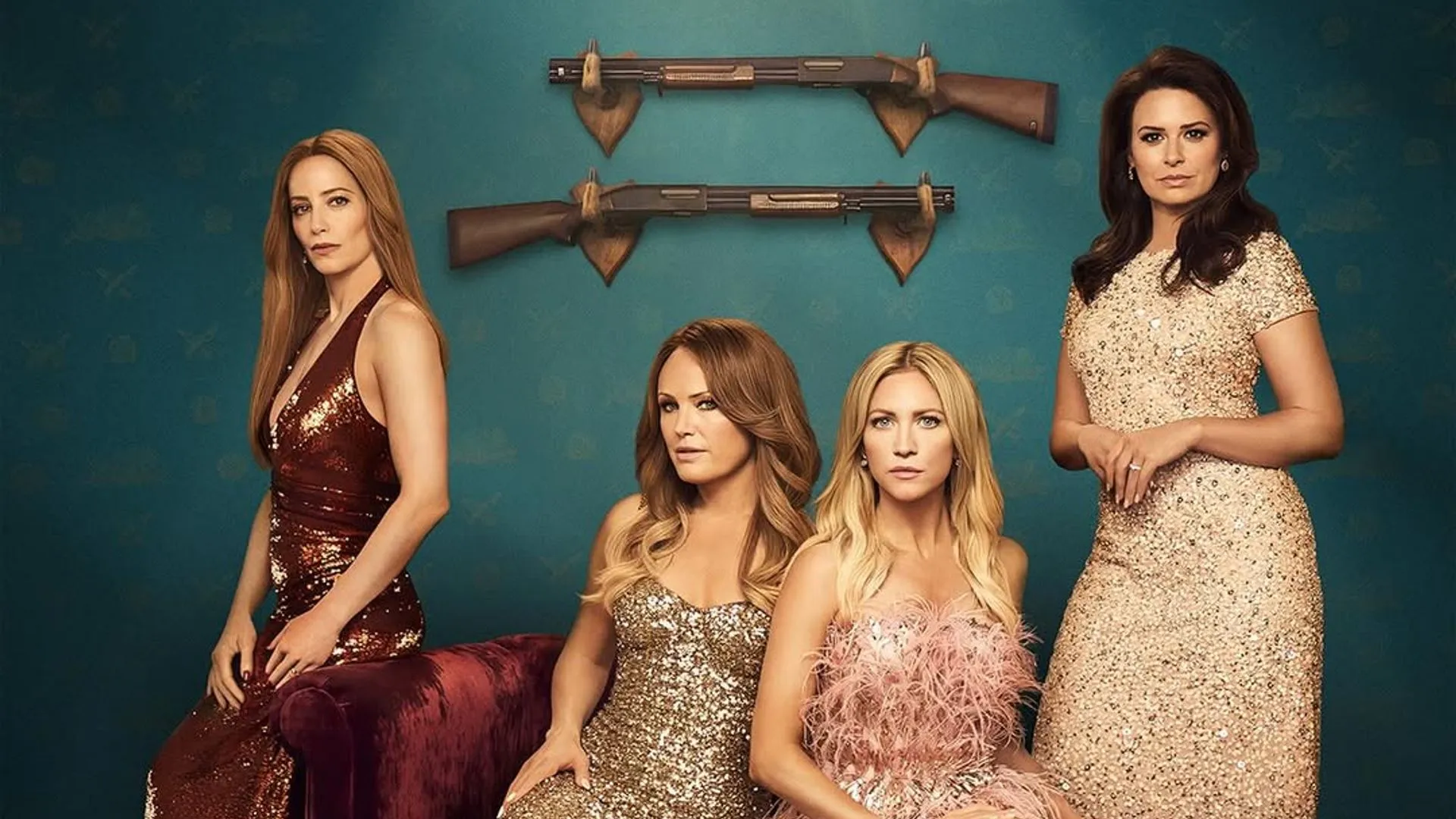

There’s a version of moving to Texas that involves finding a nice quiet suburb. The Hunting Wives is not about that version. The series drops former PR guru Sophie O’Neil into the fictional town of Maple Brook, an opulent East Texas enclave where the air is thick with money, hairspray, and bad intentions.
Her quiet, anxiety-managed existence immediately collides with a clique of hard-partying, firearm-loving socialites who consider “work” a four-letter word. This is a gloriously soapy thriller, fueled by secrets and scandalous behavior unfolding under a relentless sun.
Of course, it’s not all day-drinking and skeet shooting. A flash-forward reveals a body in the woods, a bloody promise that all the social maneuvering is leading somewhere deadly.
The Blonde Leading the Blonde
The show’s engine, a high-performance V8 running on whiskey and desire, is the volatile chemistry between its two leads. As the audience’s entry point, Sophie (Brittany Snow) is a meticulously crafted bundle of nerves. Her recent past is a road map of lost identity: a high-powered PR career in Boston traded for the isolating reality of full-time motherhood in a foreign land.
This vacancy in her life makes her a perfect target. Snow portrays Sophie with a compelling physical anxiety; her posture is tentative, her gaze wide and uncertain, as if she’s perpetually braced for an impact she can’t see coming.
Her husband, Graham, applies a gentle but firm control, using her past DUI as a permanent reason to keep her from driving or drinking. His concern is a gilded cage, making the brand of anarchic freedom offered by the town’s queen bee seem all the more intoxicating.
That queen would be Margo Banks (Malin Akerman), a magnetic predator whose life philosophy is to do what she wants simply “because it’s fun.” Akerman’s performance is a masterclass in calculated charm. She doesn’t just deliver lines; she purrs them, weaponizing her confident sexuality to disarm and dominate.
Her power is absolute, emanating from her husband Jed’s immense fortune and a carefully concealed, mysterious past. When Margo first encounters Sophie in a bathroom, the direction frames it as a fateful, almost primal meeting. Margo’s casual toplessness isn’t just for shock value; it’s a power move, an immediate demolition of Sophie’s buttoned-up boundaries.
The seduction that follows is not a slow, careful courtship but a full-force blitzkrieg. Margo teaches Sophie to shoot, pouring liquor down her throat and inducting her into sexually charged games like spin-the-bottle.
There is no slow burn here; in a television landscape often obsessed with delayed gratification, The Hunting Wives floors the accelerator from the first moment, mirroring the impulsive, hedonistic nature of its characters. Margo isn’t making a friend; she’s acquiring a new plaything, a process her husband watches with unnerving approval.
A Town Drowning in Secrets
The series populates Maple Brook with a cast of characters seemingly engineered in a lab for maximum dramatic volatility. This is a town without a moral compass, where every closet has a skeleton and every bed has the wrong person in it.
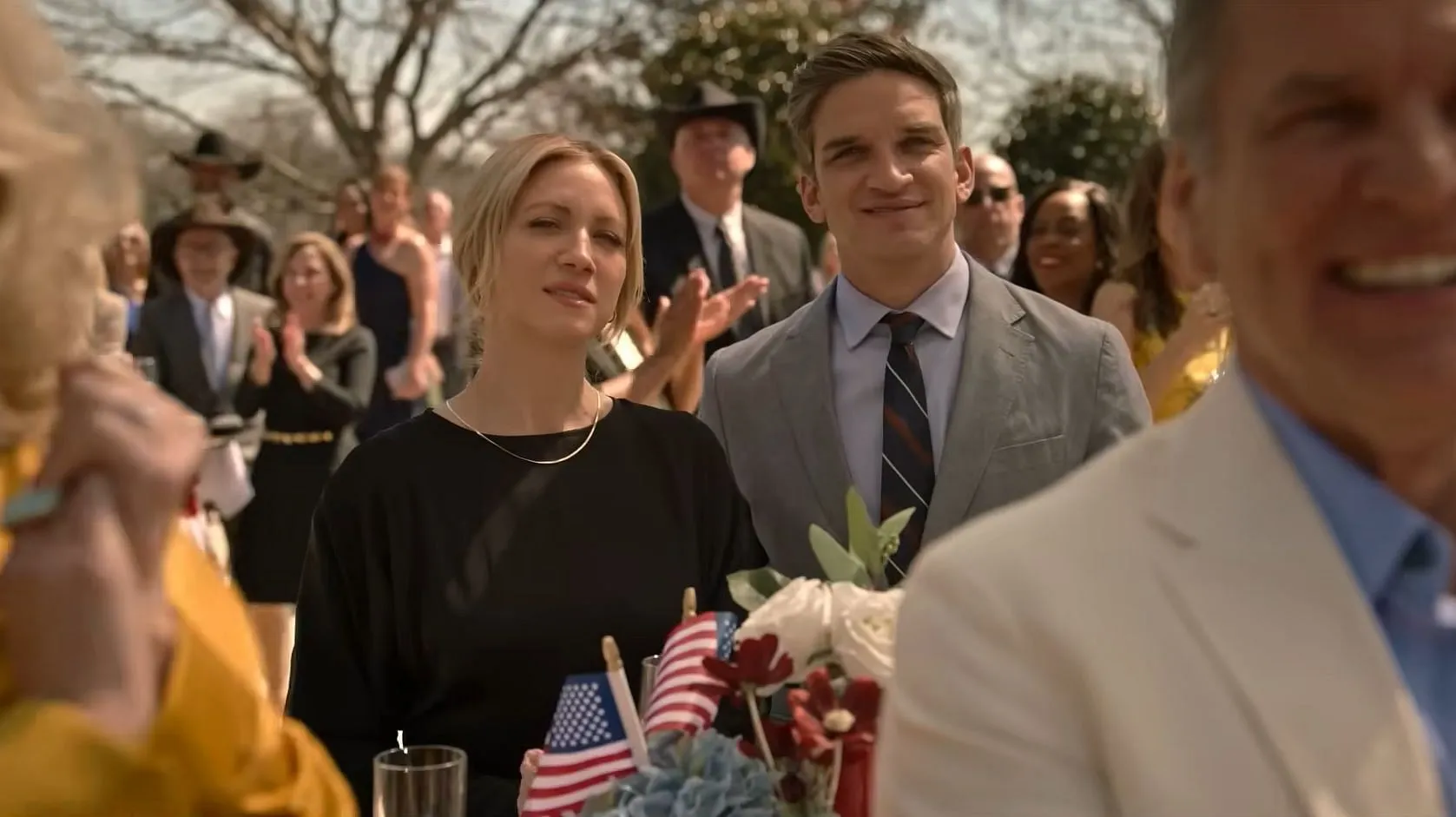
Dermot Mulroney’s Jed Banks is a perfect caricature of the modern Texas oil baron, all folksy swagger and veiled threats, his gubernatorial ambitions a convenient cover for a debauched private life. He and Margo share an “arrangement,” a chillingly sterile term for their mutual betrayals.
At Margo’s side, at least initially, is Callie (Jaime Ray Newman), the classic scorned best friend, whose rage is amplified by the high-stakes social environment. Callie is also Margo’s lover, making her jealousy of the newcomer Sophie a particularly potent cocktail of personal and romantic betrayal.
Then there is Jill (Katie Lowes), the local pastor’s wife, whose immaculate home is a pressure cooker of resentment. Her perfect Christian facade is tested daily by her creepy, collegiate-bound son, Brad (George Ferrier), a vacant boy-toy who serves as a pawn in Margo’s games.
The plot barrels forward with the logic of a runaway train, prioritizing sensational twists over sensible storytelling. The narrative structure mimics the characters’ lack of impulse control; it’s less a chain of cause and effect and more a series of escalations, with each episode seemingly designed to top the last in sheer outrageousness.
This creates a relentless, dizzying pace that can be exhilarating. The entire chaotic affair is framed by the flash-forward to a murder, a narrative device promising that this house of cards will eventually collapse into violence. Yet as the plot inevitably pivots toward a formal police investigation, one feels a sense of apprehension. The show’s primary strength is its messy, character-driven soap opera.
The introduction of a by-the-book detective threatens to impose a rigid, conventional order on a world that is fascinating precisely because of its commitment to chaos. It risks trading its unique brand of lurid social satire for a generic whodunit format that television has already produced a thousand times over.
Lone Star Libertinism
The Hunting Wives gleefully throws its blue-state protagonist into a red-state shark tank, and the resulting culture clash is one of its most entertaining aspects. The show uses political slurs as character shorthand. Sophie, aghast at the values of her new companions, privately labels them “little Marjorie Taylor Greens.”
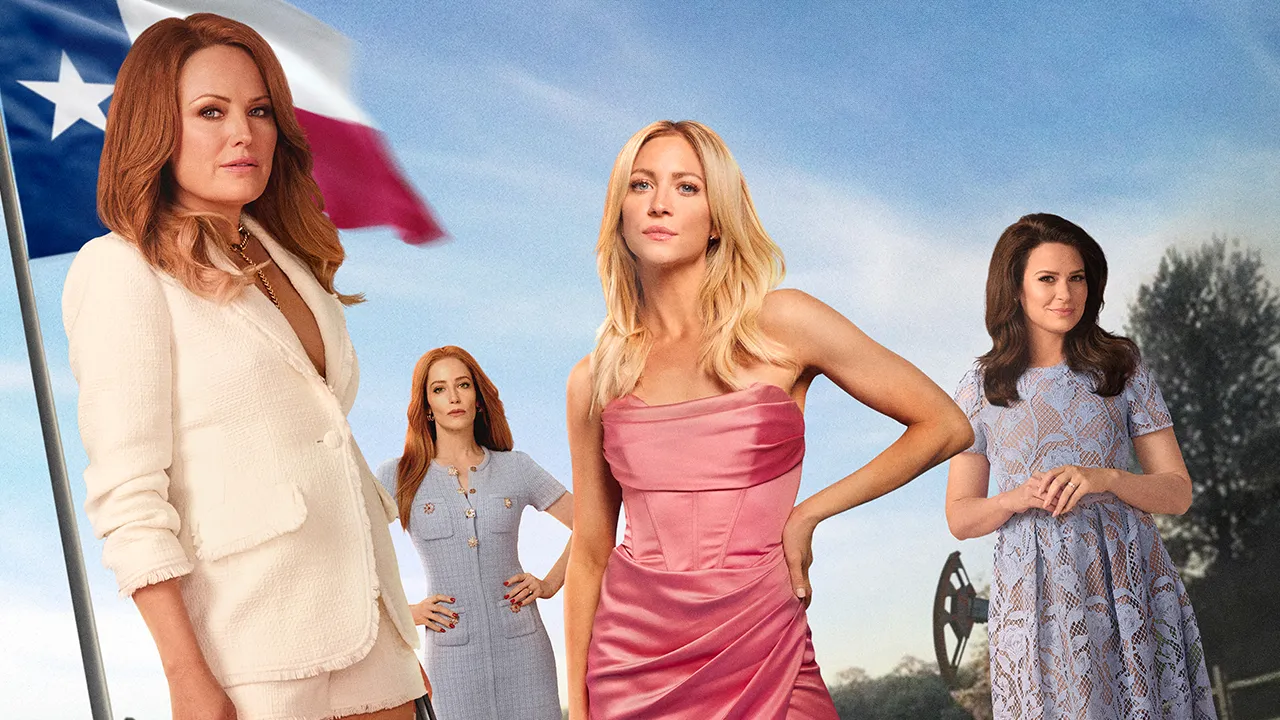
They, in turn, would surely see her as one of the coastal “deplorables” if they gave her enough thought. Yet the series smartly argues that these political labels are more about cultural branding than deeply held convictions.
The characters’ stated beliefs are almost completely divorced from their actual behavior. Jed’s pro-family, anti-immigrant rhetoric is pure political theater for his gubernatorial run, a flimsy mask for his swinging lifestyle. The wives’ performative piety at the megachurch is a social tool, a way to maintain status, not a moral guide.
The most potent example of this is Sophie herself. Her supposed anti-NRA, liberal sensibilities evaporate the moment Margo puts a shotgun in her hands and shows her the thrill of hitting a clay pigeon. Her rapid conversion to gun culture isn’t a political awakening; it’s a social one.
She isn’t adopting an ideology; she is adopting the rituals of a new tribe in a desperate attempt to belong. This speaks volumes about modern discourse, where political identity is often more about finding a team than subscribing to a coherent set of beliefs.
The show effectively uses the texture of its setting to make this point. The sprawling mansions, the oversized SUVs, and the glittering NRA fundraisers are not just backdrops. They are symbols of a wealth so extreme that it has created its own moral vacuum, a world where the only thing that matters is the pursuit of the next thrill.
All About Margo
While the ensemble cast is busy stabbing each other in the back, the show belongs entirely to Malin Akerman. Her portrayal of Margo elevates the material at every turn, transforming a potential caricature into a captivating and unpredictable force of nature.
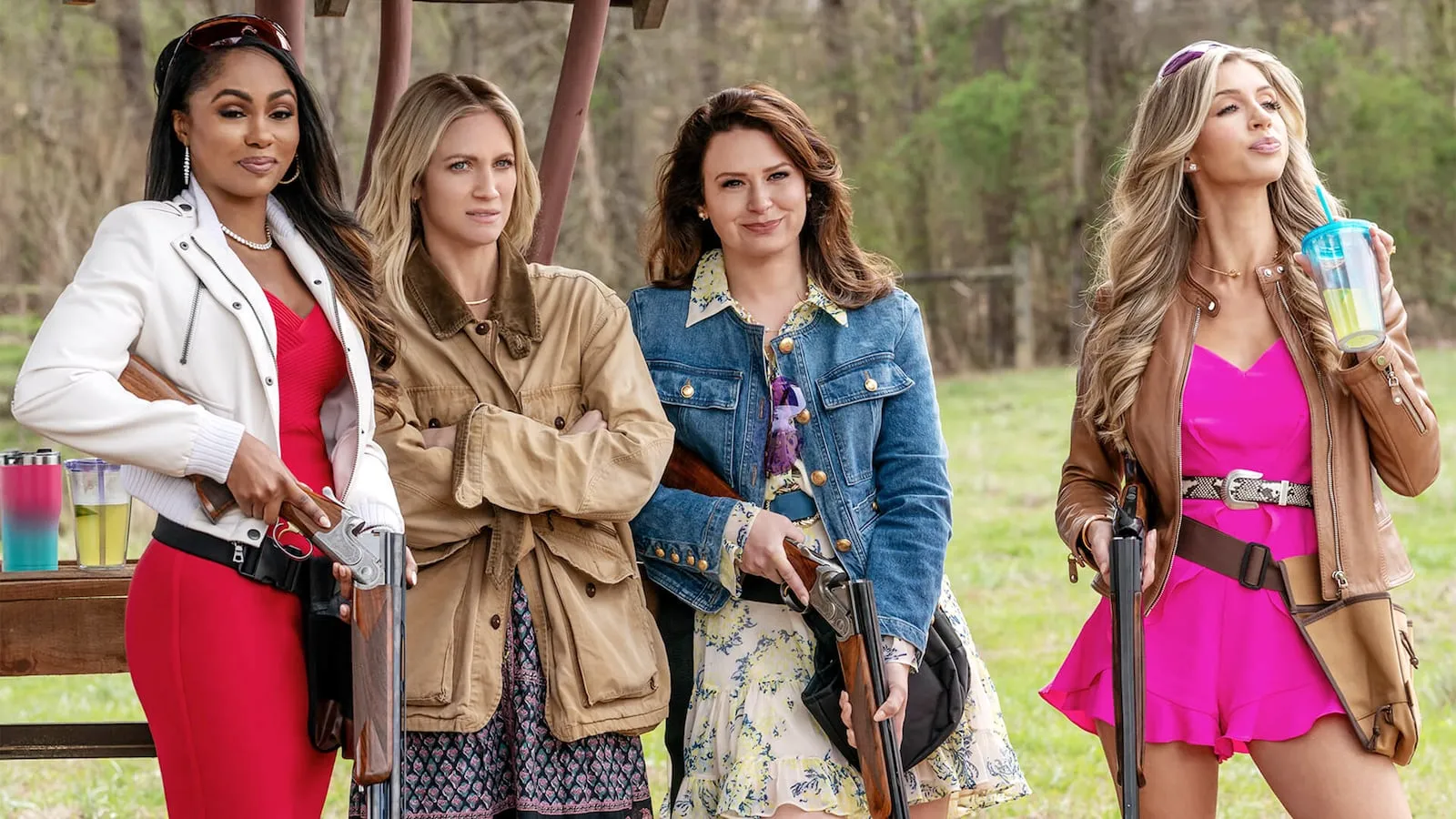
She is a temptress, certainly, but Akerman imbues her with just enough flashes of a hidden, wounded past to keep the audience guessing about her true motives. It’s a star turn that anchors the entire production. In her orbit, Dermot Mulroney is effective as the testosterone-fueled tycoon, chewing the scenery with the appropriate amount of relish.
The central dynamic, however, hinges on the contrast between Akerman and Brittany Snow. Akerman is all fluid confidence and predatory stillness, while Snow deploys a brittle, nervous energy, a physical manifestation of Sophie’s constant state of near-panic. It’s a fascinating pairing that visually represents the story’s core power imbalance.
Beyond the main players, the other men are largely decorative, and Sophie’s husband Graham comes across as particularly dim and ineffectual. The show’s presentation can be similarly uneven. The costume design deserves significant credit for effectively mapping Sophie’s internal changes onto her wardrobe.
Her journey from conservative, monochrome blouses to vibrant, cleavage-baring dresses is a well-worn visual trope, but it serves as a clear external signifier of her capitulation to Margo’s world. The direction, however, often feels as flat as the Texas landscape.
It relies heavily on standard shot-reverse-shot conversations and fails to generate a sense of visual dynamism during the frequent party scenes. A show this outrageous, this committed to excess, deserved a more audacious and inventive visual style to match its pulpy heart.
Should You Join the Hunt?
This series is a spiritual successor to the great primetime soaps of yesteryear, like Desperate Housewives or Melrose Place, but with the MPAA rating and moral ambiguity that only a streaming service can provide.
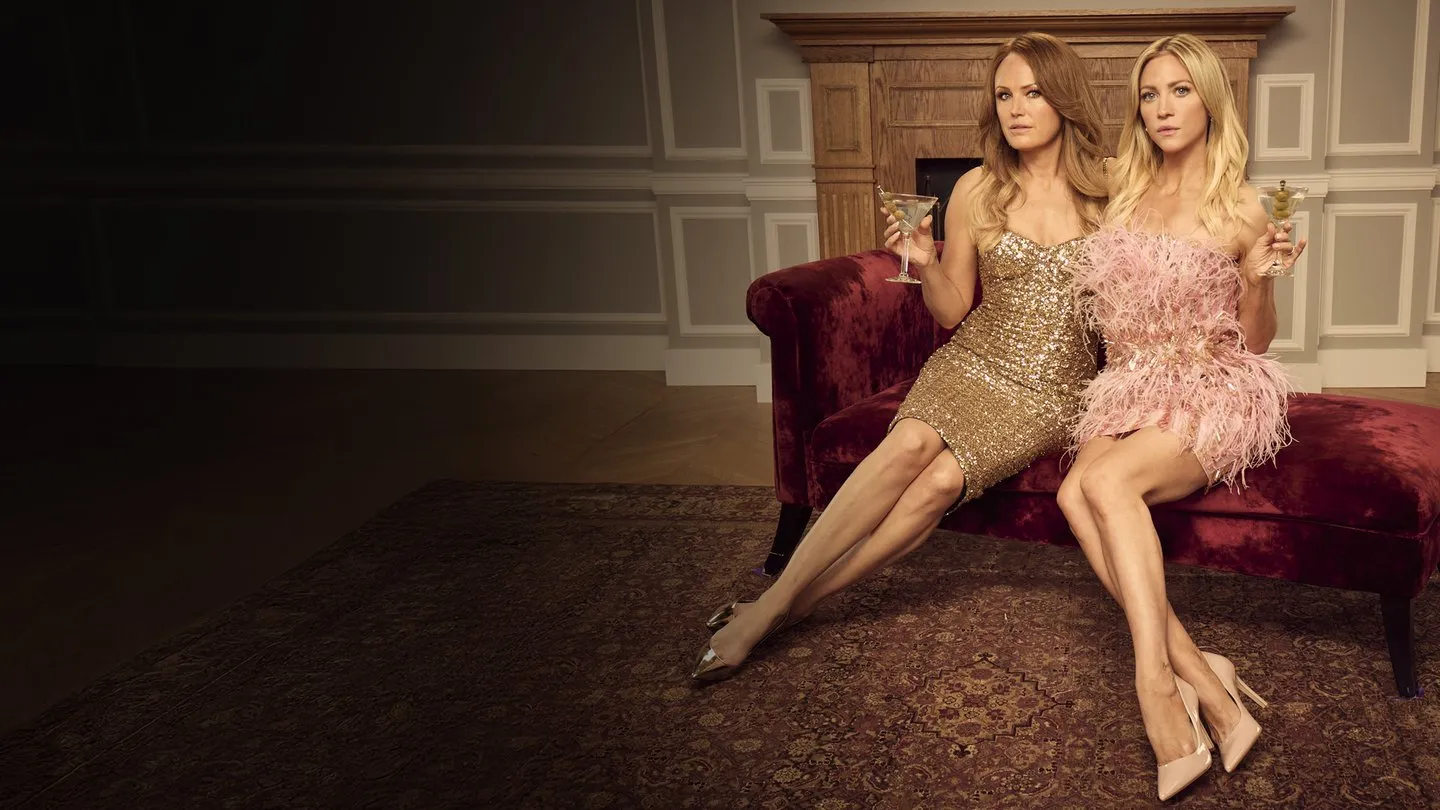
It proudly rejects the high-minded, “eat the rich” satire of its contemporaries for a more direct, voyeuristic pleasure. The Hunting Wives knows its audience. It understands that viewers want the vicarious thrill of watching impossibly wealthy people behave abominably, without a heavy-handed lecture attached.
It is an unapologetic escape, a guilty pleasure that never once feels guilty about what it is serving. The show makes no pretense of offering deep thoughts, only a dangerously good time. The only real question is whether you’re ready to pull the trigger on an eight-hour binge.
Full Credits
Writers: Rebecca Cutter, Emily Bensinger, Benjamin Flores, Breannah Gibson, Will Hettinger, Mike Weiss, Kayla Westergard-Dobson, Brandon Zuck, May Cobb
Producers: Joan Cunningham, Jeremy Beim
Executive Producers: Rebecca Cutter, May Cobb, Erwin Stoff, Julie Anne Robinson, Alex Alberts, Tara Roy, Christina Jokanovich, Scott Herbst, Courtney Mock
Cast: Brittany Snow, Malin Akerman, Dermot Mulroney, Jaime Ray Newman, Evan Jonigkeit, George Ferrier, Katie Lowes, Chrissy Metz, Hunter Emery, Karen Rodriguez, Michael Aaron Milligan, Branton Box, Jason Davis, Lauren Bowles, Madison Wolfe, Paul Teal, Chosen Jacobs, Abigail Rhyne, Joyce Glenn, Alexandria DeBerry
Composer: Jeff Danna
The Review
The Hunting Wives
The Hunting Wives is a deliciously decadent and unapologetically trashy thriller that knows exactly what it is. It forgoes depth for pure, scandalous entertainment, powered by a fast-paced plot and a truly magnetic lead performance from Malin Akerman. While the direction is plain and some characters are thin, the series succeeds as a perfect, high-calorie guilty pleasure. It’s a wild, wicked ride that is best enjoyed without overthinking.
PROS
- A captivating, star-making performance by Malin Akerman as the manipulative Margo.
- A fast-paced, unapologetically soapy plot full of twists and shocking behavior.
- Entertaining exploration of the red-state/blue-state culture clash as a performance.
- Succeeds as a fun, escapist "guilty pleasure" binge.
CONS
- Underdeveloped supporting characters, particularly the one-dimensional husbands.
- Conventional cinematography and direction that fail to match the story's outrageous tone.
- A central performance from Brittany Snow that is often overshadowed.
- The plot threatens to become a generic murder mystery in its later stages.