



























Healing in The Walking Dead: Streets of Survival means finding enough distance from the nearest walker, holding the button, and hoping nothing reaches you before the bandage is finished. Take a hit midway through and the process stops, potentially wasting a scarce resource.
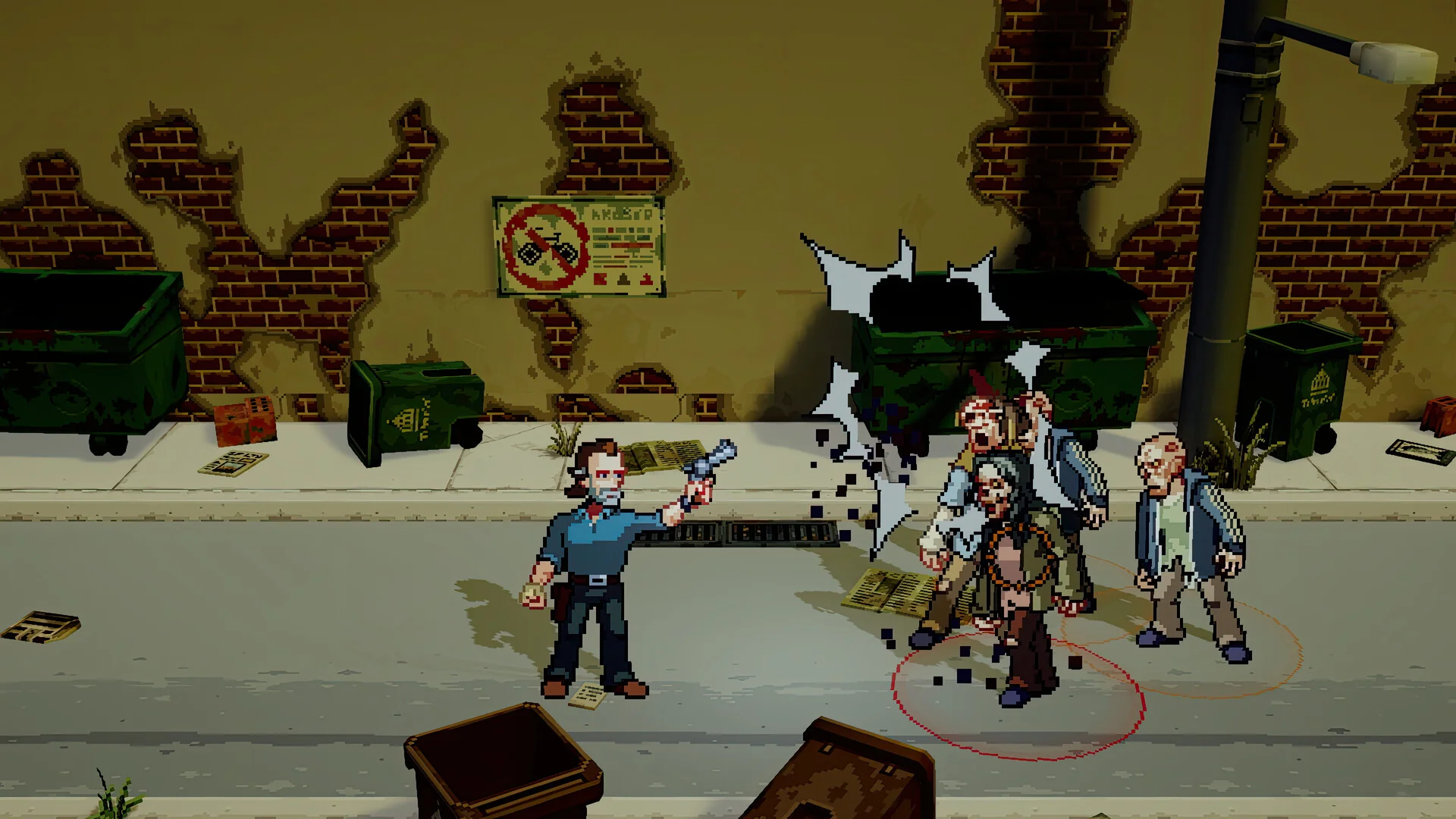
Shooting asks for similar patience. Holding your aim improves the damage, but every extra second leaves you exposed. For a game that resembles an old-school arcade brawler, it spends a surprising amount of time teaching you that aggression can get you killed.
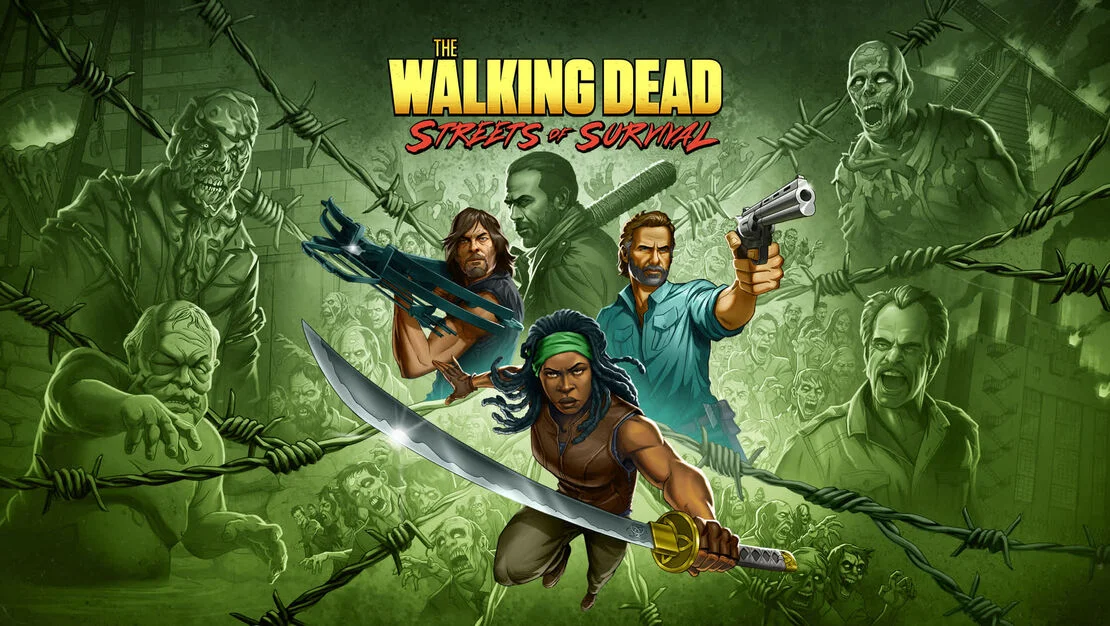
That cautious rhythm is the best idea Odaclick Game Studio brings to The Walking Dead. Previous games have approached the license from very different directions, with Telltale’s series building its reputation around character choices while action-focused adaptations have struggled to make the television material work interactively. Streets of Survival takes a simpler route. It turns AMC’s “All Out War” storyline into a pixel-art beat ’em up starring Rick, Daryl, and Michonne, then makes caution and resource management central to how its fights work.
The choice of storyline makes sense. Rick’s war against Negan and the Saviors already gives the game an excuse to move between ruined streets, warehouses, Hilltop, the junkyard, and enemy strongholds while beating through groups of human opponents and walkers.
The campaign uses familiar faces and scattered lore items to maintain its connection to the show, but the storytelling itself is fairly thin. Dialogue mainly gets the cast from one mission to the next, and anyone unfamiliar with this period of the series receives little beyond the basic idea that Negan needs to be stopped.
Fans will fill those gaps themselves. That reliance on familiarity works well enough for a short action game, though concentrating on one narrow slice of Season 8 also makes the adaptation feel smaller than the license allows. The Walking Dead has Hershel’s farm, the prison, Terminus, Alexandria, and years of memorable conflicts available to it. Restricting the campaign to the Saviors war gives the missions consistency, but it also leaves you imagining how much stronger this format could be if it moved through several distinct periods of the show.
Fortunately, the combat has enough personality to carry the campaign. Rick, Daryl, and Michonne share the same basic structure, yet their weapons create meaningful distinctions. Rick fights at close range and keeps his revolver available for ranged attacks. Daryl relies on his knives and crossbow. Michonne has the strongest melee reach thanks to her katana and refuses the disposable melee weapons the others can collect. Negan joins the roster after completing the game, bringing Lucille into subsequent runs.
None of them has an especially deep moveset. Basic attacks and heavier strikes create straightforward combinations, while a charged special can clear space when a fight becomes crowded. The important layer comes from everything surrounding those attacks. Your dodge has a cooldown, so escaping one attack can leave you unable to avoid the next. Firearms become stronger when you take time to aim. Healing locks you into an animation. Ammunition cannot be treated as an unlimited answer to difficult encounters.
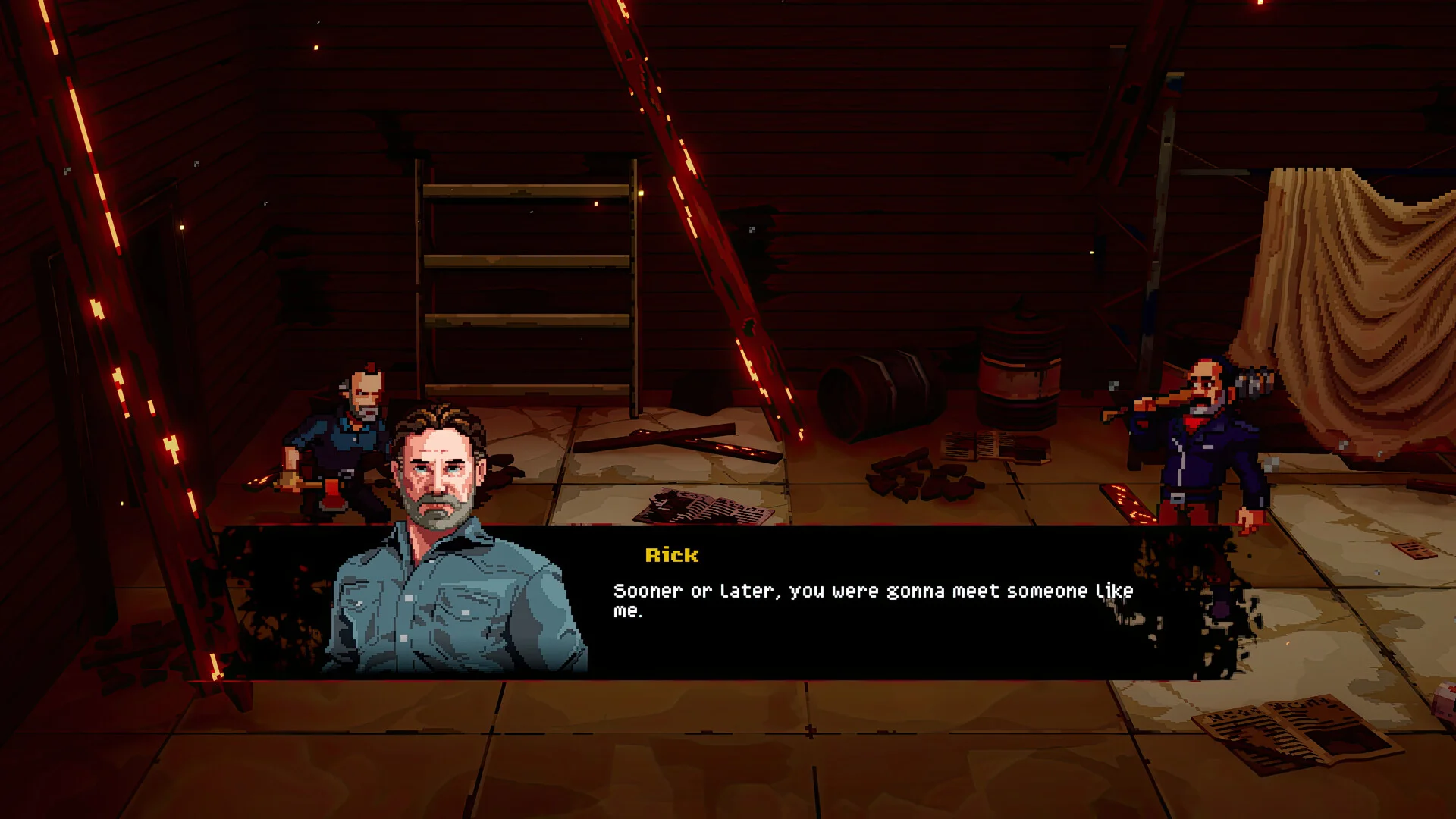
Those restrictions change the pace considerably compared with traditional arcade brawlers such as Streets of Rage. You are still moving through rooms and clearing groups before advancing, but charging directly into every encounter is rarely the safest option. A dozen walkers can force you to control distance, pick targets, wait for your dodge to recharge, and decide when spending ammunition is justified. The result can feel surprisingly close to the resource anxiety associated with survival horror, despite the side-scrolling structure and colourful pixel presentation.
The trouble begins when deliberate combat crosses into unresponsive combat. Turning toward enemies can feel sluggish, and attacks occasionally come out in the wrong direction. That is frustrating against walkers, but ranged Saviors expose the problem much more aggressively. A gunman firing from distance while two melee enemies crowd the player creates useful pressure. Several gunmen firing while attacks arrive from outside the visible area is another matter.
Enemy shooters can feel far more reliable than your own targeting. Closing the distance becomes difficult once several attacks overlap, and the dodge cooldown that usually adds discipline to combat can start working against the player. Some encounters stop asking for good decisions and start asking you to absorb awkward behavior long enough to survive them.
Bosses show the same divide. Winslow, the heavily modified walker that pursues the player through the junkyard, represents one of the better attempts to turn the game’s systems into genuine tension. You are completing objectives, fighting ordinary enemies, and searching for supplies while something far stronger continues chasing you. The encounter can become irritating because of how aggressively Winslow stays near the player, especially this early in the campaign, but the underlying concept fits the license extremely well.
Other bosses use environmental hazards such as electrified floors or sustained gunfire to alter the normal rhythm. Those encounters are far stronger than fights against Savior leaders who mostly behave like enlarged versions of regular enemies with enormous health bars. Repeating the same safe combination for an extended period does little for a combat system whose better encounters are built around positioning and resource decisions.
Exploration helps break that repetition. Levels are fairly linear, yet side rooms, hidden paths, locked doors, optional objectives, and searchable objects give you reasons to investigate before moving forward. Supplies matter enough that finding ammunition or a healing item can affect the next encounter, while Knowledge Points and progression items feed into character upgrades covering attack speed, ammunition capacity, healing, damage, and dodge recovery.
The progression is useful without changing the game dramatically. Reducing a cooldown or expanding ammunition capacity can make later battles easier to manage, but the characters still operate within the same restrained combat framework. Upgrades smooth the existing playstyles rather than creating entirely new ones.
That matters once the short campaign is finished. Negan, higher difficulties, continued progression, collectibles, repeat runs, and the wave-based Walker Pit provide reasons to keep playing, yet the missing feature becomes increasingly obvious: there is no co-op.
Beat ’em ups have spent decades using multiplayer as one of their strongest sources of replayability, and The Walking Dead gives this game a cast practically designed for it. A campaign built around Rick, Daryl, Michonne, and later Negan feels unusually lonely when every fight must be played alone.
The promising part is that the game understands something many licensed adaptations miss. Recreating The Walking Dead does not require copying its scenes exactly. When you hesitate before firing the last few bullets or search an empty room because the next healing item might decide the next fight, the license and mechanics finally meet. That makes the clumsy targeting and missing co-op especially frustrating, because Streets of Survival has already found the harder thing: a combat rhythm capable of making this world feel dangerous rather than merely familiar.
The Review
The Walking Dead: Streets of Survival
The Walking Dead: Streets of Survival finds a smart way to make the franchise work as a beat 'em up. Scarce ammunition, risky healing, cooldown-based dodging, and deliberate aiming give its fights a survival-minded identity that suits the license. Sluggish directional control, frustrating ranged enemies, uneven bosses, and the absence of co-op prevent the combat from reaching its full potential, while the short campaign leaves plenty of the television universe unexplored. Still, the central idea works well enough to make this one of the more convincing action-focused attempts at adapting AMC's series.
PROS
- Survival mechanics give combat a distinct identity
- Rick, Daryl, and Michonne feel meaningfully different
- Exploration supports resource management well
- Pixel-art presentation suits the cast and setting
CONS
- Ranged enemies can feel unfair
- Directional controls occasionally fight the player
- Some bosses rely too heavily on large health pools
- No co-op despite an ideal multiplayer setup
- Short campaign limits the franchise's scope